 Divisi
Citrus greening (Huanglongbing)
· Bacterial
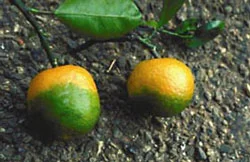
Photo: T.R. Gottwald and S.M. Garnsey · Public domain
Citrus greening (Huanglongbing, or HLB) is a deadly, incurable bacterial disease of citrus trees — orange, lemon, lime, naartjie and grapefruit. The germ lives inside the tree's food-carrying veins (the phloem, the pipes that move sugars from the leaves) and slowly blocks them, so the tree starves from the inside. It is carried from tree to tree by a tiny sap-sucking insect, the citrus psyllid, and by grafting with wood cut from a sick tree. Once a tree has it, there is no cure.
Why it matters
Citrus greening is a death sentence for a citrus tree — there is no medicine that cures it, and a badly hit orchard can lose up to 100% (your whole crop). Long before the tree dies it turns your fruit small, lopsided, green-shouldered and bitter — unsellable and uneatable. It spreads silently: a tiny insect carries the germ from one tree to the next, and by the time you see the sick leaves, nearby trees are often already infected. Because you cannot cure it, your only real weapon is stopping it getting in and cutting out sick trees fast.
When to act
Any psyllids detected on new flush, or the first trees showing blotchy leaf mottling and lopsided bitter fruit; the disease anywhere in or near the orchard.
This guidance is general, compiled from published agronomic references including FAO and CABI. Thresholds and timing shift with your crop, your variety and the season.
In much of the region a spray is simply called mushonga — medicine. But a chemical group you cannot name is one you cannot rotate, and a product you did not write down has no pre-harvest interval you can observe. Mushonga, and other farming words →
The full Citrus greening (Huanglongbing) field guide
Identify it
The first thing you see
one branch or one side of the tree goes yellow while the rest stays green — a lopsided, one-sided yellowing, not the whole tree evenly. Look up into the canopy for these odd yellow shoots standing out against healthy green.
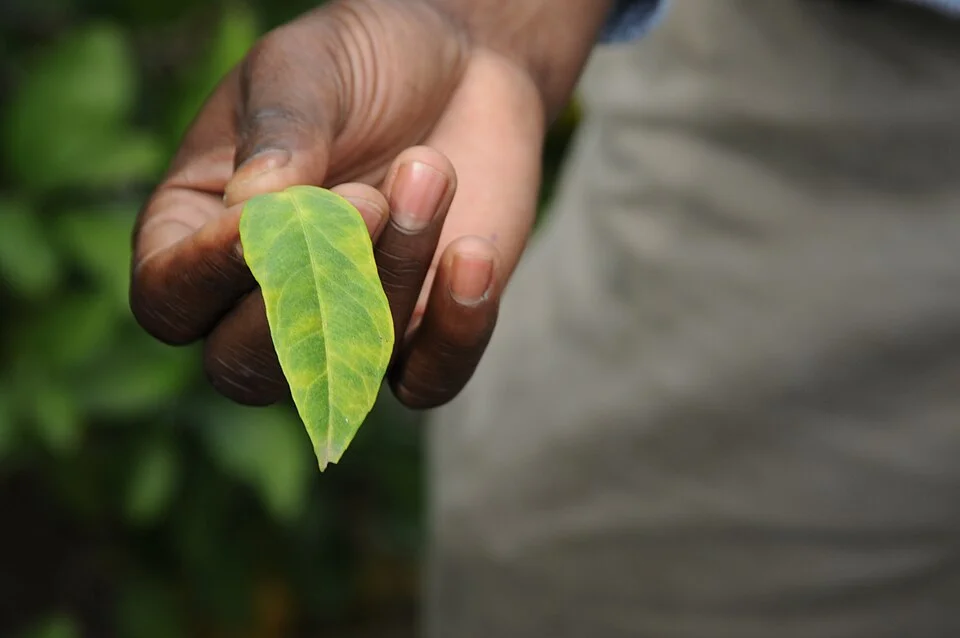
The tell-tale leaf sign — blotchy mottle:
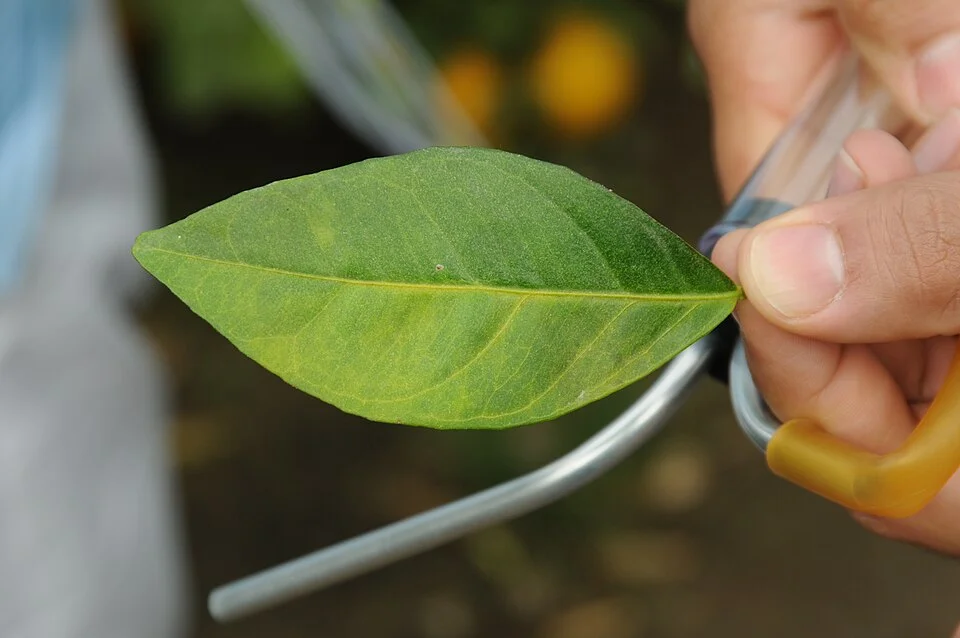
patches of yellow and green spread unevenly across the leaf and do NOT match on the two sides of the midrib (the centre vein). If you fold the leaf along that middle vein, a greening leaf's yellow patches don't line up — one side is yellow where the other is still green. The leaves are often small, thick and upright.
The fruit gives it away
fruit stays small, lopsided and hard, colours badly, and often keeps a green bottom (green-shoulder) even when ripe — the colour comes in patchy. Cut one open and the pips (seeds) are dark, shrivelled and aborted, and the juice tastes bitter and salty, not sweet. Many fruit drop early.
Over time
the tree thins out, twigs die back from the tips, it flowers out of season, and year by year it gives less until it stops bearing and dies.
Tell it apart from look-alikes
an even, matching yellowing on both sides of the midrib is usually a feeding shortage (nutrient hunger) like zinc or manganese — that pattern is symmetrical, greening's is blotchy and NOT matching. Whole-tree yellowing with dead roots points to root rot, not greening. Greening's fingerprint is the one-sided start + non-matching blotchy leaf + bitter lopsided green-shouldered fruit together.
Scout for it
When to look hardest
check every time the tree pushes out new soft red-tipped growth (a flush) — through the growing months as the tree develops, carries fruit and matures its crop. The psyllid that spreads the disease only breeds and feeds on this tender new flush, so that soft young growth is your early-warning window.
Hunt the insect first, on the new flush
the citrus psyllid (the vector — the insect that carries the germ) is smaller than a grain of rice and sits head-down at an angle on young shoots. Look for its young ones (nymphs) clustered on soft new leaves, often with white waxy threads and sticky droplets, and for curled, twisted new leaves. The African kind causes a tight leaf curl on the flush.
Walk the orchard in a big "W"
don't just check the trees by the path. Walk a "W" shape so you cover all four corners and the middle, stopping at about 10 spots. At each stop pick a tree and inspect a few new flush shoots and look up for any one-sided yellow branch.
Your action number — act on the very first sign:
greening has a hair-trigger threshold. If you find even ONE psyllid on the new flush, OR a single tree with one-sided blotchy-mottled leaves and small bitter lopsided fruit — act now. Do not wait for a count or for many trees; with an incurable disease, one is already an emergency.
Confirm before you cut a tree
the leaf-fold test (yellow patches not matching across the midrib) is your field check, but symptoms can fool you. Where you can, have a suspect tree tested by an extension officer or lab before destroying a whole tree, and mark every suspect tree (a rag or paint) so you can watch it and find it again.
Control it
Prevent
-
start clean (your strongest defence):
plant only certified disease-free young trees from a reputable nursery, and never graft with budwood (cutting wood) taken from a tree of unknown health. Most greening arrives on infected planting material or budwood — clean stock is the single biggest thing in your control.
-
kill off the hiding places:
remove abandoned, wild and backyard citrus near your orchard and any untended trees — these are silent reservoirs where the disease and the psyllid breed and then spill into your trees. Never move citrus plants, budwood or leafy material out of an area that has greening.
Act early
-
cut out sick trees fast (roguing):
the moment a tree is confirmed or strongly suspected, remove and destroy the whole tree (roguing) — a sick tree is a factory feeding the germ to every healthy tree around it. First knock down the psyllids on that tree (see spray below) so they don't just fly to neighbours when you cut it, then dig it out and burn or bury it. Cutting out inoculum early is worth more than any spray.
-
protect the good insects (biological):
tiny stingless wasps called parasitoids (such as Tamarixia) lay eggs in psyllid young and kill them, and ladybirds and lacewings eat them too. Conserve these helpers — avoid harsh broad poisons that wipe them out — and where a release programme exists, join it. On their own they only slow the psyllid (moderate help), so use them alongside sanitation, not instead of it.
Last resort — insecticide on the psyllid, timed to the flush:
where psyllids are present you can suppress them with a registered insecticide, sprayed onto the new flush when the soft growth appears (that is when psyllids are exposed and breeding). This only slows spread by cutting the carrier — it does not cure any infected tree. Safety: cover your skin, eyes, nose and mouth; spray in the cool of the morning or evening with the wind at your back; keep it off food, water sources, children and bees; wait the full pre-harvest interval (the number of days the label says you must wait between spraying and picking fruit) before you harvest; and wash yourself and your clothes afterwards. Resistance: rotate to a different chemical group each time so the psyllid doesn't stop dying to your spray.
If it keeps spreading — face it squarely:
greening cannot be cured, so if suspect trees keep appearing, rogue every confirmed tree without delay, keep the psyllid down on every flush, and work with your neighbours — one untended sick orchard reinfects a whole area. When most of a block is infected and declining, cut your losses: clear that block completely, and replant only certified clean trees in an area where the psyllid is being controlled. Nursing on dying, unproductive greening trees only feeds the disease to any healthy citrus that is left.
Catch Citrus greening (Huanglongbing) before it costs you the harvest
This guide is the general answer. Divisi works out yours — the week to scout your own field for Citrus greening (Huanglongbing), and what to do the day you find it.


Crops it affects
citrus
Get Insights by email
A short digest of new Divisi articles. No email on quiet weeks.
Frequently asked questions
How do I identify Citrus greening (Huanglongbing)?
The first thing you see. one branch or one side of the tree goes yellow while the rest stays green — a lopsided, one-sided yellowing, not the whole tree evenly. Look up into the canopy for these odd yellow shoots standing out against healthy green.
When should I take action against Citrus greening (Huanglongbing)?
Any psyllids detected on new flush, or the first trees showing blotchy leaf mottling and lopsided bitter fruit; the disease anywhere in or near the orchard.
How do I control Citrus greening (Huanglongbing)?
Prevent — start clean (your strongest defence):. plant only certified disease-free young trees from a reputable nursery, and never graft with budwood (cutting wood) taken from a tree of unknown health. Most greening arrives on infected planting material or budwood — clean stock is the single biggest thing in your control.