 Divisi
Ascochyta blight
Ascochyta spp. · Fungal
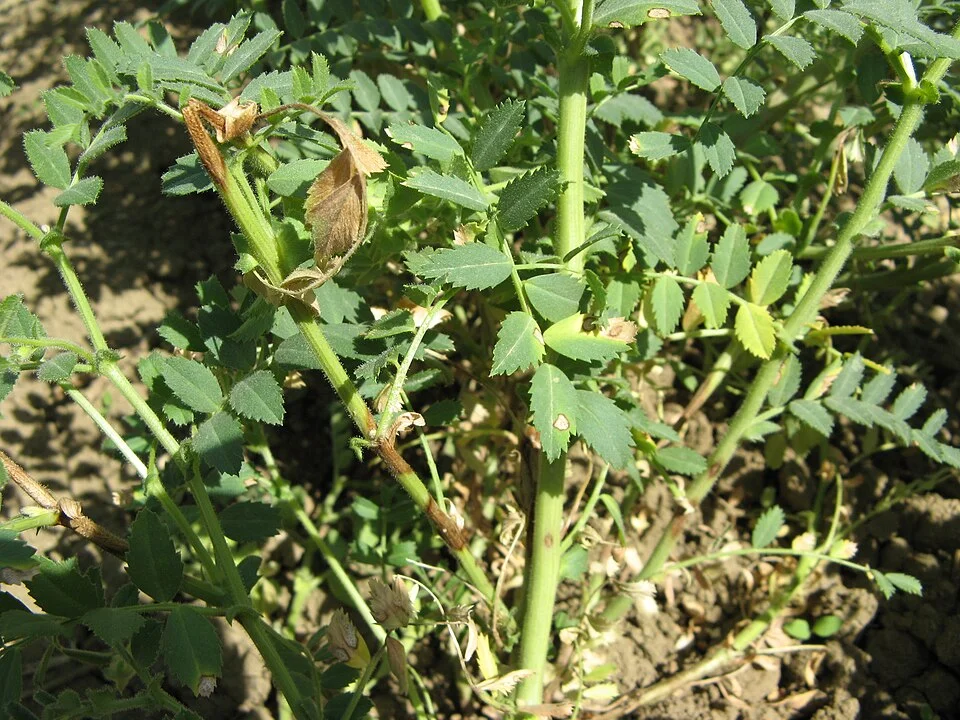
Photo: Dr. Weidong Chen Research Plant Pathologist · Public domain
Ascochyta blight is a fungal disease of cool-season food legumes — chickpea, field pea, faba bean and lentil. It rides in on infected seed and survives on old crop stubble, then spreads through the crop by rain splash and wind-blown spores in cool, wet, cloudy weather. It attacks every part above ground — leaves, stems and pods — and can girdle the stems so plants snap and fall over, and blight the pods so the seed comes out stained, shrivelled or lost.
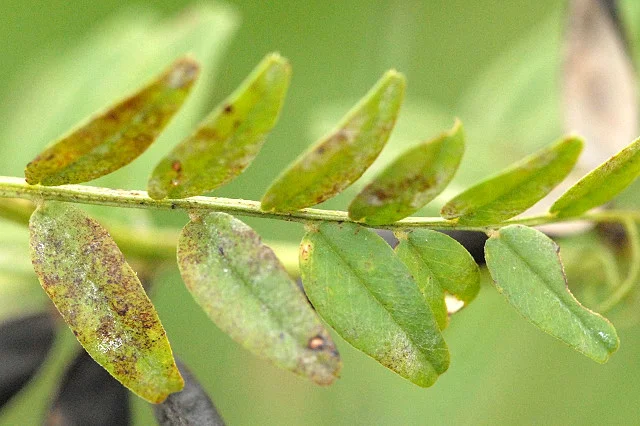
James Lindsey · CC BY-SA 3.0 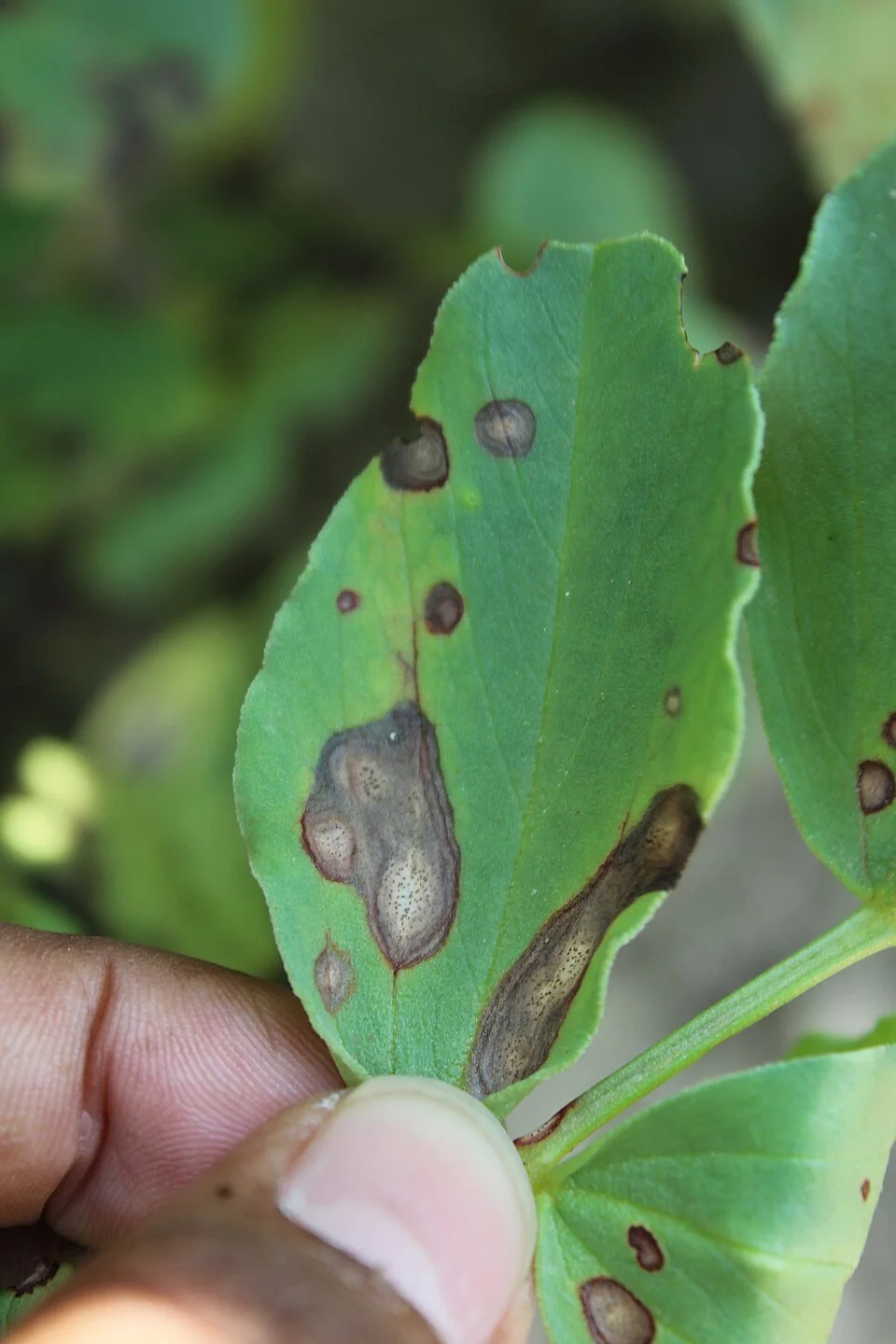
Peketichinna · CC BY-SA 4.0
Why it matters
In a cool, wet season Ascochyta blight can wipe out up to 80% of your crop — four out of every five plants' worth of pods gone. It is so hard to beat because it starts from inside your own field: the fungus rides in on the seed and lives on last year's stubble. Once rain begins splashing the spores through a thick canopy it races ahead, girdles the stems so plants snap and topple, and rots the pods. And sprays can only protect healthy growth — they cannot cure a plant that is already blighted — so if you wait until you see it everywhere, it is already too late.
When to act
Protect the crop at the first sign of lesions on leaves or stems during cool, wet, cloudy weather, before rain spreads it through the canopy.
This guidance is general, compiled from published agronomic references including FAO and CABI. Thresholds and timing shift with your crop, your variety and the season.
In much of the region a spray is simply called mushonga — medicine. But a chemical group you cannot name is one you cannot rotate, and a product you did not write down has no pre-harvest interval you can observe. Mushonga, and other farming words →
The full Ascochyta blight field guide
Identify it
The first sign
is small, tan-to-brown spots (lesions) on the lower leaves, stems and, later, the pods. They show up first low in the canopy, where the leaves stay damp, and during a cool, wet, cloudy spell.
The tell-tale sign
each spot grows into a round or oval lesion marked with rings of tiny black pinhead dots — the fungus's fruiting bodies — set in circles, like a small target or dartboard. Scratch them: these black dots are sunk into the tissue and do not wipe off. That ring of black dots is the clincher.
As it spreads
dark, sunken lesions wrap right around the stems and girdle them, so the plant snaps and topples over (this falling-over is called lodging). Infected pods carry dark blotches, and the seeds inside come out stained, shrivelled or half-empty.
Tell it apart from look-alikes
chocolate spot on faba bean makes small reddish-brown 'chocolate' flecks with no black-dot rings; grey mould is a fuzzy grey fur with no rings; rust makes raised orange-brown bumps that rub off as powder on your finger. Only Ascochyta gives the flat, spotted lesion with rings of black dots that will not rub off.
Scout for it
When to look
start scouting once the crop is bushing out and the canopy begins to close (the development stage), and keep it up hard right through flowering and podding (mid-season) into late season. Look hardest in the day or two after every cool, cloudy rain — damp weather around 10-25°C is exactly when the fungus moves.
How to walk it
cross the field in a big 'W' so you cover all four corners and the middle, not just the edge by the path. Give extra attention to low, shaded, thick or slow-drying patches, and to any crop sitting near last year's legume stubble — those spots go first.
How many to check
make about 10 stops, and at each stop bend down and inspect 10 plants (100 in all). Check the lower and middle leaves, the stems — especially at the branch joints and near the base — and the pods, because it always starts low, where the plant stays wet.
Your trigger — act on the very first one
You are not waiting for a big count. The moment you find even ONE plant carrying those ring-of-black-dots lesions during cool, wet, cloudy weather, protect the crop now, before the next rain splashes it through the canopy. One infected plant in a wet spell is your signal to act — do not wait for five or ten.
Control it
Prevent first — plant a resistant variety
This is your single strongest and cheapest defence: a resistant or tolerant variety holds the disease back more than any other single step and is the cornerstone of managing Ascochyta. Ask your seed supplier or extension officer which line is resistant for your legume and your area.
Start clean — use good seed
The fungus travels on the seed, so sow certified, disease-free, treated seed, and never save or plant seed from a crop that had blight — that is exactly how it gets into next year's field.
Deny the fungus a home
Because it also survives on old stubble: rotate 3-4 years away from host legumes (chickpea, pea, faba bean, lentil); plant new crops well away from last year's stubble (spores blow on the wind); plough under, remove or burn infected residue; and don't sow too thick — a dense, always-wet canopy is what it loves, while wider rows let the wind dry the leaves.
Act early, at the first lesion
In a wet spell, the moment you find the ringed black-dot spots: pull out and carry away the first one or two infected plants where you can (don't drop them back in the field), and get protection onto the healthy growth before the next rain — while it is still just a few plants, not a canopy full.
Chemical — a last resort — chlorothalonil
Understand what it is first: chlorothalonil is a protectant (contact) fungicide — in plain words, it lays a protective coat on the surface that stops new infections; it does NOT travel inside the plant and cannot cure a leaf that is already blighted. So it only pays if you put it on healthy growth before, or at the very first sign of, disease. Use it as a seed treatment and as protectant sprays from early flowering, timed to wet weather; and because it is only a surface coat, re-spray after heavy rain and as new leaves appear (fresh growth is not yet covered). Always respect the pre-harvest interval (PHI) — the set number of days you must wait between your last spray and harvest — so no chemical is left on the pods.
Spray safely and slow resistance
Cover your skin, eyes, nose and mouth; spray in the cool of the day with the wind at your back; keep the spray off food, drinking water, children, livestock and bees; keep people and animals out of the crop until it dries; and wash yourself and your clothes afterwards. Don't lean on sprays alone — pair them with the resistant variety, clean seed and rotation — and if you can get more than one fungicide group, rotate to a different group so the fungus never gets used to a single one.
If it keeps spreading — or it's too late
If cool, wet weather holds and lesions keep climbing despite protectant sprays, keep the crop covered on a tight schedule after each rain, and never walk or move animals through the crop while it is wet (you carry spores on your legs and their feet). But if stems are already girdling and plants are lodging across the field, this crop cannot be saved — cut your losses: harvest what sound pods you can, do NOT keep any seed from it, and after harvest bury or remove the stubble and rotate to a non-host for 3-4 years so next season starts clean.
Catch Ascochyta blight before it costs you the harvest
This guide is the general answer. Divisi works out yours — the week to scout your own field for Ascochyta blight, and what to do the day you find it.


Crops it affects
Plan the crops it attacks

All planting calendars, country by country
Get Insights by email
A short digest of new Divisi articles. No email on quiet weeks.
Frequently asked questions
How do I identify Ascochyta blight?
The first sign. is small, tan-to-brown spots (lesions) on the lower leaves, stems and, later, the pods. They show up first low in the canopy, where the leaves stay damp, and during a cool, wet, cloudy spell.
When should I take action against Ascochyta blight?
Protect the crop at the first sign of lesions on leaves or stems during cool, wet, cloudy weather, before rain spreads it through the canopy.
How do I control Ascochyta blight?
Prevent first — plant a resistant variety. This is your single strongest and cheapest defence: a resistant or tolerant variety holds the disease back more than any other single step and is the cornerstone of managing Ascochyta. Ask your seed supplier or extension officer which line is resistant for your legume and your area.
Which crops are attacked by Ascochyta blight?
Among the crops covered here: Chickpea.