 Divisi
Banana bunchy top virus
Banana bunchy top virus · Viral
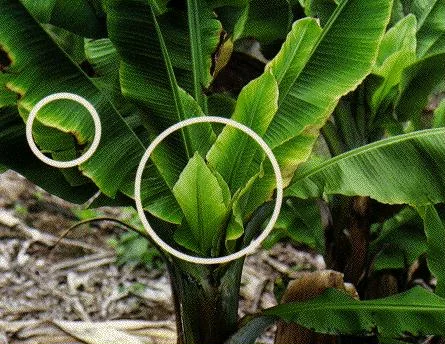
Photo: State of Hawaii · Public domain
Banana bunchy top is the most destructive virus disease of bananas and plantains. It is carried plant-to-plant by the tiny banana aphid, and travels farm-to-farm hidden inside infected suckers that still look healthy. Once a plant catches it, it can never be cured — it stunts, bunches up at the top, and stops giving fruit. Your only real weapons are clean planting material and pulling out sick plants the moment you see them.
Why it matters
Bunchy top can cost you the whole plant — up to 100% loss. A banana that catches it while young never gives a proper bunch, and because one underground corm feeds a whole mat of suckers, a single infection can wipe out the entire stool and then jump to your neighbours' plants. There is no cure and no spray that saves a sick plant — once the virus is in, it is in for good. That is why spotting it early and pulling it out at once is the only thing that truly works.
When to act
Any plant showing bunched, upright, narrow leaves must be destroyed at once; there is no cure.
This guidance is general, compiled from published agronomic references including FAO and CABI. Thresholds and timing shift with your crop, your variety and the season.
In much of the region a spray is simply called mushonga — medicine. But a chemical group you cannot name is one you cannot rotate, and a product you did not write down has no pre-harvest interval you can observe. Mushonga, and other farming words →
The full Banana bunchy top virus field guide
Identify it
The bunched top (the name-sake sign)
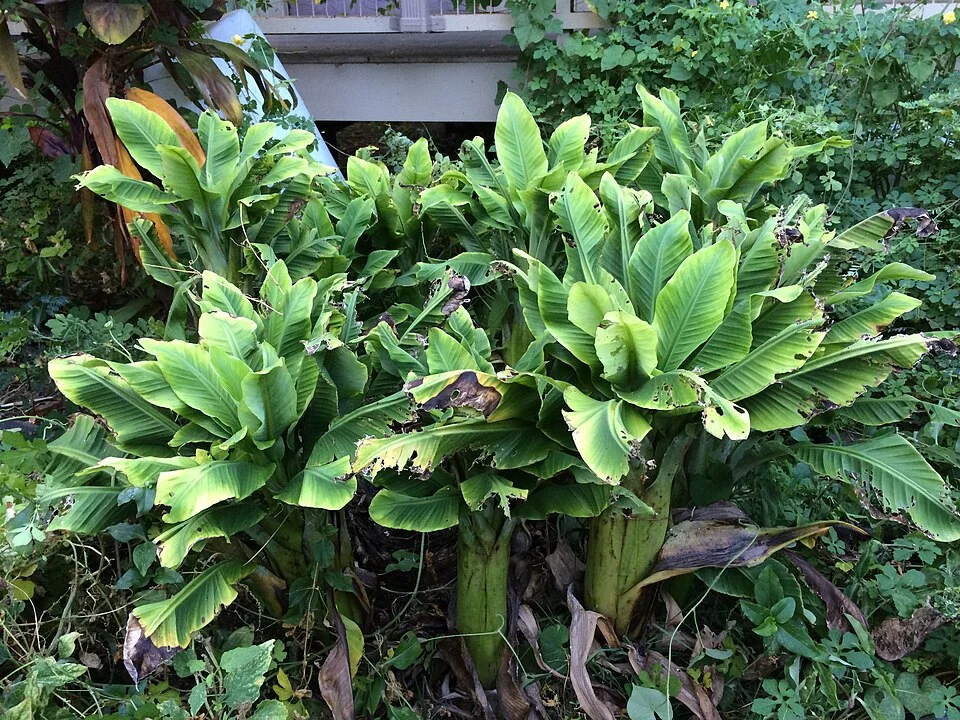
look at the crown of the plant. Each new leaf comes out shorter, narrower and more upright than the one before, until they all crowd together in a stiff rosette — a 'bunchy top' — like a shaving brush stuck on a short, stunted plant. The plant looks choked and dwarfed next to its healthy neighbours.
The 'Morse code' streaks (the early giveaway)
even before the top fully bunches, hold a young leaf up to the light and look along the veins, the midrib and the leaf stalk (the petiole). You'll see dark-green dots and dashes running in lines — like Morse code — and short dark-green hooks ('J-hooks') where the leaf blade runs into the midrib. A healthy banana leaf is an even green with no such streaks. This sign lets you catch the disease weeks before the top bunches.
Yellow, curled, brittle edges
the narrow leaves often carry pale yellow margins that curl upward and feel stiff and brittle to the touch. The whole plant is badly stunted, and any bunch it tries to throw is small, twisted and worthless.
The aphid that carries it
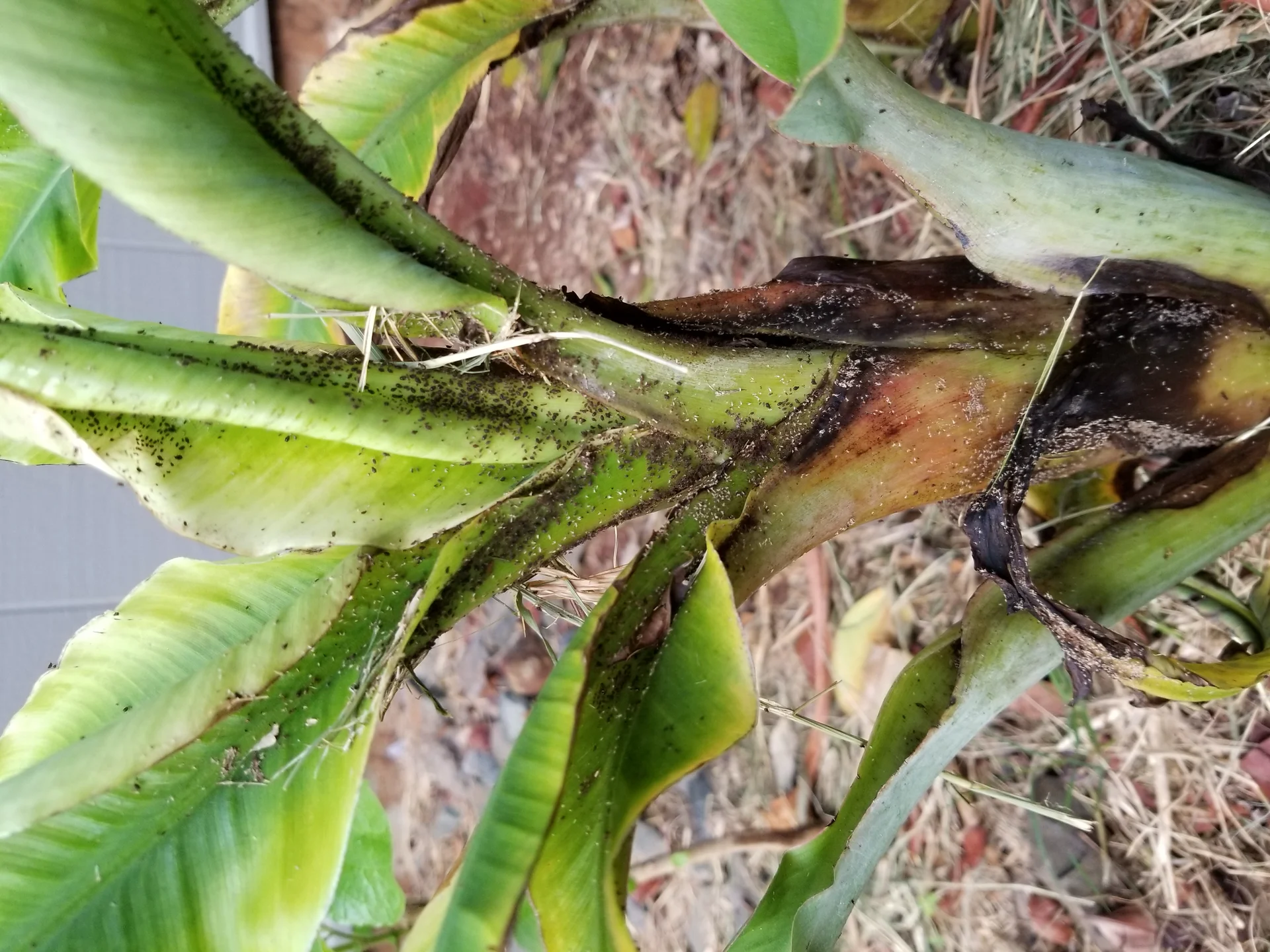
peer into the throat where new leaves unfurl and at the base of the false stem (the pseudostem) for colonies of tiny, soft, dark reddish-brown to almost-black aphids, about the size of a pinhead, often with ants running among them. This is the banana aphid — the insect (the 'vector', meaning the carrier) that ferries the virus from a sick plant to a healthy one.
Don't confuse it
with a nutrient shortage such as potassium (leaves yellow but stay normal width, with no dark-green Morse-code streaks), with mosaic virus (pale, blotchy mottling and yellow streaks — not dark-green dots-and-dashes — and no bunched top), or with weedkiller (2,4-D) drift (narrow strappy leaves but no streaks and no aphids). The sure give-away for bunchy top is the dark-green Morse-code streaks and the bunched top together.
Scout for it
When to look
check hardest while plants are young and growing fast — from a new planting or sucker, on through active growth up to bunching — because young plants show the streaks first and are hit hardest. Walk the whole plantation at least once a month, look extra hard in warm, humid spells (around 20–30°C) when the aphids multiply fastest, and always inspect any block right after you bring in new suckers.
How to walk it
don't just glance along the path edge. Walk a big 'W' shape across the plantation so you pass through all four corners and the middle, stopping at about 10 mats spread across the field.
What to check at each stop
pull the youngest, newest leaf toward you and hold it up to the light — that is where the dark-green Morse-code streaks and J-hooks appear first. Then check the crown for a bunching, narrowing top, and look into the throat and stem base for the dark aphid colonies and their ants.
The threshold — even ONE plant means act now:
with this disease there is no safe number. If you find even a single plant with a bunched, narrow, upright top or the dark-green Morse-code streaks, that plant must come out at once — don't wait, don't count a percentage, don't hope it recovers. One sick plant left standing becomes the source that infects the rest of your field.
Control it
Prevent it first — plant clean (your strongest tool):
start every new field with certified virus-free or tissue-culture suckers (lab-grown clean plantlets, guaranteed free of the virus). This one step matters most, because the disease mostly travels hidden inside infected suckers that still look perfectly healthy. Never take suckers from a plant, mat or field that has ever shown bunchy top.
Keep it out — quarantine your suckers:
treat every sucker as if it could carry the disease, because it can. Do not carry suckers out of an infected field, and bring in new planting material only from districts known to be clean. A single infected sucker is enough to seed the disease in a brand-new plantation.
Act early — pull out and kill every sick plant (roguing):
because there is no cure, removing an infected plant is the treatment. The moment you spot one, rogue it (dig it out and destroy it). Don't just chop the top — kill the whole stool, including the underground corm (the bulb it grows from), by injecting it or digging it right out so it cannot regrow or keep feeding aphids. Take out the mother plant and all its suckers on that mat, since they share the same infected corm.
Kill the aphids before you disturb the plant
the banana aphids on a sick plant will scatter the moment you cut or pull it, carrying the virus straight to healthy neighbours. Wherever you can, kill the aphids on the plant first, then destroy the plant — never disturb an infected mat and leave live aphids behind to flee.
Chemical — last resort, and only to stop fleeing aphids:
a systemic insecticide (one taken up into the plant's sap so it kills aphids feeding anywhere on it, unlike a contact spray that only kills what it directly wets) can be used to knock out the aphids on an infected mat just before you destroy it. Know its limit: spraying does NOT cure or save the plant — you must still dig it out. Killing the aphids alone will never stop the spread.
Spray safely and slow resistance
cover your skin, eyes, nose and mouth, spray in the cool of morning or evening with the wind at your back, and keep the spray off food, off water, and away from children and bees. Wash yourself and your clothes afterwards, and respect the pre-harvest interval (the set number of days you must wait between spraying and cutting the bunch). If you end up spraying aphids again and again, rotate to a different chemical group each time so the aphids don't build up resistance.
If it keeps spreading → change tack, then cut your losses
if new bunchy-top plants keep appearing after you rogue, your planting material or a nearby field is still a source. Stop replanting suckers from that block, hunt down and destroy every last infected mat, and keep the aphids knocked back. When a block is heavily infected, cut your losses: clear the whole block, rest (fallow) the land, and start again with certified clean suckers from a clean district — trying to nurse a badly infected plantation only feeds the disease and risks the rest of your farm.
Catch Banana bunchy top virus before it costs you the harvest
This guide is the general answer. Divisi works out yours — the week to scout your own field for Banana bunchy top virus, and what to do the day you find it.


Crops it affects
Plan the crops it attacks

All planting calendars, country by country
Get Insights by email
A short digest of new Divisi articles. No email on quiet weeks.
Frequently asked questions
How do I identify Banana bunchy top virus?
The bunched top (the name-sake sign). look at the crown of the plant. Each new leaf comes out shorter, narrower and more upright than the one before, until they all crowd together in a stiff rosette — a 'bunchy top' — like a shaving brush stuck on a short, stunted plant. The plant looks choked and dwarfed next to its healthy neighbours.
When should I take action against Banana bunchy top virus?
Any plant showing bunched, upright, narrow leaves must be destroyed at once; there is no cure.
How do I control Banana bunchy top virus?
Prevent it first — plant clean (your strongest tool):. start every new field with certified virus-free or tissue-culture suckers (lab-grown clean plantlets, guaranteed free of the virus). This one step matters most, because the disease mostly travels hidden inside infected suckers that still look perfectly healthy. Never take suckers from a plant, mat or field that has ever shown bunchy top.
Which crops are attacked by Banana bunchy top virus?
Among the crops covered here: Banana & plantain.