 Divisi
Black Sigatoka
Pseudocercospora fijiensis · Fungal
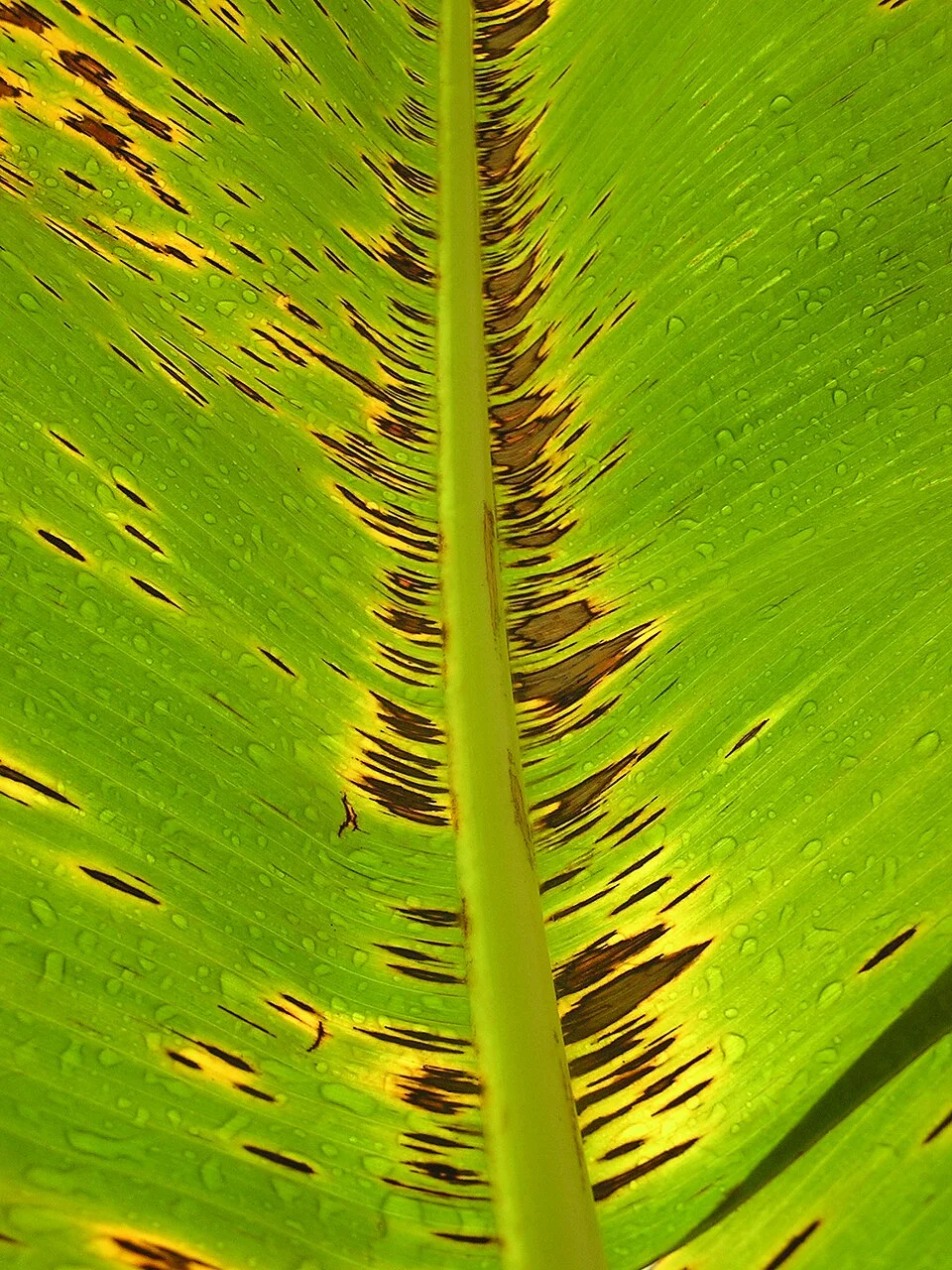
Photo: Dr. Scott Nelson · CC0
Black Sigatoka (Pseudocercospora fijiensis) is the most damaging leaf disease of banana and plantain. It is a fungus that lands on the youngest leaves and eats away the green, working leaf as fast as the plant can grow it — spreading on the wind and in splashing rain, thriving in warm, wet, crowded plantings. Once it takes hold it is very hard to stop, so the whole fight is about keeping the youngest leaves clean and the canopy dry.
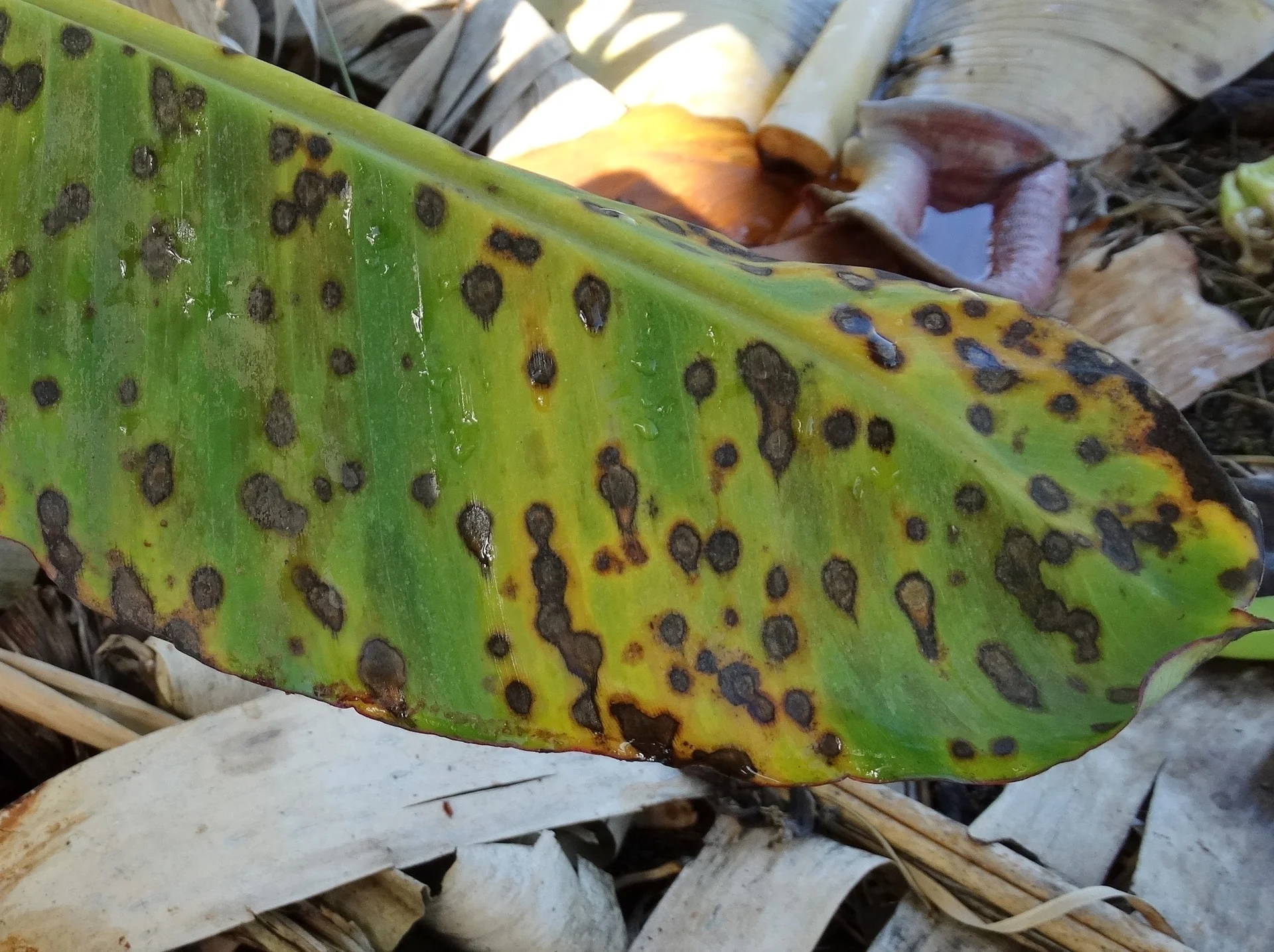
Plant pests and diseases · CC0 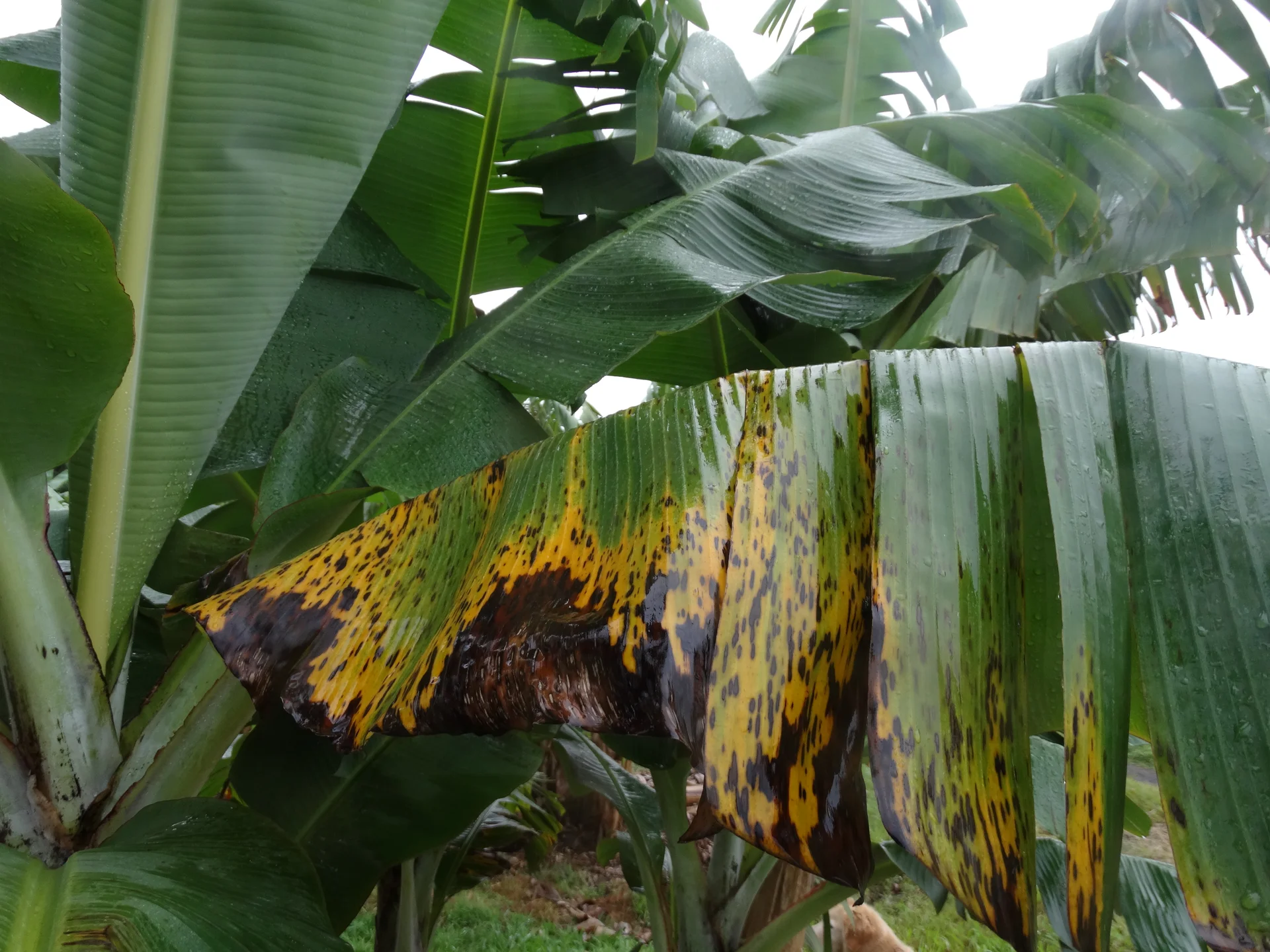
Plant pests and diseases · CC0
Why it matters
Your banana plant feeds its bunch with its leaves. Black Sigatoka kills those leaves from the youngest down, and a bad attack can cost you up to half your bunch (50%) — smaller hands, thinner fingers, and fruit that ripens too early and unevenly, so it spoils before it reaches the market. Once the black spots cover a leaf they cannot be cured, and the wind and rain carry the fungus's dust-like spores to every plant in the stand. That is why you must catch it while it is still faint streaks on the young leaves — waiting until the leaves turn black is waiting too long.
When to act
Act when early streaks appear on the youngest leaves or when leaf-spotting climbs the plant during wet weather.
This guidance is general, compiled from published agronomic references including FAO and CABI. Thresholds and timing shift with your crop, your variety and the season.
In much of the region a spray is simply called mushonga — medicine. But a chemical group you cannot name is one you cannot rotate, and a product you did not write down has no pre-harvest interval you can observe. Mushonga, and other farming words →
The full Black Sigatoka field guide
Identify it
The first sign — look underneath:
turn over the youngest open leaves and look for fine rusty, reddish-brown streaks as thin as a pencil line, running the same way as the veins. They show on the lower (under) side first, usually near the leaf tip and along one half of the leaf. This is the stage you want to catch.
As it grows
the streaks widen into brown, then black, cigar-shaped spots you can now see from both sides of the leaf. A mature spot has a sunken pale-grey or tan centre, a black ring around it, and a bright yellow halo — like a small dark eye staring out of the leaf.
When it's bad
the spots join up, whole patches of leaf turn black and die, and the leaves collapse and hang down dry. The plant is left with only a few green leaves, and its bunch ripens early and patchy — some fingers turning yellow while others are still green.
Don't confuse it
with Yellow Sigatoka (its streaks are more yellow than reddish-brown and it spreads more slowly), with Cordana leaf spot (big oval brown blotches with ring-marks that start from the leaf edge, not fine streaks between the veins), or with sun-scorch, drought or hunger (browning that creeps in from the leaf margins with no dark eye-spots). Black Sigatoka's signature is fine reddish-brown streaks on the underside of the youngest leaves that grow into black spots with grey centres and yellow halos.
Scout for it
When to look
check every two weeks right through the plant's leaf-growing and bunch-filling life — from when the plant is growing fast and putting out new leaves, through flowering, to filling its bunch, when it needs every green leaf to fill its fruit. Step up to weekly in warm, wet spells: this fungus loves warm days (about 22–30°C) with soaking rain, heavy dew or humidity above 90%.
Where and how many
walk a big "W" across the plot so you cover the four corners and the middle, not just the row by the path. Stop at about 10 mats (stools) and, at each, check the youngest 2–3 open leaves — including the half-rolled "cigar" leaf just opening at the very top.
What to check
turn those young leaves over and study the underside, near the tip and along one half, for the fine reddish-brown streaks. Fresh streaks on the youngest leaves are the early warning; black spots on the old lower leaves are an old, advanced attack.
The trigger — act now if:
you find fresh reddish-brown streaks on the youngest leaves of even about 1 in 10 mats, OR you see the spotting climbing upward from the old leaves onto the younger ones during wet weather. Don't wait for a set percentage — on the youngest leaves, a little is already a lot.
Your yield gauge
count how many fully green, unspotted leaves each plant still carries as it heads to bunching. A healthy plant keeps about 10–12; if the disease drags it below ~8 green leaves while the bunch is filling, you are already losing fruit — treat and de-leaf harder.
Control it
Prevent
-
plant a variety it struggles to beat:
where your market will take them, grow tolerant or resistant banana/plantain hybrids (a variety the fungus attacks far less). This is your strongest long-term shield and it costs you no spraying.
-
keep the canopy dry and open:
the fungus needs leaves that stay wet and humid for hours. Space plants widely, remove the extra baby suckers (keep only the ones you want to grow on), drain standing water, and cut the weeds around the mats so air flows and leaves dry fast. Feed a balanced ration so the plant keeps pushing out fresh, healthy leaves faster than the disease can kill the old ones.
Act early — cut out the sick leaves (de-leafing):
the spots are the fungus's spore factory. At the first streaks and spots, cut off the worst-hit leaves (or the diseased part of a leaf) and carry them out of the plot — chop and dry them in the sun, or bury them — so the spores can't blow back onto the young leaves. Do this regularly, but don't over-strip: leave the plant enough green leaves to fill its bunch, taking the badly-spotted ones and keeping the working ones.
Last resort — a protectant spray (mancozeb):
if streaks keep coming despite good sanitation, use mancozeb. It is a protectant (contact) fungicide — it coats the leaf surface and blocks new spores from getting in, but it cannot cure spots already there and does not move inside the leaf. So spray early, cover the youngest leaves and their undersides well, and re-cover the new leaves as they unfurl, especially through the wet season.
Spray safely
cover your skin, eyes, nose and mouth; spray in the cool of the day with the wind at your back; keep it well off food, drinking water, children, animals and bees; and respect the pre-harvest interval — the set number of days you must wait between the last spray and cutting the bunch. Wash yourself and your clothes afterwards.
Don't let it build resistance
never spray mancozeb over and over on its own, or the fungus learns to survive it (resistance — when a spray you keep using stops killing it). Alternate mancozeb with a systemic fungicide from a different chemical group (such as a triazole or strobilurin — a spray that moves inside the leaf), so each round hits the fungus a different way.
If it keeps spreading — cut your losses cleanly:
if the plant is down to only a few green leaves as the bunch fills, expect early, uneven ripening — harvest a near-mature bunch promptly before it ripens on the plant and spoils. Cut out and destroy the worst plants and leaves to protect the neighbours and next season's suckers. Then, before the next cycle, switch to a tolerant variety and fix the spacing and drainage that let the humidity build — don't just keep spraying a lost stand.
Catch Black Sigatoka before it costs you the harvest
This guide is the general answer. Divisi works out yours — the week to scout your own field for Black Sigatoka, and what to do the day you find it.


Crops it affects
Plan the crops it attacks

All planting calendars, country by country
Get Insights by email
A short digest of new Divisi articles. No email on quiet weeks.
Frequently asked questions
How do I identify Black Sigatoka?
The first sign — look underneath:. turn over the youngest open leaves and look for fine rusty, reddish-brown streaks as thin as a pencil line, running the same way as the veins. They show on the lower (under) side first, usually near the leaf tip and along one half of the leaf. This is the stage you want to catch.
When should I take action against Black Sigatoka?
Act when early streaks appear on the youngest leaves or when leaf-spotting climbs the plant during wet weather.
How do I control Black Sigatoka?
Prevent — plant a variety it struggles to beat:. where your market will take them, grow tolerant or resistant banana/plantain hybrids (a variety the fungus attacks far less). This is your strongest long-term shield and it costs you no spraying.
Which crops are attacked by Black Sigatoka?
Among the crops covered here: Banana & plantain.