 Divisi
Blue mould
Peronospora hyoscyami f.sp. tabacina · Fungal
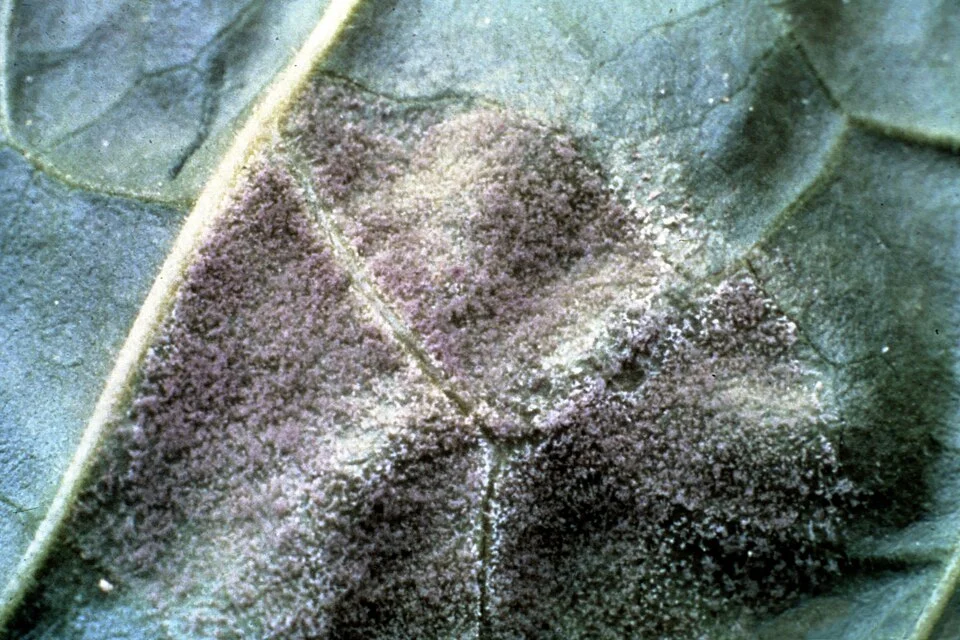
Photo: R.J. Reynolds Tobacco Company Slide Set, R.J. Reynolds Tobacco Company, Bugwood.org · CC BY 3.0 us
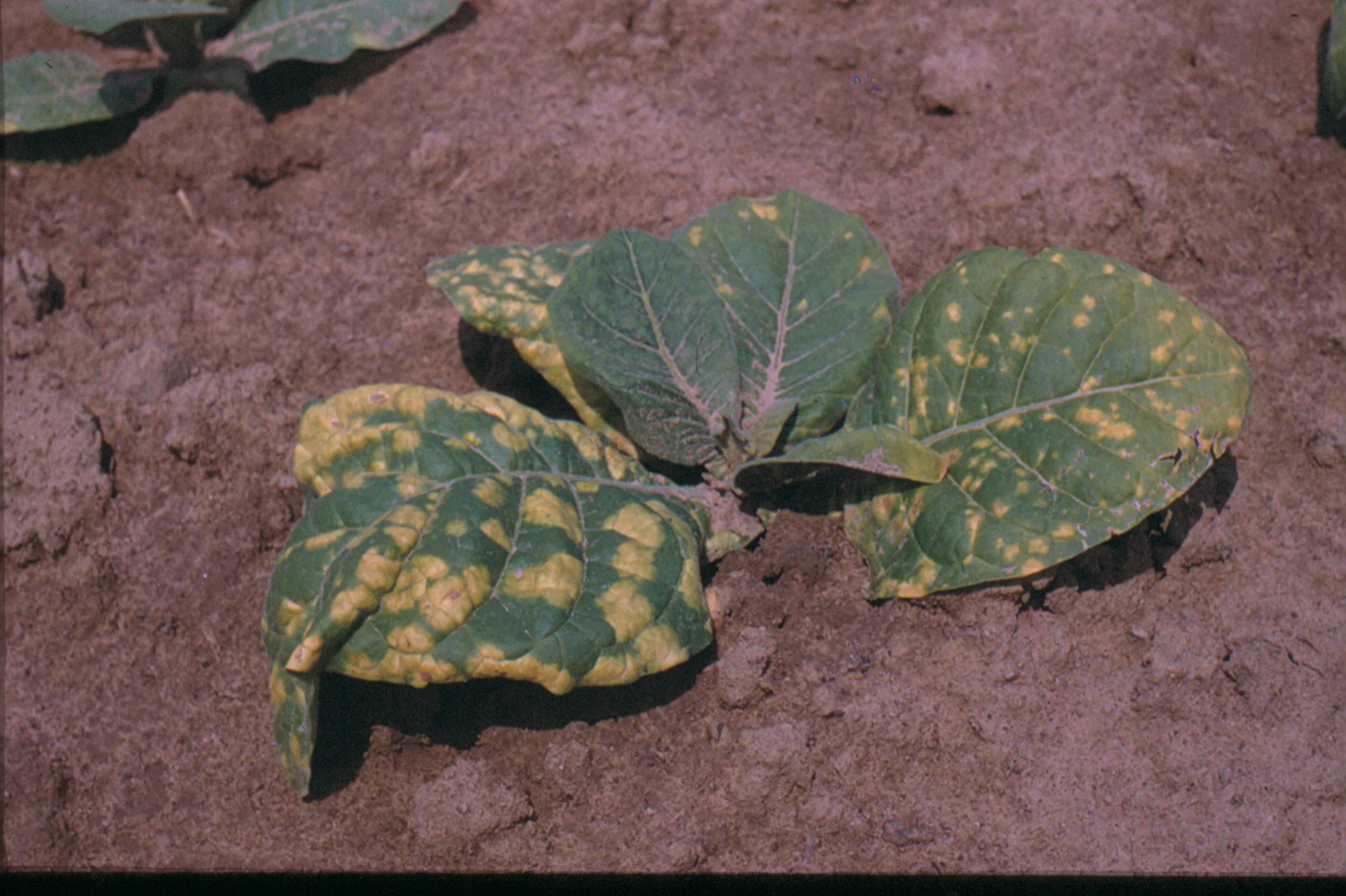
Blue mould is a fast-moving downy mildew — a water-mould — that attacks tobacco, and only tobacco, in the seedbed and in freshly transplanted young plants. In cool, wet, overcast weather it fruits at night on the undersides of the leaves and blows in on the wind, so a green, healthy seedbed can yellow and collapse within a few days. Its unmistakable mark is a bluish-grey to violet downy fuzz on the underside of yellow leaf spots.
Tashkoskip · CC BY-SA 4.0 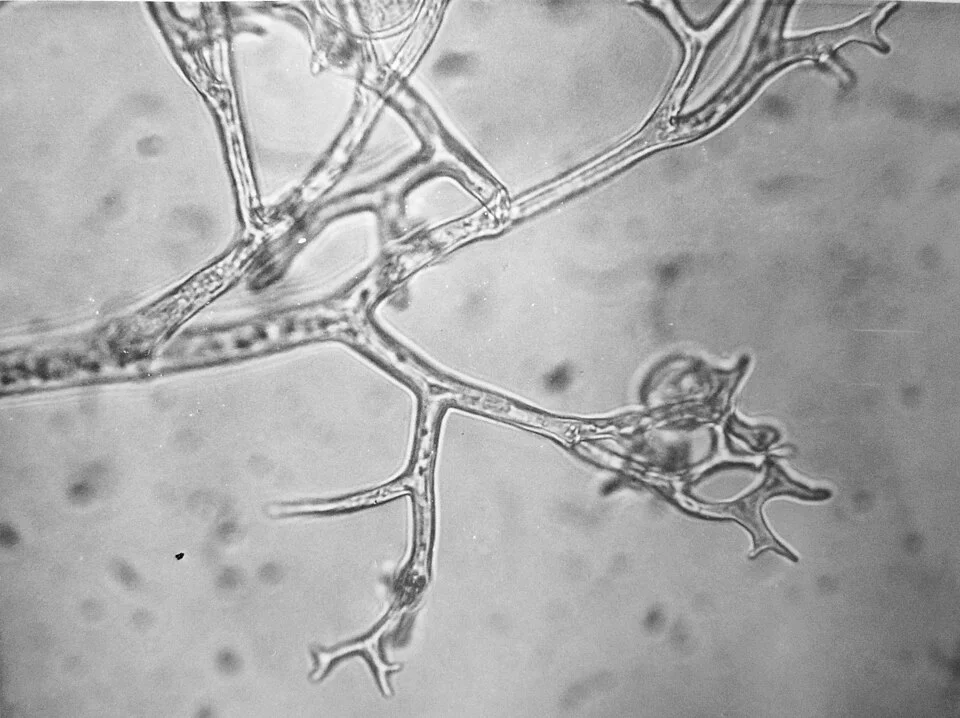
Tashkoskip · CC BY-SA 4.0
Why it matters
Blue mould is the tobacco seedbed's worst enemy: in cool, damp weather it can race through a nursery in a matter of days and take up to 90% of your seedlings — very nearly the whole bed. Once the mould works its way inside a plant, into the stem and growing tip, no spray can reach it, and every infected seedling you carry to the field plants the disease with it. That is why this battle is won or lost before you see much of it — the first yellow spot, or the first cold, wet, overcast spell, is already your signal to move.
When to act
Begin protective sprays in the seedbed when cool, wet, overcast weather sets in, or immediately if the first yellow leaf spots with grey-blue mould are found.
This guidance is general, compiled from published agronomic references including FAO and CABI. Thresholds and timing shift with your crop, your variety and the season.
In much of the region a spray is simply called mushonga — medicine. But a chemical group you cannot name is one you cannot rotate, and a product you did not write down has no pre-harvest interval you can observe. Mushonga, and other farming words →
The full Blue mould field guide
Identify it
What shows first
pale, yellow, roundish spots on the top of young leaves — small faded patches on otherwise green seedlings. In a crowded bed they often appear as yellowing patches creeping across the seedbed.
Turn a leaf over — here is the giveaway:
under each yellow spot sits a soft bluish-grey to violet downy fuzz, like fine mould or felt. It shows best early in the morning while the bed is still damp; by a hot midday it can dry and hide. No other seedbed trouble gives you that blue-grey fuzz underneath — this is what names the disease blue mould.
As it takes hold
leaves cup and twist downward, seedlings collapse and rot in patches, and once the mould moves inside the plant (a systemic infection — it has entered the stem and growing tip) the young plants come up stunted, twisted and distorted.
Tell it apart from look-alikes
plain hunger-yellowing (short of nitrogen) yellows the leaf evenly but leaves no fuzz underneath; cold or frost turns leaves yellow-brown but grows no mould; ordinary damping-off rots kill at the soil line but leave no blue-grey down on the leaf undersides. The blue-grey fuzz under a yellow spot is the one sure sign of blue mould.
Scout for it
When
start the moment seedlings are up and keep it going right through the seedbed stage and the first weeks after transplanting — the young-plant stage — because that is when blue mould strikes. Check every single day during any cool, wet, overcast spell with heavy dews: that weather is what the mould loves.
Look in the cool of the morning
, while the leaves are still damp — that is when the blue-grey fuzz is out and easiest to see. Kneel and turn the leaves over; the disease hides on the underside, so glancing only at the tops will miss it.
Cover the whole bed, not just the near edge
walk the length of the seedbed and stop at both ends, the middle and the four corners — at least 6 stops — lifting and turning leaves at each one. Look hardest at the low, shaded, crowded and damp patches, where dew lingers and the mould begins.
Your trigger is ONE — not a percentage
The instant you find even a single seedling with a yellow spot and blue-grey fuzz beneath it, act now. And do not wait to see it at all: the moment a cool, wet, overcast spell sets in, start your protective sprays, because the spores blow in on the wind and a bed can be gone in days.
Control it
Prevent it — dry the bed and give it air
Blue mould needs long leaf-wetness and still, humid air, so ventilate the seedbed (open the covers by day to dry the foliage), don't over-water — water early so leaves dry before the cool night — and don't crowd your seedlings; space them so air moves and leaves dry fast. Site the bed in an open, sunny spot away from older tobacco.
Cut the disease's bridge between seasons
pull out and destroy any volunteer tobacco (self-sown plants left from last season) and old seedbed debris, because they keep the mould alive from one year to the next. Where you can get them, grow tolerant tobacco varieties, which carry lighter losses when the disease does strike.
Act at the very first sign — rogue it out
The moment you spot infected seedlings, pull the sick plants and the ones right around them and carry them out of the bed (roguing) to bury or burn, so they can't shower spores over the rest. At the same time open the bed up and cut back the watering to dry it out.
Protective spray — mancozeb (last resort, used preventively):
the main chemical tool is mancozeb, a protectant (contact) fungicide — it coats the leaf surface and stops spores from infecting, but it cannot cure a plant that is already infected. So it must be on the leaf before the mould arrives and be re-applied as new leaves open and after rain washes it off. Spray in the cool of morning or evening with the wind at your back; cover your skin, eyes, nose and mouth; keep it off food, water, children and bees; wash well afterwards; and respect the pre-harvest interval — the least number of days you must leave between the last spray and harvest so residues are safe.
Guard against resistance
if pressure is heavy and the protectant is being overwhelmed, a systemic fungicide — one that is absorbed into the plant and can reach early infection, such as the metalaxyl group noted for this disease — may be added. Never use it on its own: always alternate it with mancozeb, because the mould builds resistance (learns to survive the chemical) fast when a systemic is used alone. Rotating a protectant and a systemic keeps both working.
If it keeps spreading — cut your losses cleanly
If, despite roguing and spraying, the blue-grey mould is running through the bed, do not transplant sick, twisted or spotted seedlings into your field — you would carry blue mould straight to the whole crop, where it can cost up to 90%. Rather sacrifice a badly-hit seedbed, clear and clean it, and set out only clean, healthy plants from a clean bed or bought-in tolerant transplants. A lost seedbed you can sow again; a lost field crop you cannot.
Catch Blue mould before it costs you the harvest
This guide is the general answer. Divisi works out yours — the week to scout your own field for Blue mould, and what to do the day you find it.


Crops it affects
Plan the crops it attacks

All planting calendars, country by country
Get Insights by email
A short digest of new Divisi articles. No email on quiet weeks.
Frequently asked questions
How do I identify Blue mould?
What shows first. pale, yellow, roundish spots on the top of young leaves — small faded patches on otherwise green seedlings. In a crowded bed they often appear as yellowing patches creeping across the seedbed.
When should I take action against Blue mould?
Begin protective sprays in the seedbed when cool, wet, overcast weather sets in, or immediately if the first yellow leaf spots with grey-blue mould are found.
How do I control Blue mould?
Prevent it — dry the bed and give it air. Blue mould needs long leaf-wetness and still, humid air, so ventilate the seedbed (open the covers by day to dry the foliage), don't over-water — water early so leaves dry before the cool night — and don't crowd your seedlings; space them so air moves and leaves dry fast. Site the bed in an open, sunny spot away from older tobacco.
Which crops are attacked by Blue mould?
Among the crops covered here: Tobacco.