 Divisi
Cassava bacterial blight
Xanthomonas axonopodis pv. manihotis · Bacterial
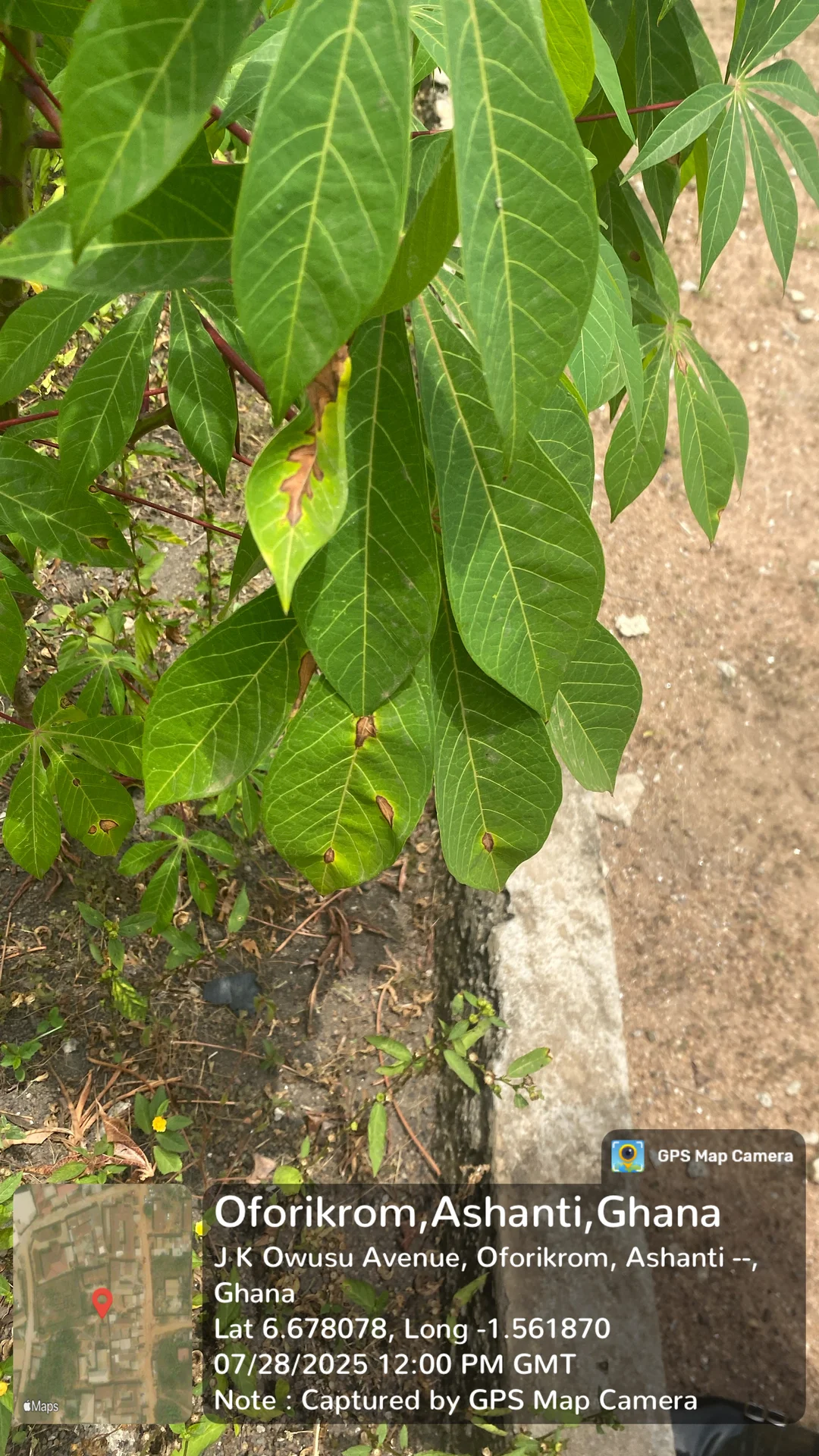
Photo: Raizkgh · CC0
Cassava bacterial blight is a disease of cassava caused by bacteria that live inside the plant's sap tubes. It shows up as angular, water-soaked leaf spots that grow into blight and wilting, amber gum oozing from the stems, and dieback of the growing tips. It spreads fastest in warm, wet, windy weather through rain-splash, shared tools and human movement — but its most dangerous journey is hidden inside infected stem cuttings, which carry it long distances and straight into next season's field.
Why it matters
Cassava bacterial blight can take up to 90% of your harvest in a bad, wet season — that is 9 plants in every 10 worth of roots and leaves lost. It lives inside the plant's sap tubes, so no spray can reach in and cure it. Worst of all, it travels hidden in the stem cuttings you replant — save stems from a sick plant and you carry the disease straight into next year's field. Once it is in your cuttings and your soil, it is very hard to get out, which is why stopping it before it arrives matters far more than fighting it after.
When to act
first angular water-soaked leaf spots or wilting shoots; act on the whole field, not single leaves
This guidance is general, compiled from published agronomic references including FAO and CABI. Thresholds and timing shift with your crop, your variety and the season.
In much of the region a spray is simply called mushonga — medicine. But a chemical group you cannot name is one you cannot rotate, and a product you did not write down has no pre-harvest interval you can observe. Mushonga, and other farming words →
The full Cassava bacterial blight field guide
Identify it
The first sign — spots that look wet:
small angular, water-soaked spots appear between the leaf veins, mostly on the lower and middle leaves. They look dark, greasy and see-through, as if oil or water is trapped in the leaf. Look in the early morning while the dew is still on the plant and hold a leaf up to the light — that is when the wet, greasy patches show up best. Because the veins box them in, the spots have straight, angular edges, not round ones.
As it spreads
the spots grow, turn brown and join into large dead brown patches (this is the 'blight'), often ringed with yellow. Whole leaves then wilt, dry to a scorched brown, droop and drop — a plant can strip itself bare from the bottom up, or a whole shoot can suddenly collapse.
The give-away — amber gum:
look closely at the stems, the leaf stalks and the scars where leaves have fallen off. Bacterial blight oozes sticky, honey-coloured gum droplets from these points. This gum is the clearest single sign that you are looking at bacterial blight and not another problem.
Dieback and the cut test
the growing tips die back, leaving bare, leafless stems standing like candlesticks. Cut cleanly across a suspect stem and look at the ring inside — with blight you see brown or black streaks in the wood where the sap tubes (the plant's water pipes) have been blocked. A healthy stem is clean and pale inside.
Tell it apart from look-alikes
cassava mosaic makes a yellow-and-green mottled, crinkled leaf pattern but has no wet spots, no gum and no wilting. Brown streak gives brown streaks on stems and rotten roots — again no gum. Plain drought or sun-scorch dries the leaves evenly with no angular spots and no gum. If you see angular wet spots + amber gum + wilting together, it is bacterial blight.
Scout for it
When to look
blight loves warm, wet weather, so scout hardest through the rains, from when your cassava is building its canopy (the development months) right through mid-season — the stages when this disease does the most damage. Check again after every heavy, wind-driven rainstorm, because that is exactly how the bacteria splash from plant to plant.
How to walk it
once a week, walk a big "W" across the field so you cross all four corners and the middle — not just the row next to the path. Make about 10 stops along the W and look closely at a few plants at each stop.
What to check at each stop
turn over the lower and middle leaves and hunt for angular wet spots; run your eye down the stems, leaf stalks and leaf scars for amber gum; check the growing tips for wilting or dieback. At one or two suspect plants, cut a stem and look for the brown ring inside.
When to act — do NOT wait for a count:
with most pests you wait until many plants are hit, but not this one. The moment you find even ONE plant with angular wet spots, oozing gum, or a wilting shoot, treat it as a whole-field problem, not one sick plant — act now. Then ask yourself: where did these cuttings come from? If a batch of cuttings brought it in, mark that source and never plant from it again.
Control it
Prevent it first — this is where you win or lose:
blight rides inside the stem, so your cuttings decide everything. Take cuttings only from strong, healthy plants that showed no spots, gum or dieback last season, and where you can, plant a resistant or tolerant variety — a resistant variety is the single most powerful and longest-lasting protection you have. Never take or plant cuttings from a field that had blight.
Keep it clean — stop it hitching a ride:
the bacteria travel on blades, hands and wet leaves. Disinfect your knife or panga (bush-knife) between plants when you cut or prune — wipe the blade with a bleach-and-water solution or pass it through a flame. Try not to walk through or work the crop while it is wet, and never carry cuttings out of an infected field into a clean one. Handle bleach with care: keep it off your eyes and skin, and wash your hands after.
Act early — pull it out and burn it:
as soon as you find infected plants, uproot the whole plant (this is called 'roguing') together with a few plants around it, carry them right out of the field, and burn them. Do not leave them lying as debris, do not compost them, and above all do not save their stems as cuttings. Burn well away from your crop and your buildings.
Slow it down across the field
put non-cassava plants between your cassava so rain-splash cannot jump so easily — intercrop with maize or legumes. After a bad outbreak, rest that land or rotate it to maize or legumes for a season or two before you plant cassava there again, so the bacteria left behind in the old debris die out.
If it keeps spreading — know that there is NO spray for this:
no chemical can cure bacterial blight once it is inside the plant, so spraying is a waste of your money. If roguing is not holding it and the field is badly hit, treat the season as lost: harvest any roots that have already bulked up, then destroy and burn every old stem (save none as cuttings), rest or rotate the land, and start fresh next season with clean cuttings of a resistant variety. That clean start is the only real cure.
Catch Cassava bacterial blight before it costs you the harvest
This guide is the general answer. Divisi works out yours — the week to scout your own field for Cassava bacterial blight, and what to do the day you find it.


Crops it affects
Plan the crops it attacks

All planting calendars, country by country
Get Insights by email
A short digest of new Divisi articles. No email on quiet weeks.
Frequently asked questions
How do I identify Cassava bacterial blight?
The first sign — spots that look wet:. small angular, water-soaked spots appear between the leaf veins, mostly on the lower and middle leaves. They look dark, greasy and see-through, as if oil or water is trapped in the leaf. Look in the early morning while the dew is still on the plant and hold a leaf up to the light — that is when the wet, greasy patches show up best. Because the veins box them in, the spots have straight, angular edges, not round ones.
When should I take action against Cassava bacterial blight?
first angular water-soaked leaf spots or wilting shoots; act on the whole field, not single leaves
How do I control Cassava bacterial blight?
Prevent it first — this is where you win or lose:. blight rides inside the stem, so your cuttings decide everything. Take cuttings only from strong, healthy plants that showed no spots, gum or dieback last season, and where you can, plant a resistant or tolerant variety — a resistant variety is the single most powerful and longest-lasting protection you have. Never take or plant cuttings from a field that had blight.
Which crops are attacked by Cassava bacterial blight?
Among the crops covered here: Cassava.