 Divisi
Citrus black spot
Phyllosticta citricarpa · Fungal
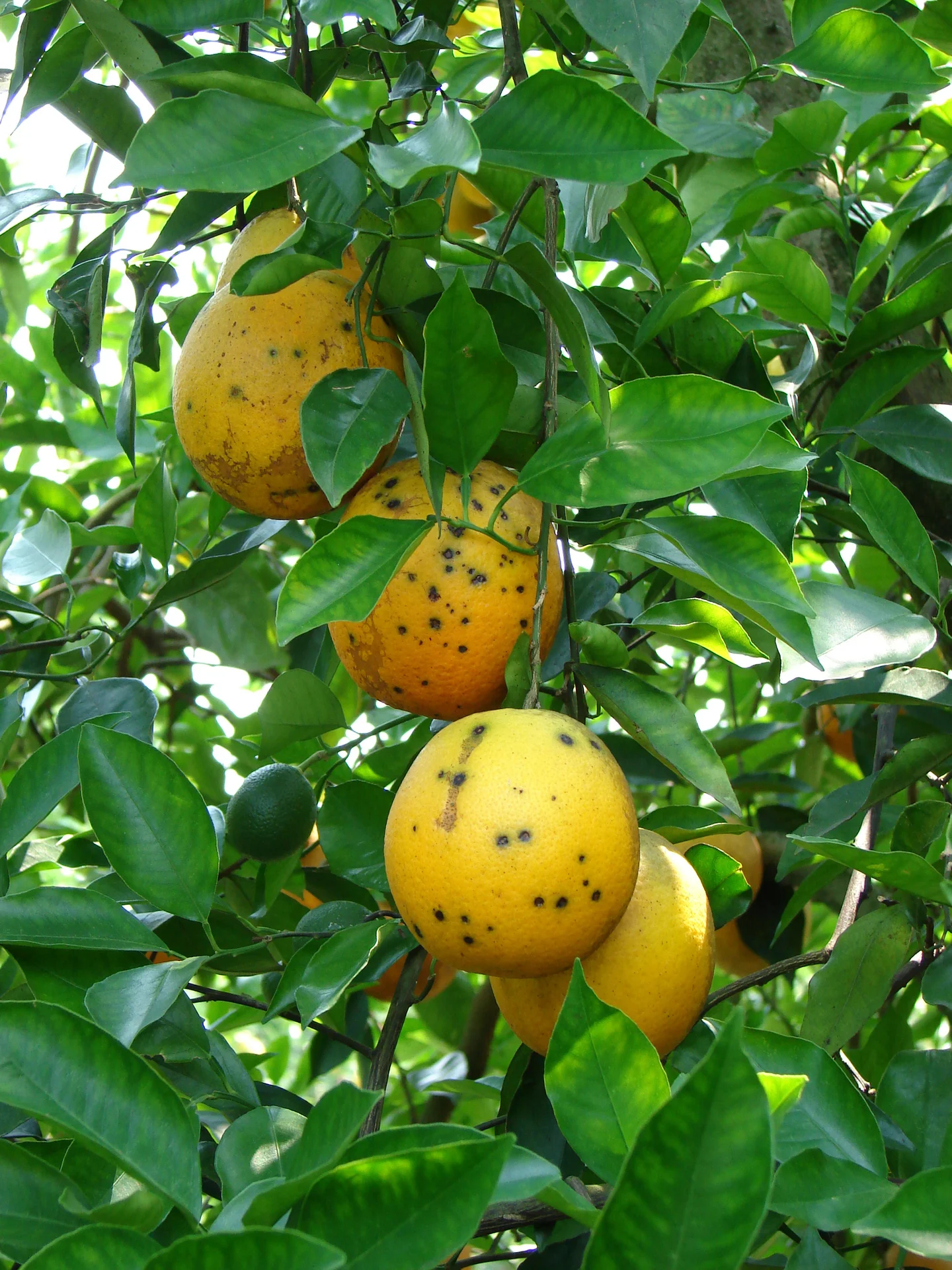
Photo: USDA APHIS · Public domain
Citrus black spot is a fungal disease of citrus (oranges, lemons, limes) caused by Phyllosticta citricarpa. Its spores blow and splash off the carpet of old, rotting leaves under the trees during warm, wet summers and infect the young fruit soon after fruit set. The fruit then looks perfectly clean for months, and the ugly spots only appear as it ripens. It scars the rind rather than rotting the flesh, so the fruit stays safe to eat, but the blemish is enough to get a load downgraded, refused by fresh and export buyers, and in bad cases the fruit drops before you can pick it.
Cesar Calderon · CC BY-SA 3.0 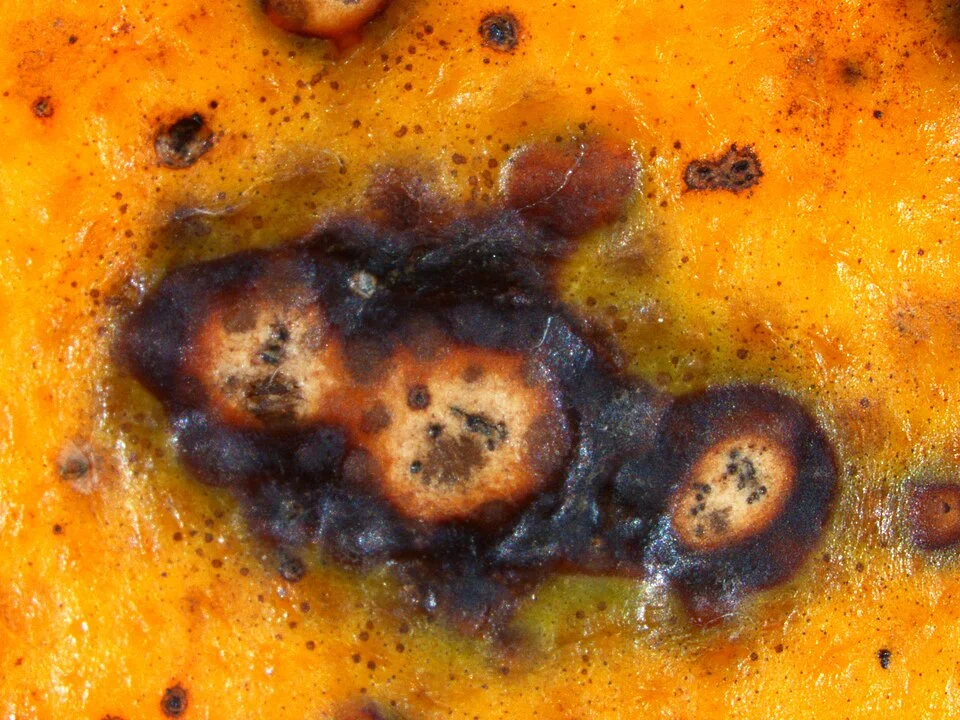
USDAgov · Public domain
Why it matters
Black spot doesn't rot your fruit — it scars the skin with ugly spots, and that alone is enough to get a whole load rejected by fresh and export buyers or dropped to cheap juice-price. A bad year can cost you up to 40% of your crop in downgrades and, on hard-hit trees, in fruit that drops before harvest. It is hard to beat because the fungus infects the young fruit in early summer but the spots stay hidden for months — by the time you see them, the damage to that fruit is already done and no spray can undo it. And the spore factory is the carpet of old fallen leaves under your trees, which re-infects the crop every warm, wet summer unless you deal with it.
When to act
In summer-rainfall citrus areas with the disease present, protect fruit preventively through the susceptible period after fruit set; symptomatic fruit at scouting confirms the need to maintain the spray programme.
This guidance is general, compiled from published agronomic references including FAO and CABI. Thresholds and timing shift with your crop, your variety and the season.
In much of the region a spray is simply called mushonga — medicine. But a chemical group you cannot name is one you cannot rotate, and a product you did not write down has no pre-harvest interval you can observe. Mushonga, and other farming words →
The full Citrus black spot field guide
Identify it
The classic sign — 'hard spot':
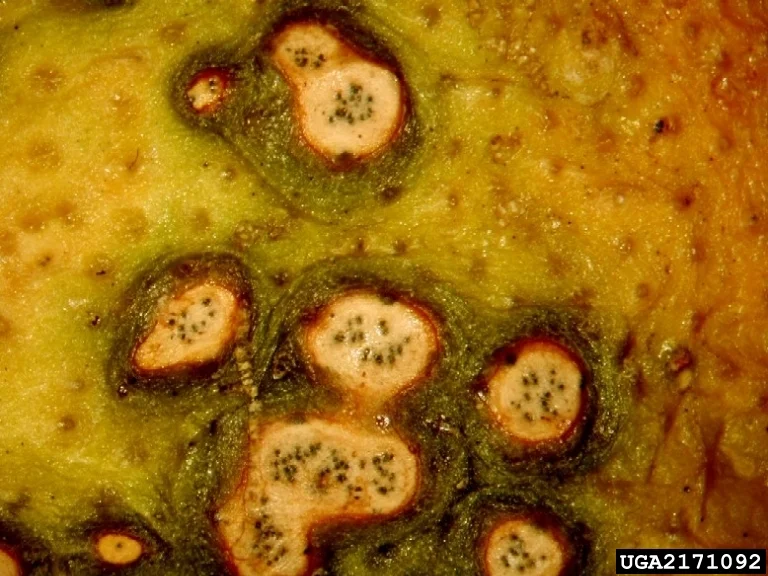
on ripening fruit, look for small round craters about the size of a match-head to a pea (3–10 mm), each with a sunken grey-to-tan centre, a dark, slightly raised ring around the rim, and a cluster of tiny black dots (pinpricks) in the middle. Those black dots are the fungus's spore factories. Spots show up first and worst on the sun-facing side of the fruit.
How it spreads and worsens
before the craters form you may see small reddish-brown freckles or specks with no pit yet. On heavily-loaded old trees late in the season, many spots run together into large dark sunken blotches that can even keep spreading in the box after picking. Severe infection makes fruit drop early. The leaves usually look clean — on most citrus the spots are almost only on the fruit.
Don't confuse it with look-alikes
Melanose is rough and raised like sandpaper, often in tear-stain streaks running down the fruit where rain washed the spores — it has no sunken grey crater and no dark ring. Citrus scab makes raised, warty, corky lumps that deform the fruit — black spot never makes warts. Sunburn, wind-scar and mite russeting are bleached or bronzed patches with no dark ring and no black dots. The give-away for black spot is the sunken grey crater ringed in dark, with tiny black dots in the centre, on the sunny side of ripe fruit.
Scout for it
Two different windows — know which is which
Through the young-fruit period just after fruit set the fungus is infecting even though nothing shows yet — that is your spray window, not your looking window. Then from fruit sizing through colour break the hidden spots finally appear — that is when you walk and look.
Walk a big 'W' across the whole block
so you cover all four corners and the middle, not just the row by the gate. Stop at about 10 trees spread across the orchard. Look hardest after a spell of warm, rainy weather, which is exactly what the fungus needs.
At each tree check about 10 fruit
, especially on the outside of the canopy on the sun-facing side, where hard spots show first — pick and turn a few fruit right the way round. Then look down at the orchard floor: a thick carpet of old fallen leaves is the main spore source, so heavy leaf litter under the trees is a warning sign in itself.
Because the infection is invisible until it is too late to cure, the number that matters is presence, not how many
Find hard spots on even 1 fruit (about 1 in 100) — or learn that a neighbour's orchard has it — and treat the disease as established: you must protect next season's young fruit preventively, from fruit set onward. Seeing spotted fruit at colour break is your signal to keep the full spray programme going and clean up the leaf litter before next summer. If more than a few fruit per tree are spotted, your spraying or your sanitation is falling behind — tighten both.
Control it
Prevent it first — starve the spore source (the leaf litter)
The fungus makes most of its spores in the old leaves rotting under your trees, so the single most useful job costs almost nothing: rake up and remove or compost the fallen leaves, or speed their rotting by mulching over them, spraying them with a little urea, and keeping a ground cover so they break down fast. Do this in the dry months before the summer rains set the spores flying. This sanitation is the strongest non-chemical tool you have.
Open the trees up and keep them clean
Prune so air moves through and the fruit and leaves dry quickly after rain — the fungus needs long wet spells to infect, so faster drying means less disease. Don't carry it into clean trees: pick off and destroy old spotted fruit left hanging, clean tools, boots and picking bins between blocks, and never move infected leaves, fruit or prunings into a clean orchard. Harvest and pack promptly so late spots don't keep forming.
Get the timing right — protect BEFORE infection, never after
You cannot cure a spot once it has started inside young fruit, so a spray only works if it is already on the fruit before the spores land. Begin protecting from when the petals drop and tiny green fruit set, and cover the whole susceptible young-fruit period through early summer. A spray put on after you can already see spots is wasted on that fruit.
Chemical, as a planned programme — a protectant fungicide (copper, mancozeb or a strobilurin)
'Protectant' means it coats the fruit surface and stops new spores germinating — it does not move inside to cure an infection already there — so you must cover every fruit thoroughly, including the outer, sun-facing canopy, and re-apply through the susceptible period because rain washes it off. Rotate between the different groups — copper, mancozeb and strobilurins are different chemical families — so the fungus can't build up resistance (strobilurins especially lose their punch fast if over-used). Safety every time: cover your skin, eyes, nose and mouth; spray in the cool, calm part of the day with the wind at your back; keep spray off water, food, children and bees; wash yourself and your clothes afterwards; and respect the pre-harvest interval — the minimum number of days the label tells you to wait between the last spray and picking.
If spots keep coming, check three things
were you too late starting to spray, did every fruit get covered, and is there still a carpet of old leaves feeding spores? Fix whichever is failing. Remember the fruit is only skin-blemished, not rotten — it is still safe to eat, so if a block is badly spotted, sell it to the local or juice market rather than lose it chasing an export grade you can't meet. At season's end, strip and destroy every spotted fruit and all the leaf litter to starve next year's crop. For very old, heavily infected, low-value trees that spot every year no matter what, cut your losses on that block and put your effort into sanitation plus a full preventive programme on the trees worth saving.
Catch Citrus black spot before it costs you the harvest
This guide is the general answer. Divisi works out yours — the week to scout your own field for Citrus black spot, and what to do the day you find it.


Crops it affects
Plan the crops it attacks


All planting calendars, country by country
Get Insights by email
A short digest of new Divisi articles. No email on quiet weeks.
Frequently asked questions
How do I identify Citrus black spot?
The classic sign — 'hard spot':. on ripening fruit, look for small round craters about the size of a match-head to a pea (3–10 mm), each with a sunken grey-to-tan centre, a dark, slightly raised ring around the rim, and a cluster of tiny black dots (pinpricks) in the middle. Those black dots are the fungus's spore factories. Spots show up first and worst on the sun-facing side of the fruit.
When should I take action against Citrus black spot?
In summer-rainfall citrus areas with the disease present, protect fruit preventively through the susceptible period after fruit set; symptomatic fruit at scouting confirms the need to maintain the spray programme.
How do I control Citrus black spot?
Prevent it first — starve the spore source (the leaf litter). The fungus makes most of its spores in the old leaves rotting under your trees, so the single most useful job costs almost nothing: rake up and remove or compost the fallen leaves, or speed their rotting by mulching over them, spraying them with a little urea, and keeping a ground cover so they break down fast. Do this in the dry months before the summer rains set the spores flying. This sanitation is the strongest non-chemical tool you have.
Which crops are attacked by Citrus black spot?
Among the crops covered here: Lemon, Lime.