 Divisi
Cocoa swollen shoot virus
Cacao swollen shoot virus · Viral
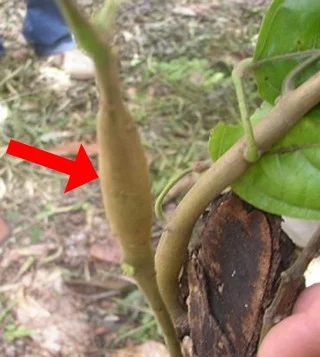
Photo: DiSnouk · CC0
Cocoa swollen shoot virus (CSSV) is a devastating viral disease of cocoa, caused by a badnavirus and spread from tree to tree by mealybugs that ants move and protect, as well as by infected planting material and grafts. It swells the shoots, stems and roots, red-bands then yellows the leaves, shrinks the pods, and kills the tree within a few years, with no cure. It is a leading cause of cocoa decline across West Africa (Ghana, Cote d'Ivoire, Togo and Nigeria), and control rests almost entirely on cutting out infected trees to stop the spread.
User:DiSnouk/D. Snoeck · CC0
Why it matters
Swollen shoot is the tree-killer of cocoa. There is no cure — once a tree catches the virus it slowly dies over two to five years, and a bad, uncontrolled outbreak can take your whole planting (up to 100% loss). It is so hard to stop because the virus lives inside the wood and sap, where no spray can reach it; tiny mealybugs, carried and protected by ants, pass it from tree to tree; and by the time you can clearly see it, it has usually already infected the neighbouring trees whose branches touch. The only way to save the rest of your cocoa is to cut out the sick trees early — and keep cutting.
When to act
Zero tolerance: cut out and destroy infected trees plus a ring of contact trees as soon as symptoms are confirmed, and act on mealybug colonies feeding on the canopy.
This guidance is general, compiled from published agronomic references including FAO and CABI. Thresholds and timing shift with your crop, your variety and the season.
In much of the region a spray is simply called mushonga — medicine. But a chemical group you cannot name is one you cannot rotate, and a product you did not write down has no pre-harvest interval you can observe. Mushonga, and other farming words →
The full Cocoa swollen shoot virus field guide
Identify it
The first tell-tale sign — red along the veins of the young flush
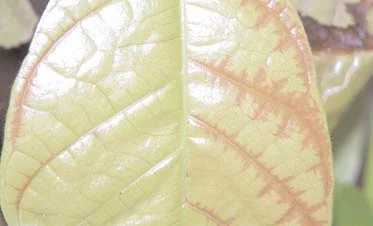
When a tree pushes out a flush (a burst of soft, newly-opened young leaves), look closely along the veins. Healthy young cocoa flush is red all over and then hardens to an even green. With swollen shoot you instead see bright red or pink banding that follows the veins — red running as stripes ALONG the leaf veins, not spread over the whole leaf. This vein pattern is the surest early sign.
Then the yellowing and dieback
As the leaves harden and the disease builds, the red fades to yellow flecking and a fern-like mottle that follows the veins, together with pale, see-through veins (called vein-clearing) that stays even on older, hardened leaves. Over months the tree yellows, sheds leaves, and its branches die back from the tips.
The swellings that give the disease its name
Look for swellings (galls) on the green shoots, stems and even the roots — a shoot or twig that bulges out fat in one spot instead of staying an even thickness along its length.
The pods
Infected trees carry small, rounded, smooth, mottled pods — almost ball-shaped instead of the normal long, ridged cocoa pod — with few, small beans inside.
The carrier — white mealybugs and their ants
On the shoot tips, leaf joints, and the cushions (the knobbly spots on the trunk and branches where flowers and pods form), look for tiny soft insects coated in white, cottony, mealy wax, usually with ants running up and down the trunk tending them. These mealybugs are the vector — the insect that carries the virus from tree to tree.
Don't confuse it with
(a) normal red flush — new cocoa leaves are naturally red, then green up evenly; swollen shoot red is a stripe along the veins that turns into a yellow vein-mottle and never fully greens up. (b) Hunger yellowing (nutrient shortage) — that yellows the leaf between the veins and shows up evenly across many trees on poor soil; swollen shoot yellowing follows the veins and radiates out from a patch of sick trees. (c) Drought or capsid (mirid) bug dieback — dieback on its own, with NO red vein-banding and NO shoot swellings, and not spreading as a widening patch, is not swollen shoot.
Scout for it
When to look
check hardest when the trees push a new flush of soft young leaves — that is when the red vein-banding shows up clearest. Keep it up right through the season, from the young developing trees into the mid and late season, because the sick patch keeps widening month by month.
Where to walk
walk the whole plot in a big "W" so you cross the middle and all four corners, not just the row by the path. Pay special attention to the edges next to any old, abandoned or neighbouring cocoa — that is where the virus usually creeps in from.
How many and what to check
stop at trees as you go (at least 10 stops across the plot) and at each one check three things — the young flush for red vein-banding, the shoots and stems for swellings, and the pods for the small round mottled shape. Then check the shoot tips and trunk cushions for the white mealybugs and the ants tending them.
Mark, don't guess
Tie a ribbon on or paint any suspect tree. Because felling a tree is final, get it confirmed (by a survey or extension team where one exists) before you cut — but do not sit and wait for months while it spreads.
The threshold — zero tolerance
There is no safe number to live with: even ONE confirmed infected tree is too many. As soon as a tree is confirmed, act — cut it out plus a ring of the touching neighbour trees around it, because those contacts are almost certainly already infected but not yet showing it. And if you find white, ant-tended mealybug colonies building up on the pods and shoot tips, act on those too.
Control it
PREVENT — start clean and stay clean (your strongest tool)
Plant only certified virus-free (tested-clean) seedlings from a trusted nursery, and never take seed, budwood or suckers from a sick or unknown tree — grafts and planting material carry the virus. Where they exist, plant tolerant varieties that suffer less. Keep a barrier between your cocoa and any old, abandoned or infected cocoa nearby — a real gap or a band of non-host plants (plants the virus and its mealybugs cannot live on) — so the carrier cannot cross. This cultural line is the mainstay of control.
ACT
-
the only cure is the saw (roguing)
As soon as a tree is confirmed, cut it down and destroy it, and cut out the ring of touching contact trees around it — those neighbours are already infected even if they still look healthy. This cutting-out is called roguing. Do it fast: every month you delay, the virus spreads further. Then replant the gaps with clean, tolerant stock.
-
starve the carrier (biological)
The mealybugs that spread the virus are moved and protected by ants. Break the ant trails and disturb their nests, and protect the natural enemies (such as ladybird beetles) that eat mealybugs, so the colonies stay small. This slows the spread but does not replace cutting out sick trees — do both.
No chemical cures it — a spray cannot save a sick tree
The virus lives inside the wood and sap, so there is no spray that can cure an infected tree, and this disease has no chemical control listed — do not waste money on one. The only thing an insecticide could do is knock back the mealybug carriers, and even that is better done by managing the ants and natural enemies above. IF you ever do reach for any insecticide against mealybugs: cover your skin, eyes, nose and mouth, spray in the cool of the day with the wind at your back, keep it well off food, water, children and bees, wash yourself and your clothes afterwards, respect the label's pre-harvest interval (the wait between spraying and picking pods), and rotate to a different chemical group each time so the pest cannot build up resistance. It still never replaces cutting out the infected trees.
If it keeps spreading — widen the cut, then cut your losses
If the sick patch keeps growing after you rogue, it usually means infected trees nearby (a neighbour's plot, or abandoned cocoa) keep feeding the virus back in, or you did not take the full ring of contacts. Widen the cut — take a bigger ring, or a cordon right around the whole outbreak — and get your neighbours to rogue on their side the same season (it must be done area-wide, together, or the virus walks straight back in). When a block is too far gone and most trees are sick and dying, stop nursing single trees: cut your losses — clear the whole block, leave it fallow or under a non-host crop for a season to starve out the mealybugs, then replant the entire area at once with certified virus-free, tolerant stock. Clean, all-together replanting beats patching a dying block.
Catch Cocoa swollen shoot virus before it costs you the harvest
This guide is the general answer. Divisi works out yours — the week to scout your own field for Cocoa swollen shoot virus, and what to do the day you find it.


Crops it affects
Plan the crops it attacks

All planting calendars, country by country
Get Insights by email
A short digest of new Divisi articles. No email on quiet weeks.
Frequently asked questions
How do I identify Cocoa swollen shoot virus?
The first tell-tale sign — red along the veins of the young flush. When a tree pushes out a flush (a burst of soft, newly-opened young leaves), look closely along the veins. Healthy young cocoa flush is red all over and then hardens to an even green. With swollen shoot you instead see bright red or pink banding that follows the veins — red running as stripes ALONG the leaf veins, not spread over the whole leaf. This vein pattern is the surest early sign.
When should I take action against Cocoa swollen shoot virus?
Zero tolerance: cut out and destroy infected trees plus a ring of contact trees as soon as symptoms are confirmed, and act on mealybug colonies feeding on the canopy.
How do I control Cocoa swollen shoot virus?
PREVENT — start clean and stay clean (your strongest tool). Plant only certified virus-free (tested-clean) seedlings from a trusted nursery, and never take seed, budwood or suckers from a sick or unknown tree — grafts and planting material carry the virus. Where they exist, plant tolerant varieties that suffer less. Keep a barrier between your cocoa and any old, abandoned or infected cocoa nearby — a real gap or a band of non-host plants (plants the virus and its mealybugs cannot live on) — so the carrier cannot cross. This cultural line is the mainstay of control.
Which crops are attacked by Cocoa swollen shoot virus?
Among the crops covered here: Cocoa.