 Divisi
Coffee wilt disease
Fusarium xylarioides · Fungal
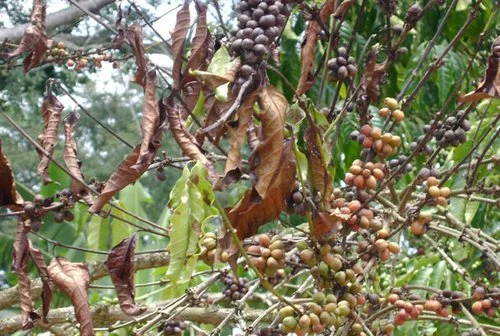
Photo: The Mediae Company · CC BY-SA 4.0
Coffee wilt disease (CWD), also called tracheomycosis (a disease of the water-carrying tubes), is a fungal disease that blocks the pipes inside the coffee tree that carry water up from the roots. The fungus (Fusarium xylarioides) lives in the soil and in dead coffee wood; it gets in through wounds on the roots or stem, grows up inside the wood, and chokes off the tree's water supply so the whole bush wilts and dies. It attacks both Arabica and Robusta, has caused major epidemics across East and Central Africa, and once it is inside a tree there is no cure — all the work is in stopping it spreading.
Why it matters
Coffee wilt disease does not just cut your harvest — it kills the whole bush, and a coffee tree takes three to four years of care before it even begins to pay you back. Once the fungus is inside the wood there is no spray and no cure: the tree will wilt, drop its leaves and die, and a bad outbreak can take every tree in the block (up to 100%). Worse, it spreads quietly from bush to bush on your pruning knife, on soil stuck to your tools and boots, and through roots touching underground — so one sick tree you ignore becomes a dead patch, then a lost field. Everything you do is about catching it early and stopping the spread, because you can never rescue a tree that is already infected.
When to act
Any bush showing progressive one-sided wilting and leaf yellowing that does not recover; treat as a sanitation emergency.
This guidance is general, compiled from published agronomic references including FAO and CABI. Thresholds and timing shift with your crop, your variety and the season.
In much of the region a spray is simply called mushonga — medicine. But a chemical group you cannot name is one you cannot rotate, and a product you did not write down has no pre-harvest interval you can observe. Mushonga, and other farming words →
The full Coffee wilt disease field guide
Identify it
The first sign
one branch, or one whole side of the bush, suddenly wilts and turns yellow while the rest still looks green. The leaves lose their shine, curl inward, droop and hang down — and unlike a thirsty tree, they do not perk up after rain or watering.
It spreads through the tree and never recovers
the yellowing and leaf-drop move branch by branch until the whole bush is bare and dead, often within a few months. On a dying branch the cherries often ripen too early (red berries on a sick branch), and the bark may split in long cracks up the stem.
The sure sign — look inside the wood:
scrape the bark off a wilting stem, or cut a slanting slice into it, and you will see blue-black, brown or purple streaks staining the wood underneath (healthy wood is creamy white). On stems that have been dead a while you may also spot rows of tiny dark bumps on the bark — that is the fungus making its spores.
Don't confuse it with drought or root rot
a thirsty tree wilts all over evenly and recovers once it rains or you water it; wilt disease starts one-sided, keeps getting worse, never recovers, and stains the wood dark inside. Waterlogged or root-eaten trees wilt too, but their wood stays clean and pale — no dark streaks.
Scout for it
When to look
watch most closely from berry-filling through ripening and harvest (mid- and late-season), and in the weeks during and just after pruning or picking — that is when the tree is under water stress and when knives, hands and soil are moving wounds and spores from bush to bush.
How to walk it
every couple of weeks walk a big "W" across the plot so you pass through all four corners and the middle, not just the row beside the path. Look hardest at bushes next to a spot where a sick tree was already pulled out, near paths, and downhill from any past infection — soil and water carry the fungus that way.
What to check on each bush
look for a branch or one side that is yellowing, drooping and not recovering while the rest is green. On any suspect, scrape a little bark near the base and check for the blue-black or brown streaks in the wood — that is what confirms it is wilt disease and not thirst or hunger.
The threshold — one is an emergency:
this is not a pest you count up to a percentage. Even a single bush showing progressive one-sided wilt that does not recover, with dark-stained wood, means act today — treat it as a sanitation emergency (a clean-up you cannot delay) before it seeds the whole field. Mark every suspect bush the same day you find it.
Control it
Prevent
-
start clean and grow resistant:
plant only certified, disease-free seedlings from a trusted nursery (certified means guaranteed clean of the disease), and wherever your national coffee programme supplies resistant or tolerant varieties, choose those — a resistant tree is your strongest and cheapest long-term protection, because there is no cure once a tree is sick.
-
make no wounds, and clean your tools:
the fungus can only get in through a wound, so weed, dig and prune gently and avoid nicking the stems, the collar (the base of the stem at ground level) or the roots. Disinfect your pruning saw, knife and picking tools between every bush — dip the blade in a bleach solution or pass it through a flame — so one cut on a sick tree cannot carry the disease straight into the next. Wear gloves, keep bleach off your skin and eyes, and keep any flame well away from dry grass and the crop.
Act early — dig out and burn the sick bush (this is called roguing):
the moment you confirm one (one-sided wilt that won't recover, plus dark-stained wood), uproot the whole bush — roots and all — and burn it. If you leave the stump or roots in the ground the fungus stays alive and spreads through root contact to the next tree. Do not drag the sick plant across your healthy rows, and never chop it into mulch — that only spreads the spores.
There is no spray that cures it — so contain it:
do not waste money on any fungicide sold as a cure; no chemical can save an infected tree, which is exactly why removing sick bushes fast matters so much. Instead quarantine the affected patch — keep soil, tools, seedlings and picked cherries from moving out of it into your clean blocks, and clean your boots and tools before you leave it.
If it keeps spreading → rest the land and cut your losses
if new bushes keep wilting despite roguing, treat the whole patch as contaminated — stop moving anything out of it and rest the ground, and do not replant coffee in the same spots for at least a season. Where a block is mostly dead, clear and burn it, rest the soil, and re-establish with resistant seedlings elsewhere rather than pouring more work into feeding the epidemic.
Catch Coffee wilt disease before it costs you the harvest
This guide is the general answer. Divisi works out yours — the week to scout your own field for Coffee wilt disease, and what to do the day you find it.


Crops it affects
Plan the crops it attacks

All planting calendars, country by country
Get Insights by email
A short digest of new Divisi articles. No email on quiet weeks.
Frequently asked questions
How do I identify Coffee wilt disease?
The first sign. one branch, or one whole side of the bush, suddenly wilts and turns yellow while the rest still looks green. The leaves lose their shine, curl inward, droop and hang down — and unlike a thirsty tree, they do not perk up after rain or watering.
When should I take action against Coffee wilt disease?
Any bush showing progressive one-sided wilting and leaf yellowing that does not recover; treat as a sanitation emergency.
How do I control Coffee wilt disease?
Prevent — start clean and grow resistant:. plant only certified, disease-free seedlings from a trusted nursery (certified means guaranteed clean of the disease), and wherever your national coffee programme supplies resistant or tolerant varieties, choose those — a resistant tree is your strongest and cheapest long-term protection, because there is no cure once a tree is sick.
Which crops are attacked by Coffee wilt disease?
Among the crops covered here: Robusta coffee.