 Divisi
How to grow robusta coffee
Coffea canephora · Rubiaceae
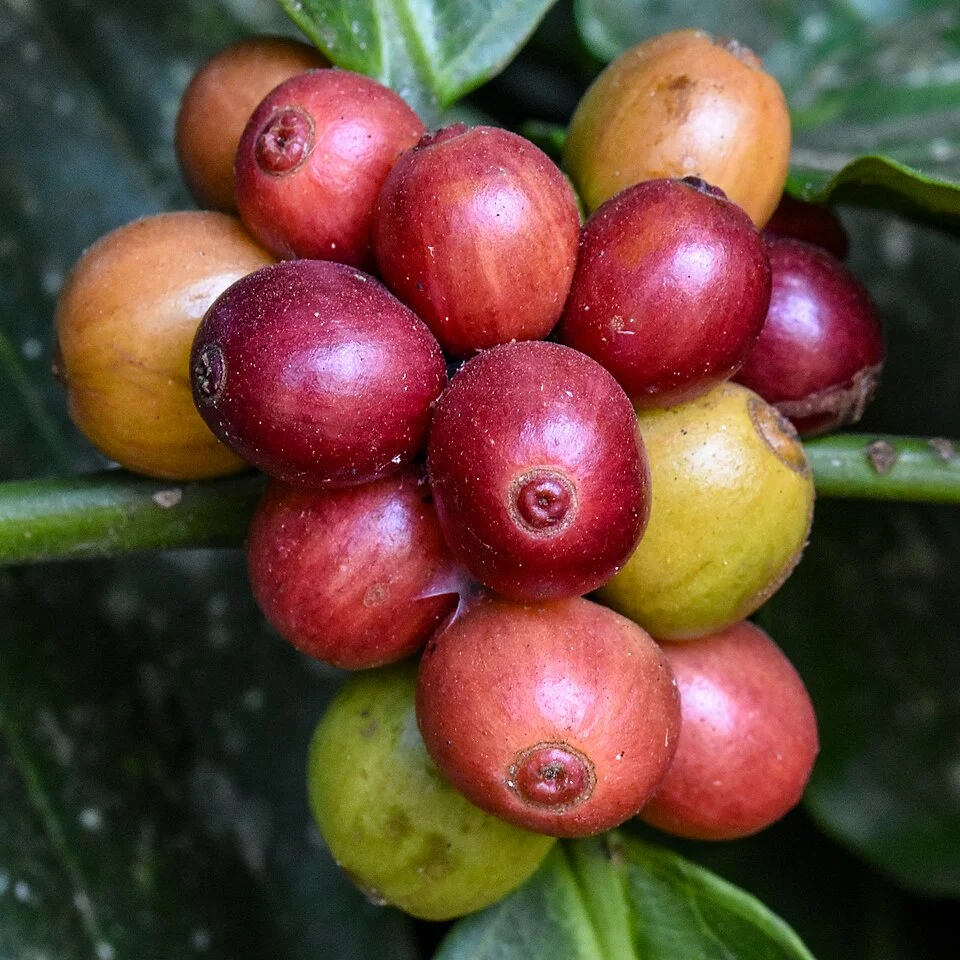
Robusta (Coffea canephora) is a hardy evergreen coffee tree of the warm lowlands — bigger, tougher and higher-yielding than highland Arabica, and far better at shrugging off leaf rust. It carries one strict rule: a coffee flower cannot set a berry with its own pollen. So you must plant several different kinds (clones or seedlings) side by side that flower at the same time — with the help of bees, they pollinate each other. Plant it once and, cared for well, one tree bears cherries for many years.
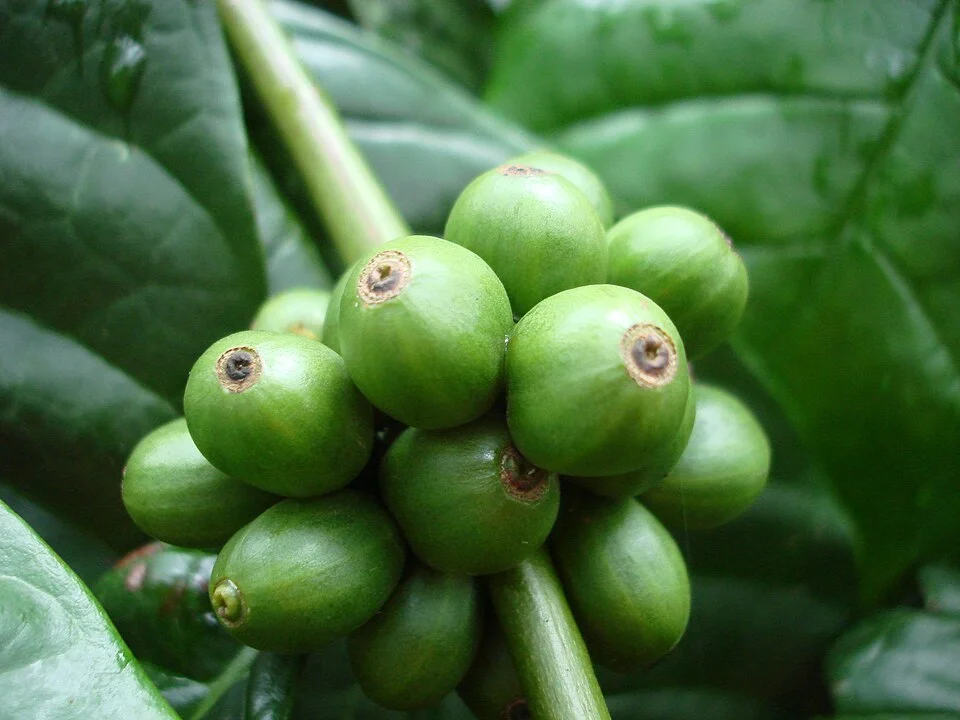
Ksd5 · CC0 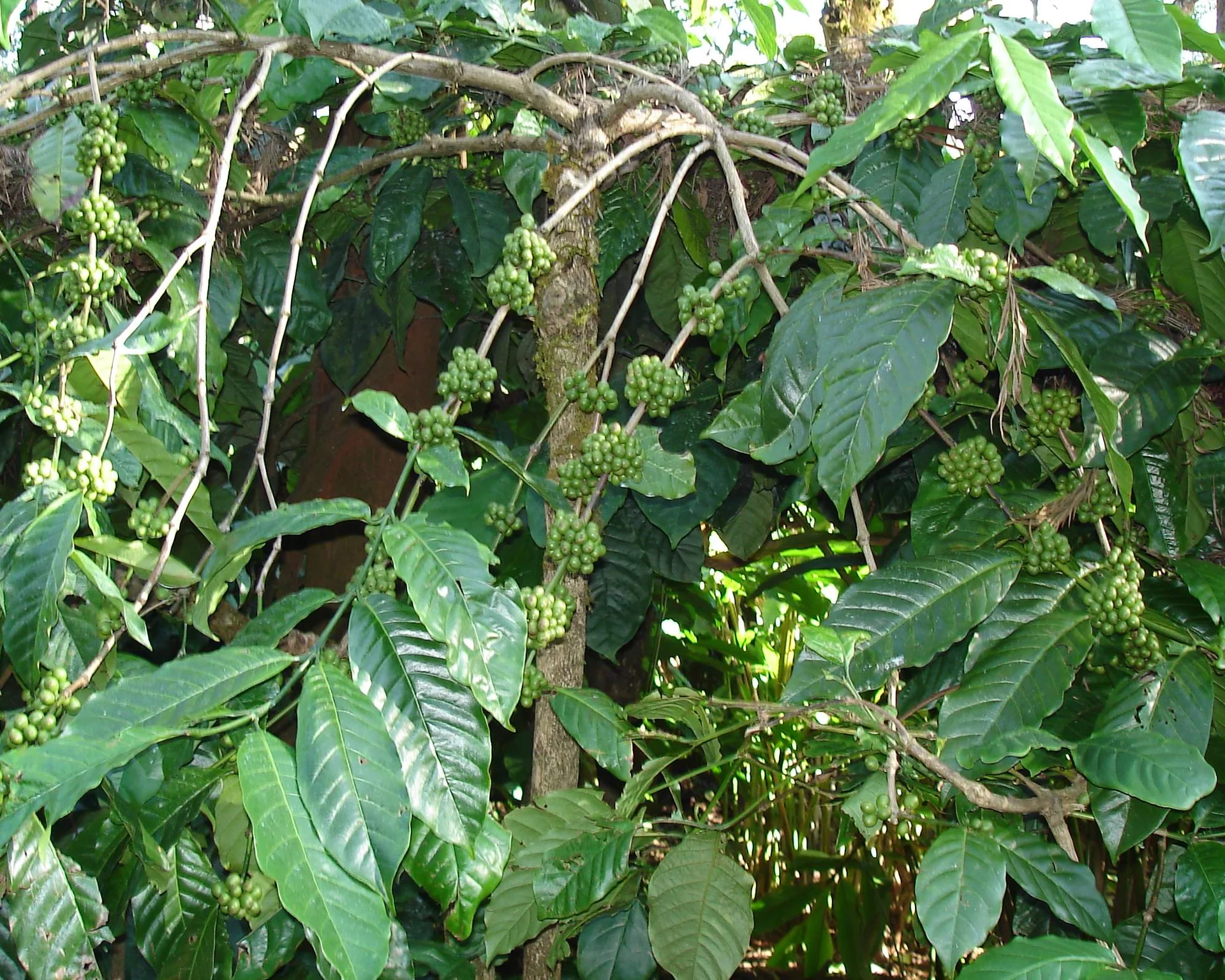
Gaurav Pant · CC BY-SA 3.0
- Days to maturity
- 270–330 days
- Row spacing
- 275 cm
- Plant spacing in the row
- 275 cm
These are general figures for the crop, compiled from published agronomic references including FAO and CABI. The right choice for your field depends on your soil, rainfall and the yield you are aiming for.
Will robusta coffee actually do well on your field? Check your own field against every crop in the catalogue — no signup. Run the crop check →
Also known as
Robusta coffee is also called Congo coffee.
- English
- Congo coffee
- French
- café robusta
- Luganda
- mmwanyi
- Portuguese
- café robusta, café-conilon
- Swahili
- kahawa
Working in buckets, bags or paces? The farming glossary turns the measures growers actually use into kilograms and hectares — what a 20 litre bucket of each crop really weighs, and how to size a field by walking it — alongside the Shona, Swahili, Ndebele and Yoruba words used in the field. Open the glossary →
Growing robusta coffee, stage by stage
Raise clean young trees, plant several different types together so they cross-pollinate, then each year feed, prune, beat coffee wilt and the berry borer, and pick and dry the ripe red cherries.
Raise clean young trees and prepare the site
Almost everything about your coffee plot is decided before the first tree goes in the ground — and you live with it for years. Here you raise strong, clean young trees (best of all from clones — cuttings from one chosen mother tree, so every plant is an identical, wilt-resistant copy), line up several different types that can pollinate each other, and prepare a deep, warm, well-drained lowland site. Get these right and the trees thrive for a decade or more; get them wrong and no amount of later care fully fixes it.
Root clonal cuttings / raise seedlings Critical
Your whole plot starts from these young trees, and each one will stand for years — so it pays to start with strong, clean stock. A clone is a cutting grown from one chosen mother tree, so every plant is an exact copy of a known wilt-resistant, heavy-bearing tree. Weak or diseased young trees set you back a long time. If you can't raise good ones yourself, buy from a trusted nursery.
Understand what a clone is: a cutting grown from one chosen mother tree, so all the young trees are identical copies of that single known-good tree. Clones beat seed here because they come out uniform and you can pick wilt-resistant types.
Take single-node cuttings from healthy, wilt-free mother trees: cut short pieces of young stem, each with one node (the knuckle on the stem where a leaf-pair grows) and one pair of leaves. Trim each leaf back by half so the cutting loses less water.
Set the cuttings in a shaded, damp rooting bed, or in poly-sleeves (small planting bags) of loose, clean soil. Keep them humid under a low frame covered with clear plastic, out of direct sun — roots form over a few weeks.
If you raise seedlings from seed instead, take seed from several different healthy mother trees (never just one), sow in a shaded nursery bed, then prick the young seedlings out into poly-sleeves.
Grow the young trees on in the shade and water regularly. Before planting out, harden them off — slowly cut back the shade and the watering over a couple of weeks so they toughen up. They are ready at about knee-height (about 45 cm) with several leaf-pairs — roughly 6-10 months in the nursery.
If the cuttings blacken and rot, or very few root: the wood was stressed, or the bed too wet or too sunny. Take fresh single-node cuttings from healthy shoots, give more shade, and keep them humid but never soaking.
- Do:
Take cuttings and seed only from healthy, wilt-free mother trees — coffee wilt can hide inside the planting material itself and travel straight to your new plot.
- Watch out:
Keep the nursery shaded and humid but never waterlogged — cuttings rot in soggy beds.
- Tip:
Raising a single type — you will need several different kinds to get berries later (see the next task).
Select several compatible clones Critical
This is the make-or-break rule of Robusta. A coffee flower cannot make a berry with its own pollen — it needs pollen from a different type. Plant just one type and you get plenty of flowers but almost no cherries. So you must choose several different, compatible kinds that flower at the same time. Get this wrong and the trees look healthy for years but never fill with fruit — and by then it is far too late to fix.
Know the rule: Robusta is self-incompatible — a flower will not set a berry with pollen from its own tree (or its clone-mates, which are identical copies of it). It needs pollen from a genetically different tree.
Choose at least 3-4 different compatible types (clones or seedling lines). Your nursery or dealer can name types that are known to go together.
Make sure they flower at the same time — pollen only helps if the neighbour is in flower when this tree is. Ask for types with overlapping flowering.
Plan to mix the types across the field (alternate them down the rows) so every tree has a different-type partner within bee-flying distance.
In the 2 months before you plant out, line up enough plants of each type for your whole field.
If you can only get one type: expect very few berries. Get at least one more different, same-flowering type before you plant — even a handful of seedlings — rather than plant a single clone alone.
- Do:
Mix at least 3-4 different types that flower together.
- Tip:
A solid block of one clone — identical trees can't pollinate each other, so the block stays nearly empty of cherries.
- Watch out:
What matters is 'compatible and flowering at the same time', not just 'looks a bit different'.
Prepare a deep, drained lowland site Recommended
Coffee roots run deep (about 1.5 m) and the tree stands in this one spot for many years, so the ground must be deep, loose and well-drained. Warm lowland (0-800 m) suits Robusta — it loves warmth and is hurt by cold. Prepare the site well now and the tree thrives for years; skimp and it never fully recovers.
Pick a warm, low site (0-800 m). Robusta grows best at 22-28 degrees C and is harmed by cold — it can be killed near 5 degrees C — so avoid frost-prone hollows.
Choose deep, well-drained loam (sandy loam, loam or clay loam). Avoid any spot where water sits after rain — coffee roots rot in waterlogged ground.
Coffee likes slightly sour soil (pH 5.0-6.5 is best). It survives from 4.0 to 8.0 but grows poorly at the extremes; add lime only if a soil test shows it is very sour.
In the 2 months before planting, clear the land and dig planting holes 2.5-3 m — about three strides — apart each way. Dig each hole about knee-deep (about 45 cm) and just as wide, and mix the topsoil back with well-rotted manure or compost.
On slopes, plant across the slope and dig the ground well, so the heavy rains (this is a wet crop — 1200-3000 mm a year) soak in instead of washing the soil away.
Where it is very hot and exposed, plan light shade (a few scattered shade trees) — young coffee does better with a little shade than in full, blazing sun.
- Do:
Dig and fill the planting holes with topsoil plus rotted manure ahead of time, so they settle before planting.
- Tip:
Low waterlogged spots and frost hollows — both slowly kill coffee.
- Watch out:
Set the holes a full 2.5-3 m (about three strides) apart now — you can never move a tree once it's in the ground.
Plant several types together and settle them in
This is when the young trees go into the ground — and you lock in for the life of the plot the two things you can't change later: several different types mixed together (so they cross-pollinate) and the 2.5-3 m spacing. After planting, mulch heavily, water in, feed lightly, and start a monthly watch for coffee wilt — the deadly one, with no cure — and the berry borer. Uproot and burn any wilt tree the moment you see it.
Plant several clones together + mulch Critical
This is the day you lock in your plot for years. Two things you cannot change afterwards: you must plant several different types mixed together (a single type sets almost no berries), and you must space them 2.5-3 m apart. Heavy mulch and a good watering-in now decide whether the young trees survive their first dry spell.
Plant at the start of the rains (the first week or two) so the young trees settle in with steady moisture.
Mix several different compatible types across the field — alternate the types along each row so every tree has a different-type neighbour within bee range. (A tree can't pollinate itself.)
Space the trees 2.5-3 m — about three strides — each way, one tree per hole (about 1350 trees fill a hectare).
Plant into the prepared holes at the same depth the tree grew in the nursery — don't bury the stem. Firm the soil gently around the roots and water in well.
Mulch heavily around each tree — a thick ring of dry grass or leaves to hold moisture and smother weeds — but keep the mulch a hand-span (about 20 cm) clear of the stem so the bark doesn't rot.
Give a little young-tree fertiliser after planting (see the young-tree NPK task), spread in a ring and kept off the stem.
If the rains fail and young trees wilt: water by bucket each week and thicken the mulch; replace any that die, keeping the same mix of types.
- Do:
Alternate the different types down the row so every tree has a pollen partner close by.
- Tip:
Planting a solid block of one clone — it will flower but barely fruit.
- Watch out:
Keep mulch a hand-span (about 20 cm) off the stem so it doesn't rot the bark or hide pests.
Scout (coffee wilt, borer) Critical
Coffee wilt disease has no cure — one infected tree can seed the whole plot, so you must find and destroy it early. A monthly walk also catches the berry borer and leaf spots before they spread. Ten minutes a month protects trees that take years to replace.
From about a month after planting, walk the whole plot once a month (every 4-5 weeks).
Coffee wilt: look for a whole tree — or one side of it — suddenly wilting and yellowing, with the dead leaves hanging on instead of dropping. Peel a little bark: dark brown or blue-black streaks in the wood (the tree's water pipes) confirm it. Mark that tree and go straight to the wilt-sanitation task.
Berry borer (once the trees carry cherries): look for a tiny round hole at the crown (blossom) end of green or ripe cherries — the end away from the stalk — sometimes with fine 'sawdust'. Hang funnel traps baited with a methanol-and-ethanol mix (both are types of alcohol) to catch the flying beetles.
Leaf spot (brown-eye): brown spots on the leaves and berries with a pale grey centre and a yellow ring — like an eye.
Root-knot nematode (a tiny soil worm): if young trees stay stunted and yellow for no clear reason, dig gently beside one and look for knobbly swellings on the roots.
Note what you saw and where, so you can act on the matching task.
- Do:
Flame or disinfect your knife or panga between trees — coffee wilt spreads on dirty tools.
- Watch out:
A tree that wilts but keeps its dead leaves hanging on (not just gone dry from drought) is the classic coffee-wilt sign — check the wood under the bark.
Young-tree NPK Recommended
In its first year a young coffee tree is building the roots and frame that will carry cherries for years. Small, regular feeds of a balanced NPK (nitrogen, phosphorus and potassium — the three main plant foods) grow it strong and even; starve it now and it bears late and light. Little and often beats one big dose.
Start feeding from about 3 months after planting (once the tree has taken hold), and repeat every 3-4 months through the first year.
Use a balanced compound (roughly equal parts N, P and K). Your recommendation gives the exact amount — as a rough guide, about a small handful (a matchbox-full) per young tree.
Spread it in a ring around the tree, out at the drip line — the circle on the ground under the outer leaves, where rain drips off the canopy; that's where the hungry feeding roots are — not against the stem.
Feed onto moist soil (after rain or watering) and cover it lightly with soil or mulch so it isn't wasted.
Safety: wash your hands afterwards; keep fertiliser off wet leaves, out of streams and drinking water, and away from food and children.
- Do:
Feed in a ring at the drip line, where the feeding roots are — not piled against the stem.
- Tip:
A single big dose — young roots scorch. Split it into small feeds every few months.
- Watch out:
Keep fertiliser off the stem and off wet leaves so it doesn't burn them.
Build the frame, prune, and stop coffee wilt
Now the young trees build their bearing frame. You train each to 2-3 strong stems while it's young, then once a year renew tired old wood by cutting it back, so fresh bearing wood keeps coming. Keep feeding and weeding. Above all: coffee wilt has no cure — resistant clones plus ruthless sanitation (uproot and burn) are your only defence.
Scout (coffee wilt, leaf spot) Critical
Coffee wilt can strike a growing tree at any time, and no spray will save an infected one — your only weapon is spotting it fast and destroying it before it spreads down the row. The same monthly walk catches leaf spot early, while feeding and shade can still fix it.
From about 6 months after planting, walk the whole plot once a month.
Coffee wilt: a whole tree, or one branch or one side, wilts and yellows while the dead leaves stay hanging on; under the bark the wood shows dark brown or blue-black streaks. Treat any such tree as wilt — mark it and go straight to wilt-sanitation.
Brown-eye / leaf spot: brown spots on the leaves with a pale grey centre and a yellow ring (like an eye), worst on hungry, unshaded or waterlogged trees. Improve feeding, shade and drainage, and rake up the worst fallen leaves.
Check that the new growth is healthy and green — pale, hungry leaves mean it's time to feed.
- Do:
Flame or disinfect (in a flame, or in bleach) your cutting tools between trees — coffee wilt rides from tree to tree on dirty blades and moved cuttings.
- Watch out:
One wilting tree is an emergency, not a wait-and-see — the longer it stands, the more trees it takes with it.
- Tip:
Pruning a healthy tree with the same blade you just used on a suspect one.
Coffee-wilt sanitation Critical
Coffee wilt disease (a fungus that blocks the tree's water pipes) kills the tree and spreads through the soil, touching roots, and dirty tools. There is no cure and no spray. The only way to save the rest of your plot is to remove and burn every sick tree at once and stop it moving. One tree left standing can cost you a whole row.
The moment a tree shows wilt (whole-tree or one-sided wilting plus dark streaks in the wood), act — don't wait.
Uproot the whole tree, roots and all, and burn it on the spot. Don't drag it across the plot (that scatters the spores), and never keep it as firewood or mulch.
Flame or disinfect every tool (panga, hoe) you used — and your hands — before you touch a healthy tree.
Dig out and burn as much of the root as you can, then leave that hole empty — fallow, meaning unplanted — for 6-12 months. Don't replant coffee in the same spot straight away.
When you do replant, use only wilt-resistant clones and clean nursery stock.
If it keeps spreading: widen the gap — remove neighbouring trees as soon as they start wilting too, keep every tool flamed, and stop moving any coffee material around the plot.
- Do:
Burn the sick tree where it stands — carrying it out spreads the disease.
- Tip:
Replanting coffee in the same hole right away, or using wilt wood as mulch or firewood near coffee.
- Watch out:
Prevention is the only real cure — plant only resistant clones from a trusted nursery.
Formative + cycle pruning Recommended
Coffee bears best on young wood. Training a young tree to 2-3 strong stems builds an open, easy-to-manage frame; then renewing tired old stems each cycle keeps fresh bearing wood coming and stops the yield fading. Skip pruning and the tree grows tall, tangled and shy-bearing, with the cherries out of reach.
Formative training (young trees, from about 6 months): keep 2-3 strong upright stems per tree and rub or cut off the rest, so the tree grows an open frame of a few main stems. (Some growers bend or cap the single stem to force these stems up.)
Each year, cut out dead, weak, crossing and diseased branches and any low suckers (side shoots low on the trunk), to let light and air into the tree.
Change-of-cycle (stumping) on older trees: when a main stem gets old and bears poorly, cut it right back near the base to force fresh young shoots. Bring on a few of these new shoots and, over several cycles, renew the whole tree.
Do the hard cutting after harvest / at the start of the wet season, so the fresh shoots grow away strongly.
Burn or carry off the prunings — especially any dry old berries on them — to deny the berry borer a home.
- Do:
Keep only 2-3 strong stems and take the rest — an open tree bears better and is easier to pick and spray.
- Watch out:
Flame or disinfect the saw or panga between trees — every pruning cut is a doorway for coffee wilt.
- Tip:
Leaving old dry berries and prunings lying about — they shelter the berry borer into next season.
Flowering — get the cross-pollination right
A dry spell followed by rain triggers the trees to burst into white flowers, often all at once. Now the cross-pollination you planned pays off: several different types must be flowering together so they can trade pollen, and bees must be there to carry it. Don't let the trees go thirsty now, and never spray anything that kills bees while the flowers are open.
Ensure synchronous clones + bees Critical
This is where 'several types' turns into berries — or doesn't. Robusta flowers cannot fertilise themselves; a flower only sets a berry if pollen from a different type reaches it, carried mostly by bees. If your types don't flower together, or the bees are missing (killed by spray), the flowers drop and the branches stay bare. Poor pollination is the biggest yield risk of the whole year.
After the first rains break a dry spell, the trees flower — often heavily and all together, over roughly the first 3 weeks of the flowering season.
Check that your different types are flowering at the same time. This overlap is what lets them pollinate each other.
Protect the bees — they do the pollinating for free. Do not spray any insecticide (bug-killer) on open flowers; if a pest must be controlled, wait until flowering is over.
Keep some flowering plants or hedges around the plot so bees stay nearby.
Keep the trees watered through flowering — thirsty trees drop their flowers before they can set.
If one type flowers well but its partners don't (or set is poor): note which types don't line up, and at the next planting fill in with types that flower together. This year, just make sure nothing kills the bees.
- Do:
Leave the bees alone at flowering — they're doing your most important job for free.
- Tip:
Any insecticide on open flowers — it kills the pollinators, and the crop with them.
- Watch out:
Lots of flowers but few tiny berries a few weeks later means pollination failed — check your type mix and your bees.
Scout (antestia/capsids) Recommended
The antestia bug (a shield-shaped bug) feeds on flowers and young berries — it makes flowers abort (drop before setting) and berries rot or turn into spoiled 'zebra' beans (beans with pale stripes) that fetch a low price. Caught early on its threshold, a careful spot-spray saves the crop; missed, it quietly eats your set.
Through flowering and early berry set, check the trees twice a week (every 5-7 days).
Antestia: a brown, shield-shaped bug with pale markings on flowers, shoots and green berries; it gives off a strong smell when disturbed. Also watch for capsid bugs (soft green or brown bugs) causing dark, sunken spots on shoots and berries.
Tap a branch over a cloth or open lid and count the bugs that fall; check several trees right across the whole plot.
Only if numbers pass the threshold (a few bugs per tree — follow your local advice), spot-spray just the affected trees with a recommended insecticide — after flowering, never on open flowers full of bees.
Spray safety: cover your skin, eyes and nose; spray in the cool of the day with the wind at your back; keep off food and water; respect the pre-harvest interval (the number of days you must wait after spraying before you may pick, so no poison is left on the cherries); and wash yourself and the sprayer afterwards.
- Do:
Scout several trees right across the plot, not just the row by the path.
- Tip:
Spraying open flowers — wait until the petals drop so you don't kill the bees.
- Watch out:
A strong bad smell when you disturb the bush is a giveaway that antestia bugs are there.
Fill the berries and beat the borer
From flowering, the green berries take about 9-11 months to ripen (longer than Arabica), so this is a long haul. Keep the moisture even and feed potassium (K) — the nutrient that fills and plumps the beans. And this is the borer's season: the coffee berry borer drills into the cherries and ruins the beans, so scout with traps and clear away every leftover berry.
Scout (berry borer) Critical
The coffee berry borer is the worst pest of Robusta — a tiny beetle that drills into the cherry and eats the bean inside, and once it's in, no spray reaches it. Weekly scouting with traps catches the flight early, so you can trap and sanitise before it ruins your crop and your price.
From flowering right through berry fill, walk the plot weekly (every 7-10 days).
Berry borer: look for a tiny round hole at the crown (blossom) end of green and ripening cherries — the end away from the stalk — sometimes with fine 'sawdust' at the hole. Split a few suspect cherries: you may find the tiny black beetle and its grubs in the seed.
Hang funnel traps baited with a methanol-and-ethanol (alcohol) mix among the trees; rising catches warn you the beetles are flying and it's time to tighten sanitation.
Coffee leaf rust: also watch for orange-yellow powdery patches on the underside of the leaves and early leaf drop. Robusta shrugs rust off better than Arabica, but note it and keep the trees well-fed and open.
Keep a note of trap catches and holed cherries so you can act on the sanitation task.
- Do:
Keep the traps topped up and hung among the bushes through the whole berry season.
- Watch out:
A hole at the blossom (crown) end of the cherry is the borer; a hole at the stalk end is usually something else.
- Tip:
Leaving holed or dropped cherries on the tree or ground — each one breeds the next wave.
Berry-borer sanitation Recommended
The berry borer survives from one season to the next inside leftover cherries — dry berries left on the tree or fallen on the ground. Stripping and destroying them starves the pest, and it's the single most effective no-chemical way to keep borer numbers down. Skip it and you hand next season's crop straight to the beetle.
Every month or so through the season, strip the trees of any leftover, over-ripe, dried ('mummified') and holed cherries.
Pick up the fallen cherries from the ground under the trees too — the beetle breeds in these.
Destroy what you collect: burn it, bury it deep, or soak it in hot or soapy water — don't just heap it at the plot edge.
Do a thorough clean-up strip right after the main harvest, so no cherries carry the borer into next season.
If you use a biocontrol — Beauveria, a natural fungus that infects and kills the beetle — apply it as advised, alongside sanitation, not instead of it.
- Do:
Clean up fallen and leftover cherries after every picking round.
- Tip:
Heaping stripped cherries at the plot edge — the beetles just fly back in. Burn or bury them.
- Watch out:
A single un-stripped tree can re-seed the whole plot next year.
K feed Recommended
Filling berries pull hard on potassium (K) — coffee is especially hungry for it. Short of K, berries stay small and light with pale, poorly-filled beans and scorched leaf edges. Feeding potassium while the berries fill puts weight and quality into the beans you'll sell. (At fruiting, coffee actually takes up more potassium than nitrogen.)
Feed potassium during berry fill — from flowering through the main filling months, every 2-3 months.
Use a potassium fertiliser such as muriate of potash (MOP). Your recommendation gives the exact amount — as a guide, spread about a handful in a ring around each tree.
Spread it in a ring at the drip line (the edge of the leaf canopy, where the feeding roots are), onto moist soil, and cover it lightly with soil or mulch.
Don't pile it against the stem, and keep it off wet leaves.
Safety: wash your hands afterwards; keep fertiliser out of streams and drinking water and away from food and children.
- Do:
Split the potassium into a couple of feeds through the filling season rather than one big dose.
- Watch out:
Pale, thin, poorly-filled beans and scorched leaf edges can mean the trees are short of potassium.
- Tip:
Dumping it against the trunk or on wet leaves — feed in a ring at the drip line.
Pick the ripe red cherries
About 9-11 months after flowering the cherries ripen — but not all at once. Because the trees flowered in flushes, the cherries ripen in waves, so you pick selectively over several rounds, taking only the fully ripe cherries each time (deep red, or yellow on yellow types). Ripe, evenly-coloured, firm and glossy cherries make the best beans and the best price.
Pick ripe cherries Critical
Only fully ripe cherries make good, heavy beans and top price — green ones are light and bitter, and over-ripe or dried ones breed the borer. Because the crop ripens in waves, picking selectively every week or two, round after round, is how you get quality and quantity both.
Start picking at about 9 months after flowering, when the cherries are fully and evenly coloured — deep red (or yellow on yellow types), firm and glossy.
Pick selectively: take only the ripe cherries and leave the green ones to ripen for the next round. Roll each ripe cherry off with your fingers; don't strip the whole branch.
Go round again every 10-14 days as more cherries ripen — several rounds across the season.
On each round, also pick off any dried, over-ripe or holed cherries, keep them separate, and destroy them (berry-borer sanitation) — don't drop them under the tree.
Put the picked cherries in clean bags or baskets and get them to drying the same day (see the sun-dry and hull task).
If cherries are still green or part-coloured, or squash softly when pressed: they're not ready. Leave them and come back in a week or two — stripping a branch of unripe cherries to save a trip costs you weight and price.
- Do:
Pick only the fully red/ripe cherries each round — selective picking is what makes the price.
- Tip:
Strip-picking whole branches (ripe and green together) — the green ones drag down your quality and price.
- Watch out:
Take the dried and holed cherries off the tree as you go — they carry the borer into next season.
Dry the cherries and hull the beans
Robusta is usually dry-processed (called 'natural'): you sun-dry the whole cherries — skin, pulp and all — turning them until they are hard and dry (about 11-12% moisture), then hull off the dried covering to free the beans. Dry them well and hull clean, and the beans store and sell well; leave them damp and they go mouldy and get rejected.
Sun-dry whole cherries + hull Recommended
Beans dried too little go mouldy and can be rejected at market; dried and hulled well, they keep for months and fetch a fair price. Careful, even drying on clean beds — never bare ground — is what protects the value of everything you grew this year.
Spread the whole ripe cherries in a thin layer on raised drying beds or clean tarpaulins / mats — never on bare ground, which pushes damp and dirt back in.
Turn them several times a day so they dry evenly, and rake them into a heap and cover them at night and whenever rain threatens.
Dry until the cherries are hard and rattle — about 11-12% moisture. A well-dried cherry is hard, the bean loose and rattling inside, and it no longer dents when you press it.
Then hull the dry cherries — crack them open with a pestle-and-mortar or a hand huller to break off the dried skin, pulp and the parchment (the thin papery skin around the bean) and free the clean beans.
Store the hulled beans dry, clean and off the floor in a cool, airy place; winnow out the dust and any broken or black beans first.
If the cherries still feel soft, bendy or leathery, or the bean squashes: they're too wet to store. Keep drying and turning, and don't bag them until they're hard and rattling, or they'll mould.
- Tip:
Storing damp beans — dry to hard-and-rattling (about 11-12%) first, or they mould and get rejected.
- Do:
Dry on raised beds or tarpaulins, turning often — never on bare ground.
- Watch out:
Cover the cherries at night and against rain — re-wetting causes mould and uneven colour.
Pests and diseases that attack robusta coffee


Where to sell robusta coffee
Markets that trade this crop — what each one sells it by, when supply peaks there, and the currency used.

Grow robusta coffee with a plan, not a guess
This guide is the general answer. Divisi works out yours — the week to plant robusta coffee on your soil and your rainfall, and each job dated for your field.


When to plant robusta coffee, country by country
- When to plant robusta coffee in Angola
- When to plant robusta coffee in Benin
- When to plant robusta coffee in Burkina Faso
- When to plant robusta coffee in Burundi
- When to plant robusta coffee in Cabo Verde
- When to plant robusta coffee in Cameroon
- When to plant robusta coffee in Comores
- When to plant robusta coffee in Congo
- When to plant robusta coffee in Côte d'Ivoire
- When to plant robusta coffee in Egypt
- When to plant robusta coffee in Eritrea
- When to plant robusta coffee in Ethiopia
- When to plant robusta coffee in Gabon
- When to plant robusta coffee in Gambia
- When to plant robusta coffee in Ghana
- When to plant robusta coffee in Guinea Ecuatorial
- When to plant robusta coffee in Guinea-Bissau
- When to plant robusta coffee in Guinée
- When to plant robusta coffee in Kenya
- When to plant robusta coffee in Liberia
- When to plant robusta coffee in Madagascar
- When to plant robusta coffee in Malawi
- When to plant robusta coffee in Mali
- When to plant robusta coffee in Mauritanie
- When to plant robusta coffee in Mauritius
- When to plant robusta coffee in Moçambique
- When to plant robusta coffee in Namibia
- When to plant robusta coffee in Niger
- When to plant robusta coffee in Nigeria
- When to plant robusta coffee in Rwanda
- When to plant robusta coffee in République centrafricaine
- When to plant robusta coffee in République démocratique du Congo
- When to plant robusta coffee in Sao Tome and Principe
- When to plant robusta coffee in Seychelles
- When to plant robusta coffee in Sierra Leone
- When to plant robusta coffee in Somalia
- When to plant robusta coffee in South Africa
- When to plant robusta coffee in South Sudan
- When to plant robusta coffee in Sudan
- When to plant robusta coffee in Sénégal
- When to plant robusta coffee in Tchad
- When to plant robusta coffee in Togo
- When to plant robusta coffee in Uganda
- When to plant robusta coffee in United Republic of Tanzania
- When to plant robusta coffee in Zambia
- When to plant robusta coffee in Zimbabwe
Where robusta coffee scores best
Districts where Divisi's engine currently rates this crop highest, ranked by fit.
-
 Gisagara
 -
 Maquela do Zombo
 -
 Lower Jloh
 -
 Inongo
 -
 Zanaga
 -
 Muleba
 -
 Tsamba-Magotsi
 -
 Mahanoro
 -
 Bomachoge Chache
 -
 Nsok-Nsomo
 -
 East Mahe
 -
 Bushenyi
Get Insights by email
A short digest of new Divisi articles. No email on quiet weeks.
Frequently asked questions
How do I grow robusta coffee?
How to grow robusta coffee: 270–330 days to maturity, 275 cm rows. Also called Congo coffee, café robusta, mmwanyi, café-conilon, kahawa.
What is café robusta in English?
Café robusta (also café-conilon) is the French and Portuguese name for robusta coffee.
What is mmwanyi in English?
Mmwanyi is the Luganda name for robusta coffee.
What is kahawa in English?
Kahawa is the Swahili name for robusta coffee.
How long does robusta coffee take to grow?
Robusta coffee takes about 270–330 days from sowing to maturity, though the exact length varies with variety, temperature and how the season runs.
What spacing should I use for robusta coffee?
Space robusta coffee rows about 275 cm apart, with roughly 275 cm between plants within the row.
What pests and diseases attack robusta coffee?
The ones covered in this guide are Antestia bug, Brown eye spot, Coffee berry borer. Each has its own page explaining how to identify, check for and control it.