 Divisi
Coffee leaf rust
Hemileia vastatrix · Fungal
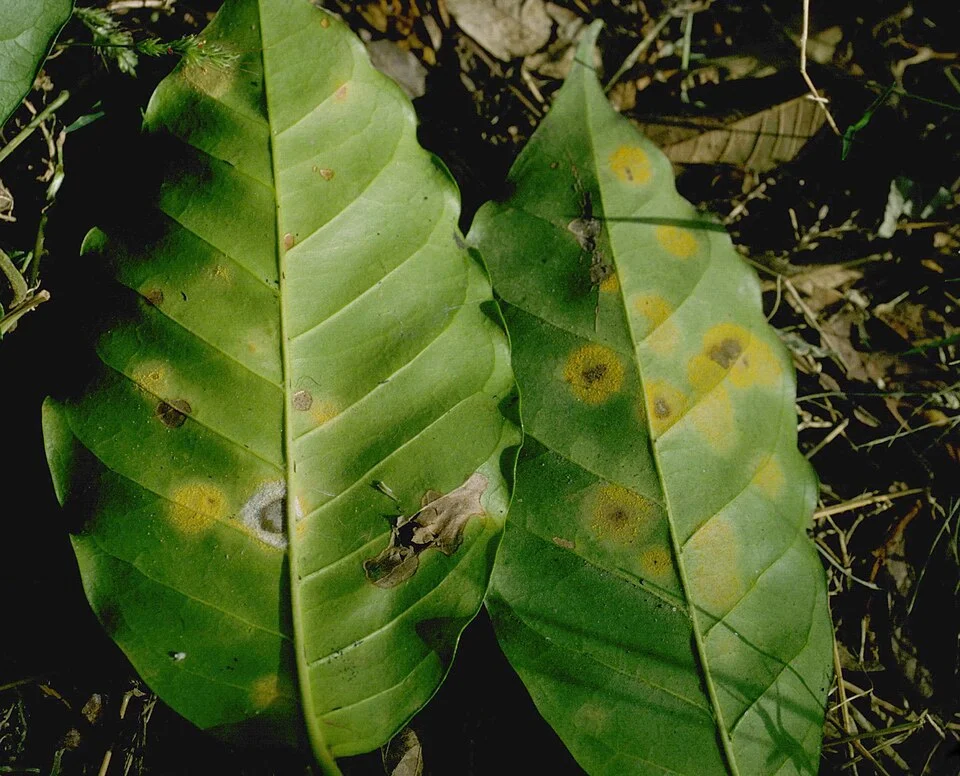
Photo: Howard F. Schwartz · CC BY 3.0 us
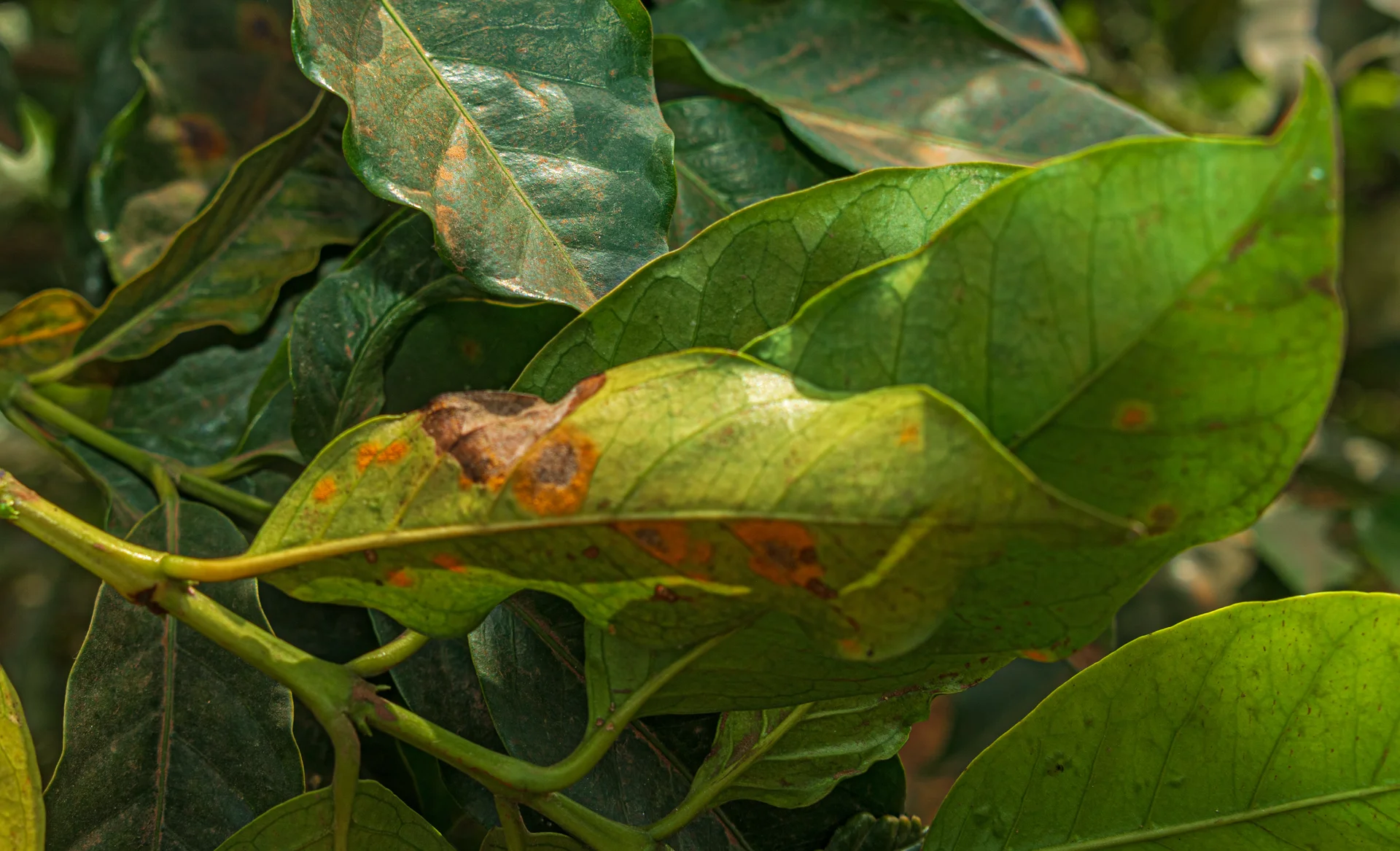
Coffee leaf rust, caused by the fungus Hemileia vastatrix, is the most damaging disease of coffee worldwide. It infects the underside of the leaves: spores need a film of water (rain or dew) to germinate and slip in through the tiny leaf pores, then throw up orange, powdery spore masses that spread on wind, rain splash, and on the hands, clothes and animals that move through wet bushes. Heavy infection strips the bush of its leaves, so it cannot fill this year's cherries or build next year's crop.
Daniel Case · CC BY-SA 4.0 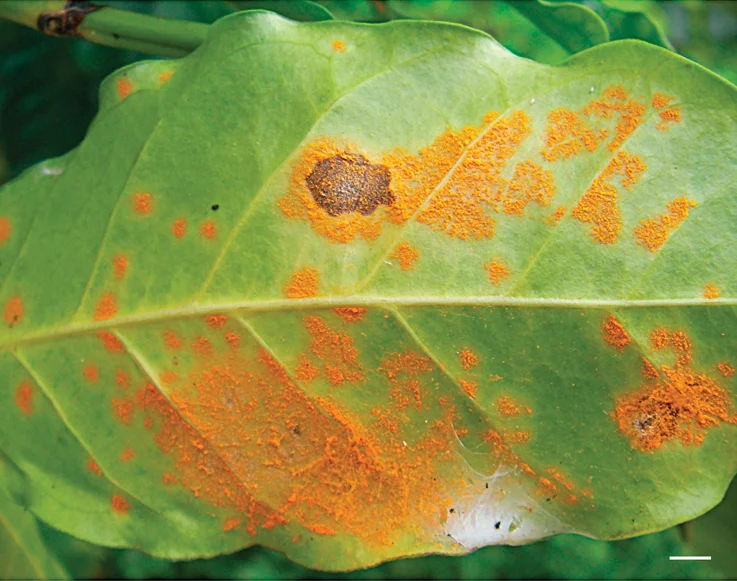
Carvalho et al. · CC BY 2.5
Why it matters
Coffee leaf rust is the most serious disease your coffee will face. It attacks the leaves and makes the bush drop them, and a bush with no leaves cannot fill its cherries this year or carry a good crop next year — a heavy outbreak can take up to 70% of your harvest. The hard part is that once the leaves are covered in orange spots and falling, no spray can bring them back — copper only shields the leaves that are still healthy. So everything depends on spotting the very first spots and acting before it spreads through the bush.
When to act
First yellow-orange powdery spots on lower leaves, especially on heavily bearing bushes going into the rains.
This guidance is general, compiled from published agronomic references including FAO and CABI. Thresholds and timing shift with your crop, your variety and the season.
In much of the region a spray is simply called mushonga — medicine. But a chemical group you cannot name is one you cannot rotate, and a product you did not write down has no pre-harvest interval you can observe. Mushonga, and other farming words →
The full Coffee leaf rust field guide
Identify it
First sign
on the older, lower leaves you'll see small pale-yellow, oily-looking spots, round like little coins. Hold the leaf up to the light and each spot looks see-through, like a small window in the leaf.
The clincher — turn the leaf over:
underneath those spots sits a bright orange-yellow powder, the colour of rust or turmeric, that rubs off on your finger. That powder is the fungus's spores (its dust-fine seeds), and nothing else on coffee looks like it — this is how you know for sure it is rust.
As it spreads
the spots grow and join up, their centres dry to brown, dead patches, and the leaf falls off. A badly hit bush is left with bare branches and dying twigs (dieback — the twig-tips going brown and dead), carrying small, poorly-filled cherries.
Don't confuse it with
brown eye spot (brown blotches with a pale grey "eye" in the middle and no orange powder underneath); plain hunger yellowing from a poorly-fed bush (the whole leaf yellows evenly, with no spots and no powder); or black sooty mould (a black soot that wipes off the top of the leaf). The orange powder on the underside is what makes it rust, and nothing else.
Scout for it
When
start checking as soon as the rains begin and keep going right through the wet months, all the way to harvest — this whole time the bush is carrying and filling its crop, and the leaves stay wet long enough for rust to get in. Watch hardest the bushes carrying a heavy crop, because a big crop drains the bush and rust hits those worst.
How to walk it
walk a big "W" shape through the block so you cover all four corners and the middle — not just the edge row by the path. Stop at about 10 bushes along the way.
What to check
at each bush, look at the lower and middle leaves first, because rust starts low and climbs. Turn several leaves over and check the underside for the orange powder — that is where it shows first, not on top.
When to act
the moment you find those first orange spots — even 1 or 2 spotted leaves in every 10 you turn over — on bushes heavy with a crop as the rains set in, start control now. Don't wait for it to spread: copper only protects the leaves that are still clean, so early is everything.
Control it
Prevent
-
plant resistant bushes (your strongest tool):
where you can choose new plants or replant, grow rust-resistant coffee varieties (such as the catimor / sarchimor types, Ruiru 11 or Batian, where they suit your area). A resistant bush shrugs off most attacks with no spraying at all — this is the cheapest, longest-lasting protection you have, which is why it beats every spray.
-
open up and feed the bush:
rust loves a wet, crowded, shady canopy because the leaves stay wet. Prune the bush and thin heavy shade so air moves through and the leaves dry quickly after rain. Feed and mulch your bushes to keep them strong — a well-fed bush resists rust, and easing the every-other-year over-bearing (a huge crop one year that drains the bush and leaves it weak) stops it crashing. Don't let bushes grow into each other.
Act early — and don't spread it yourself:
rust spores travel on wet hands, clothes and tools, so work your rusted bushes last, and avoid brushing through the bushes while the leaves are still wet. The moment scouting shows those first spots, begin your copper spray rounds (below) — early, while most of the canopy is still clean.
Copper spray
-
how it works:
copper is a protectant — it coats the leaf like a shield and stops new spores from getting in, but it cannot cure a spot already growing or bring a dropped leaf back. So it only works if you put it on early and keep topping it up: start at the beginning of the rains / at the first spots, and repeat through the wet season, because rain washes it off and fresh leaves grow up unprotected.
-
safety:
before you spray, cover your skin, eyes, nose and mouth. Spray in the cool of the day (early morning or evening) with the wind behind you so the mist blows away from your face. Keep spray off food, drinking water, children and bees. Respect the pre-harvest interval — the waiting time on the label between your last spray and picking — so no chemical ends up on the cherries you sell or drink, and wash yourself and your clothes afterwards. If you ever step up to a stronger systemic fungicide (one that soaks into the leaf and can knock back a fresh infection, unlike copper which only sits on top), rotate between different chemical groups so the fungus never gets used to one and stops responding to it (that is resistance).
If it keeps spreading — and when it's too late:
if new spots keep coming, keep the copper rounds going on schedule and prune harder to dry the canopy — a gap in spraying during the rains is usually why rust gets away. But don't waste spray on a bush that has already dropped most of its leaves; copper can't help bare wood. Instead, cut out the dead, bare twigs, feed and mulch hard so the bush pushes fresh healthy leaves, accept this season's loss on the worst bushes, and plan to replace them with resistant varieties. Protect the clean bushes and write off the ones too far gone.
Catch Coffee leaf rust before it costs you the harvest
This guide is the general answer. Divisi works out yours — the week to scout your own field for Coffee leaf rust, and what to do the day you find it.


Crops it affects
Plan the crops it attacks


All planting calendars, country by country
Get Insights by email
A short digest of new Divisi articles. No email on quiet weeks.
Frequently asked questions
How do I identify Coffee leaf rust?
First sign. on the older, lower leaves you'll see small pale-yellow, oily-looking spots, round like little coins. Hold the leaf up to the light and each spot looks see-through, like a small window in the leaf.
When should I take action against Coffee leaf rust?
First yellow-orange powdery spots on lower leaves, especially on heavily bearing bushes going into the rains.
How do I control Coffee leaf rust?
Prevent — plant resistant bushes (your strongest tool):. where you can choose new plants or replant, grow rust-resistant coffee varieties (such as the catimor / sarchimor types, Ruiru 11 or Batian, where they suit your area). A resistant bush shrugs off most attacks with no spraying at all — this is the cheapest, longest-lasting protection you have, which is why it beats every spray.
Which crops are attacked by Coffee leaf rust?
Among the crops covered here: Arabica coffee, Robusta coffee.