 Divisi
Groundnut leaf spot
Passalora personata · Fungal
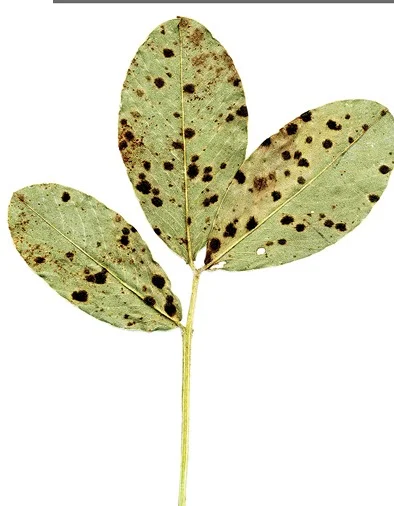
Groundnut leaf spot is a fungal leaf disease of groundnut caused by two close cousins — early leaf spot (Cercospora arachidicola) and late leaf spot (Passalora personata). The fungus lives on last season's groundnut trash and spreads on wind and rain-splash. Spots kill the leaf tissue and knock the leaves off the plant during pod-filling, so the pods stay small and the haulm (the leafy vine you feed to livestock) is ruined. Late leaf spot is usually the worse of the two.
Why it matters
Groundnut leaf spot can strip the leaves off your plants right when the pods are filling, and a bad attack can take half your crop (up to 50%) — smaller pods, fewer kernels, and vines too bare to feed your animals. It matters because the leaves are the engine that fills the pods: lose them early and the pods never fatten. It is hard to fix once it takes hold — the spots are already killing leaves before you notice, the spores spread fast in wet weather, and by the time the plant is half bare there is little you can do. The win is to break the cycle before planting and to catch the first spots early.
When to act
First spots appearing on lower leaves during pod fill, especially after a wet spell in a continuous-groundnut field.
This guidance is general, compiled from published agronomic references including FAO and CABI. Thresholds and timing shift with your crop, your variety and the season.
In much of the region a spray is simply called mushonga — medicine. But a chemical group you cannot name is one you cannot rotate, and a product you did not write down has no pre-harvest interval you can observe. Mushonga, and other farming words →
The full Groundnut leaf spot field guide
Identify it
The damage you see first
small round spots on the lower, older leaves — the leaflets near the ground yellow, then dry up and drop off, so the plant goes bare from the bottom upward. In a bad year the vines look half-stripped by pod-fill.
The spots up close
roughly circular spots the size of a pin-head to a small seed, brown to nearly black, often ringed by a yellow halo (a soft yellow glow around the spot). Turn the leaflet over: late leaf spot shows dark, rough spots with a dusty grey-black mould on the underside (that dust is the spores); early leaf spot spots are a bit lighter, more reddish-brown, with the halo more obvious on top.
Where and when
always starts low and old — the bottom leaves — and climbs upward as it spreads. Worst in warm, damp, dewy weather and in fields where you grew groundnut last season too.
Don't confuse it with
groundnut rust, which makes orange-brown powdery bumps (pustules) that burst on the underside and rub off orange on your finger — leaf spot spots do not rub off orange. Also not the same as plain leaf yellowing from hunger (nutrient shortage), which yellows evenly with no distinct dark round spots. If you see clear dark rings with a yellow halo, and lower leaves dropping, it is leaf spot.
Scout for it
When to look
start walking the field from about 4 to 6 weeks after the plants come up, through the flowering, pegging and pod-filling stretch — that is when the disease bites hardest and defoliation costs you pods. Check once a week, and always after a wet or dewy spell, when the fungus spreads fastest.
How to walk it
cross the field in a big "W" so you cover all four corners and the middle — not just the row by the path. Make about 10 stops along the W.
What to check at each stop
bend down and look at the lower, older leaves of a few plants. Turn a leaflet over to check the underside for the dusty grey-black mould of late leaf spot. Note how many leaves carry spots and whether lower leaves are already yellowing or dropping.
The number that means act
the trigger is the very first spots showing up on the lower leaves during pod-fill — as a plain count, if you find spots on even 1 in 10 of the plants you check, especially after a wet spell in a field that grew groundnut last season, treat that as your signal to act now. Don't wait for the whole field to spot up — by then the leaves are already falling.
Control it
Prevent it first — break the cycle (your strongest, cheapest tools):
Rotate — grow a cereal like maize, sorghum or millet on that land for at least two seasons before groundnut returns, so the fungus in the old trash starves out (rotation = not growing the same crop on the same land year after year). Never plant groundnut straight after groundnut.
Clean up the source
after harvest, plough down or gather and burn the old groundnut haulms (the leafy vines) where the spores overwinter, and pull out any volunteer groundnut (self-sown plants from last year) that carries the fungus into the new crop.
Start clean and give air
plant certified clean seed and choose a tolerant/resistant variety bred to slow leaf spot where you can get one — this alone cuts a big share of the damage. Avoid over-thick stands: a crowded canopy stays wet longer and the fungus loves that, so keep to the recommended spacing so leaves dry off after dew and rain.
Act early if spots appear
these fungal controls don't cure dead leaves — they protect the healthy ones still on the plant, so start at the very first spots, not when the plant is half bare. Prioritise the non-chemical steps above; on their own the tolerant variety plus good rotation and sanitation carry most of the load.
Chemical — LAST resort, fungicide:
on a high-value crop, from the first spots, spray a fungicide (a plant-disease spray — the recommended one is a chlorothalonil-type contact/protectant that coats the leaf surface, or a triazole systemic that moves inside the leaf), repeating every 2 to 3 weeks through pod-fill. Safety: cover your skin, eyes, nose and mouth; spray in the cool of morning or evening with the wind at your back; keep it off food, drinking water, children and grazing animals; respect the pre-harvest interval (the number of days you must wait between the last spray and lifting the crop) on the label; and wash yourself and your clothes after. Resistance: don't spray the same product every time — rotate between different fungicide groups so the fungus doesn't learn to survive it.
If it keeps spreading →
re-check that you started early enough and covered the undersides of the lower leaves; a wet spell can outpace one spray, so tighten to the shorter end of the spray interval and rotate to a different fungicide group. When it's too late — the plant is already stripped bare from the base up → stop spending on sprays, because bare leaves won't come back this season. Harvest promptly before the weakened pegs rot and pods drop in the soil, keep the least-diseased vines for haulm, and plan next season now: a clean rotation, a tolerant variety and buried trash so you don't carry the disease forward.
Catch Groundnut leaf spot before it costs you the harvest
This guide is the general answer. Divisi works out yours — the week to scout your own field for Groundnut leaf spot, and what to do the day you find it.


Crops it affects
Plan the crops it attacks

All planting calendars, country by country
Get Insights by email
A short digest of new Divisi articles. No email on quiet weeks.
Frequently asked questions
How do I identify Groundnut leaf spot?
The damage you see first. small round spots on the lower, older leaves — the leaflets near the ground yellow, then dry up and drop off, so the plant goes bare from the bottom upward. In a bad year the vines look half-stripped by pod-fill.
When should I take action against Groundnut leaf spot?
First spots appearing on lower leaves during pod fill, especially after a wet spell in a continuous-groundnut field.
How do I control Groundnut leaf spot?
Prevent it first — break the cycle (your strongest, cheapest tools):. Rotate — grow a cereal like maize, sorghum or millet on that land for at least two seasons before groundnut returns, so the fungus in the old trash starves out (rotation = not growing the same crop on the same land year after year). Never plant groundnut straight after groundnut.
Which crops are attacked by Groundnut leaf spot?
Among the crops covered here: Groundnut.