 Divisi
Leaf blotch
· Fungal
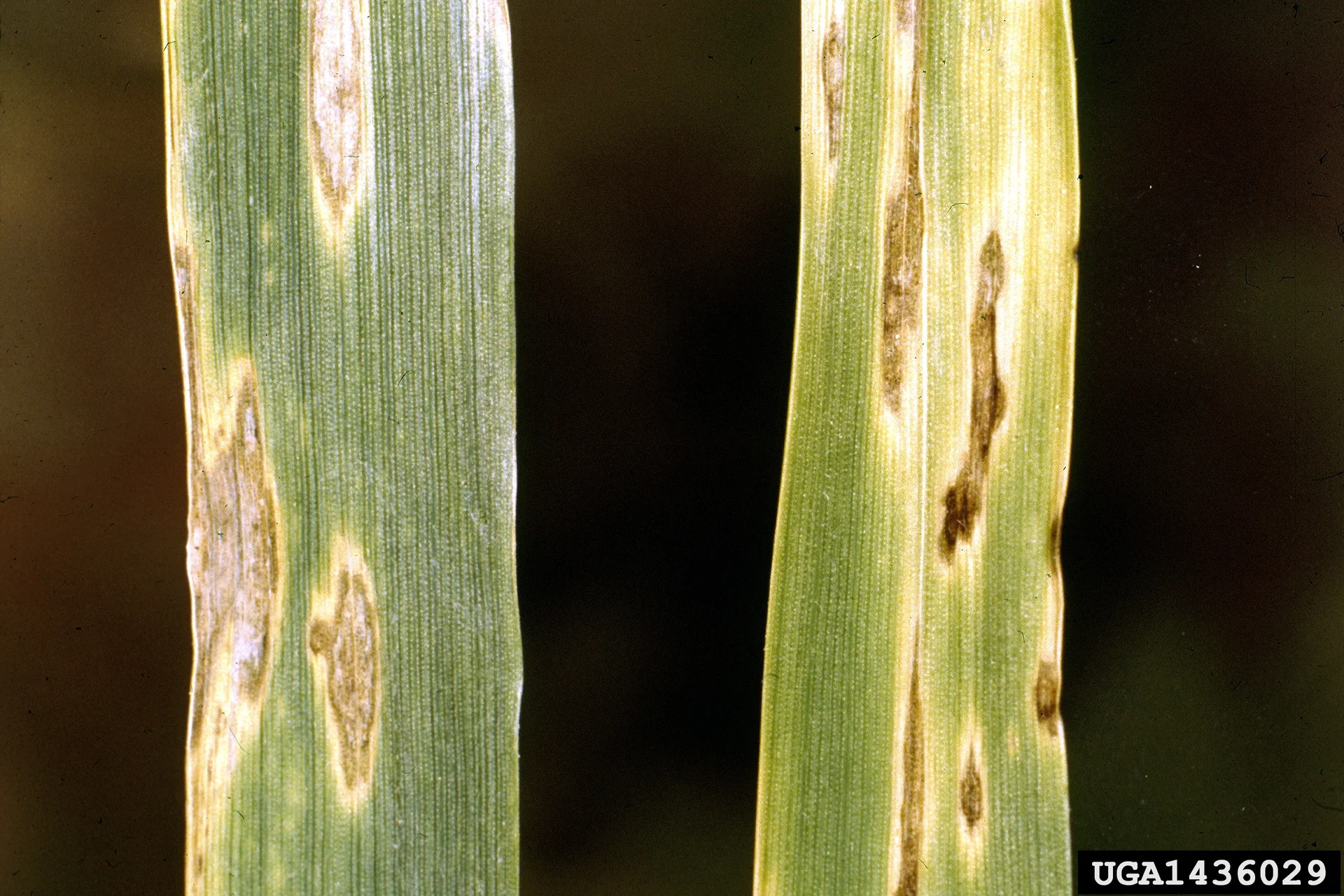
Photo: Clemson University - USDA Cooperative Extension Slide Series · CC BY 3.0
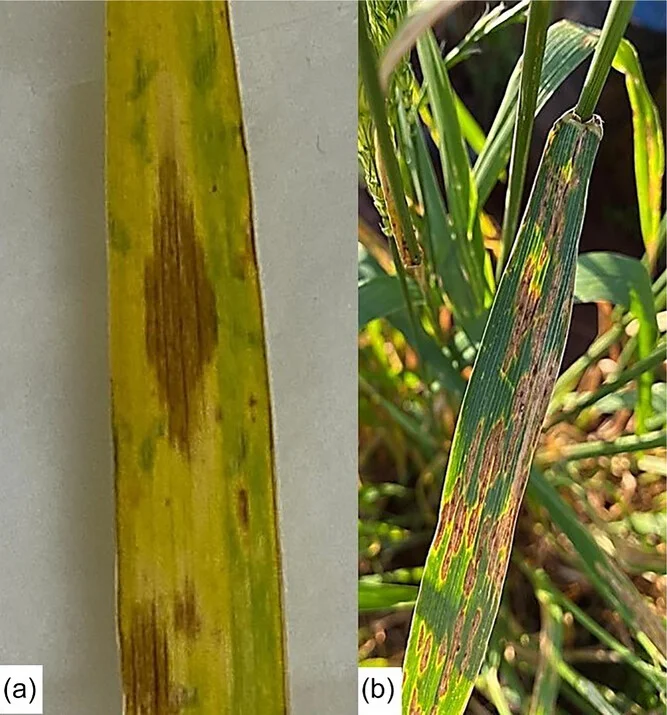
Leaf blotch is a fungal leaf disease of wheat and barley. It makes irregular light-brown to grey blotches on the leaves and leaf sheaths, spreading by rain-splashed spores from the lower leaves upward and from last season's leftover straw. It hits hardest in cool, wet seasons and can rob the crop of the top green leaves that fill the grain.
M. Fernandez-Gamarra et al. · CC BY 4.0 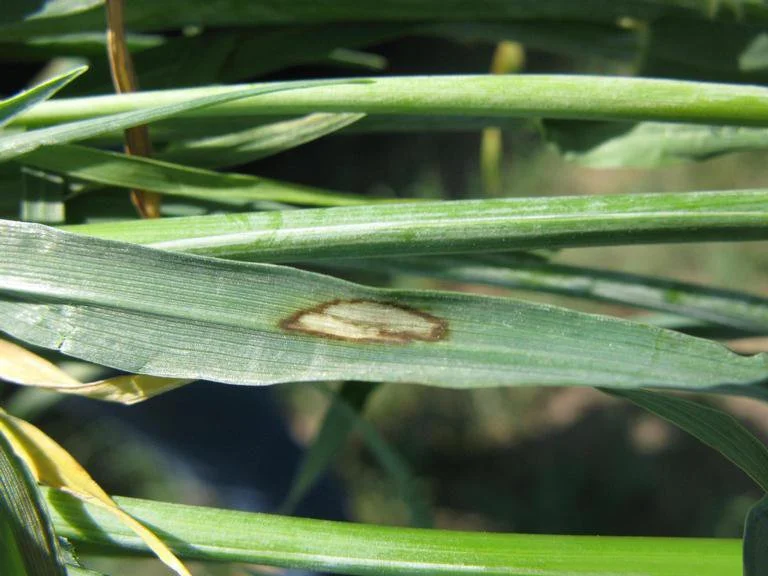
Mary Burrows, Montana State University · CC BY 3.0
Why it matters
The top leaves of your wheat or barley are what feed the grain. Leaf blotch kills them from the tips down, and a bad attack in a wet season can take up to 40% of your harvest — nearly half. The tricky part is that once the fungus is spreading up the plant in warm, wet weather, sprays only protect the leaves that are still green — they cannot bring back a leaf that is already blotched and dying. That is why you must stop it early, before it climbs to the top leaves.
When to act
blotches appearing on the upper leaves during stem elongation to heading, especially in a wet season
This guidance is general, compiled from published agronomic references including FAO and CABI. Thresholds and timing shift with your crop, your variety and the season.
In much of the region a spray is simply called mushonga — medicine. But a chemical group you cannot name is one you cannot rotate, and a product you did not write down has no pre-harvest interval you can observe. Mushonga, and other farming words →
The full Leaf blotch field guide
Identify it
The damage you see first
small light-brown to grey blotches on the leaves, often with a yellow edge around them. They are not neat circles — they have ragged, irregular shapes, roughly the size of a grain of rice up to a thumbnail, and they start on the lower, older leaves first.
As it spreads
the blotches join together and blight whole sections of the leaf, so the leaf looks scorched and dies from the tip back. Hold an older, blotched leaf up to the sunlight and look closely — you may see tiny dark specks inside the old lesions. These are the fungus's fruiting bodies (the little sacs that release the spores), and they confirm it is leaf blotch and not just weather damage.
It climbs upward in wet weather
after rain you will see fresh blotches appearing on higher and higher leaves, moving up toward the flag leaf (the top leaf, just below the head). Rain splash carries the spores up the plant.
Don't confuse it with look-alikes
Rusts make raised, powdery orange or brown pustules that rub off as coloured dust on your finger — leaf blotch does not rub off and stays flat. Frost or sun scorch turns leaf tips pale evenly with no dark specks inside and no yellow-edged blotches. Nitrogen shortage yellows the whole older leaf evenly, tip to base, without ragged brown patches.
Scout for it
When to look
start walking the field at stem elongation (when the stem begins to shoot up and you can feel the swelling joints through the sheath) and keep going through heading (when the grain head pushes out). This is the crop's most vulnerable stretch — the stages when protecting the upper leaves decides your yield.
Look more often in wet weather
check once a week in a normal season, but after rainy, humid, or dewy spells — the weather this fungus loves (cool and wet, around 15–25°C) — check twice a week, because that is when it jumps to new leaves.
How to walk
cross the field in a big "W" shape so you cover all four corners and the middle, not just the edge by the path. Make about 10 stops along the way.
What to check at each stop
look at 10 plants — inspect the upper leaves (the top two or three, especially the flag leaf and the one below it) for fresh blotches, and hold a leaf up to the light to spot the dark specks inside older lesions.
Your threshold — the number that means act:
if you find fresh blotches reaching the upper leaves of about 1 in 5 plants (2 in every 10) during stem elongation to heading — especially in a wet season — treat now. Don't wait for the flag leaf itself to be covered; by then the damage to yield is already being done.
Control it
Prevent it
-
start with a resistant variety (your strongest single tool):
where you can, plant a wheat or barley variety bred to resist leaf blotch. A resistant variety slows the disease down more than any other prevention step, so fewer blotches form even in a wet year. Ask your seed supplier or extension officer which local varieties hold up best.
-
break the disease's home with good field habits:
the fungus survives on old cereal straw and stubble, so rotate — don't grow wheat or barley on the same land two seasons running; put in a non-cereal crop (a legume like beans, or an oilseed) to starve the fungus. Plough down or remove infected stubble after harvest so last year's leaves can't infect this year's crop. Use clean or treated seed. And keep the canopy from staying wet: don't sow too thickly and don't over-apply nitrogen, because a dense, lush, damp canopy is exactly what the fungus needs.
Act early, while the lower leaves are the only ones hit
this disease has no caterpillar to pick off — your "act early" move is to catch it low and stop the climb. Once you reach the threshold, the top leaves are still clean, so treating now protects the leaves that actually fill your grain. Waiting until the flag leaf is blotched is too late to save that leaf.
Chemical — a triazole fungicide, as a last resort:
if the disease reaches the threshold and is climbing toward the top leaves, spray a triazole fungicide. A triazole is systemic (it moves a short way inside the leaf) and protectant (it shields healthy tissue) — but it cannot cure a leaf that is already blotched and dying, so it only pays off if you spray while the upper leaves are still green, ideally around the flag-leaf stage. Safety: cover your skin, eyes, nose and mouth; spray in the cool of the morning or evening with the wind at your back; keep spray away from food, drinking water, children, and bees; wash yourself and your clothes afterward; and respect the pre-harvest interval (the number of days written on the label that you must wait between spraying and harvesting) so no chemical remains on the grain. Resistance: a fungus can learn to survive a fungicide if you lean on it too hard, so use the fewest sprays that do the job and never spray more times in a season than the label allows. Remember that all triazoles belong to the same chemical group — spraying one triazole after another gives the fungus no new obstacle, so if it keeps beating your triazole that is a signal to ask your extension officer for a fungicide from a different group (a different mode of action), since only a triazole is named in this guide.
If it keeps spreading
if blotches keep climbing after your habits and one spray — usually because the weather stays wet — a second triazole spray may be justified, but only while green leaf remains to protect and only if the label still allows another application. If the disease shrugs off your triazole even then, don't just keep adding more of the same group — ask your extension officer for a fungicide with a different mode of action. When it's too late — the flag leaf and head are already blotched and dying — stop spending on sprays; you can't buy that leaf back. Instead protect next season: harvest, then rotate off cereals and bury the infected straw, and switch to a more resistant variety so the disease starts the next crop with far less to feed on.
Catch Leaf blotch before it costs you the harvest
This guide is the general answer. Divisi works out yours — the week to scout your own field for Leaf blotch, and what to do the day you find it.


Crops it affects
Plan the crops it attacks

All planting calendars, country by country
Get Insights by email
A short digest of new Divisi articles. No email on quiet weeks.
Frequently asked questions
How do I identify Leaf blotch?
The damage you see first. small light-brown to grey blotches on the leaves, often with a yellow edge around them. They are not neat circles — they have ragged, irregular shapes, roughly the size of a grain of rice up to a thumbnail, and they start on the lower, older leaves first.
When should I take action against Leaf blotch?
blotches appearing on the upper leaves during stem elongation to heading, especially in a wet season
How do I control Leaf blotch?
Prevent it — start with a resistant variety (your strongest single tool):. where you can, plant a wheat or barley variety bred to resist leaf blotch. A resistant variety slows the disease down more than any other prevention step, so fewer blotches form even in a wet year. Ask your seed supplier or extension officer which local varieties hold up best.
Which crops are attacked by Leaf blotch?
Among the crops covered here: Wheat.