 Divisi
Leaf rust
Puccinia triticina · Fungal
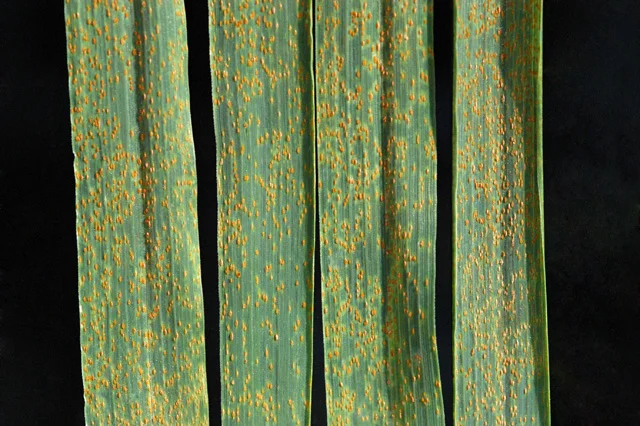
Photo: James Kolmer · Public domain
Leaf rust (Puccinia triticina) is a wind-borne fungal disease of wheat and barley. It erupts as orange-brown, powdery pustules scattered over the upper side of the leaves. Each pustule bursts the leaf skin and releases dust-like spores that ride the wind to healthy plants and neighbouring fields, so a few early spots can carry a whole area within a couple of weeks. By killing green leaf, it robs the plant of the factory that fills the grain.
Why it matters
Leaf rust eats the green in your wheat and barley leaves — the very part that feeds the grain — so heads fill light and pinched. A bad, early attack can take up to 40% of your harvest, and once those orange pustules are pouring out spores across the field there is no cure that heals a sick leaf: you can only protect the leaves that are still green. That is why it pays to plant a resistant variety and catch the first spots before they reach the flag leaf.
When to act
first rust pustules on the upper leaves before or at heading, particularly on a susceptible variety
This guidance is general, compiled from published agronomic references including FAO and CABI. Thresholds and timing shift with your crop, your variety and the season.
In much of the region a spray is simply called mushonga — medicine. But a chemical group you cannot name is one you cannot rotate, and a product you did not write down has no pre-harvest interval you can observe. Mushonga, and other farming words →
The full Leaf rust field guide
Identify it
The first sign
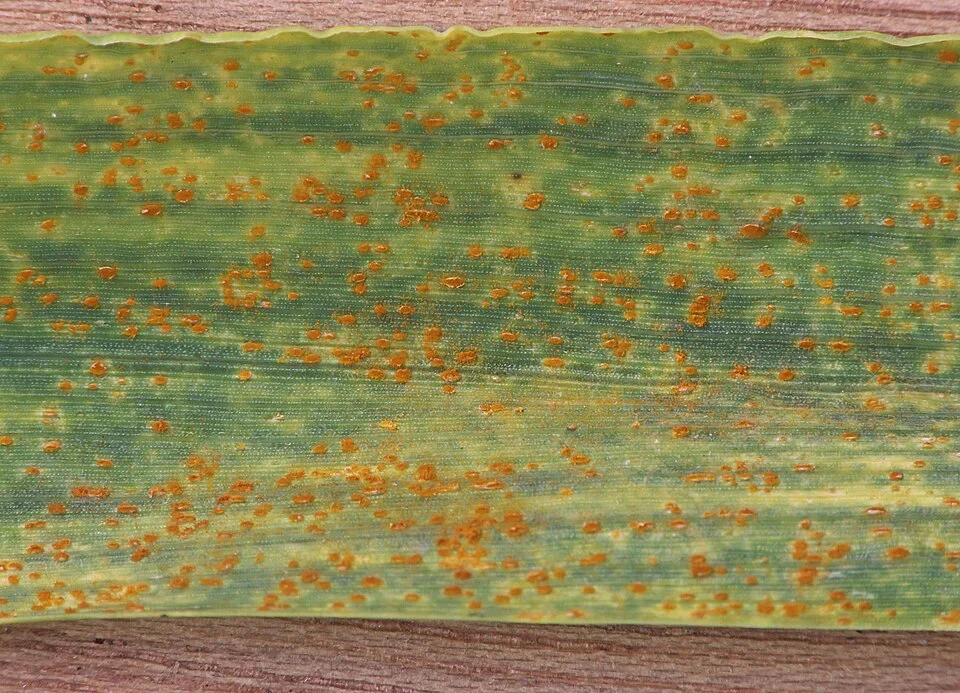
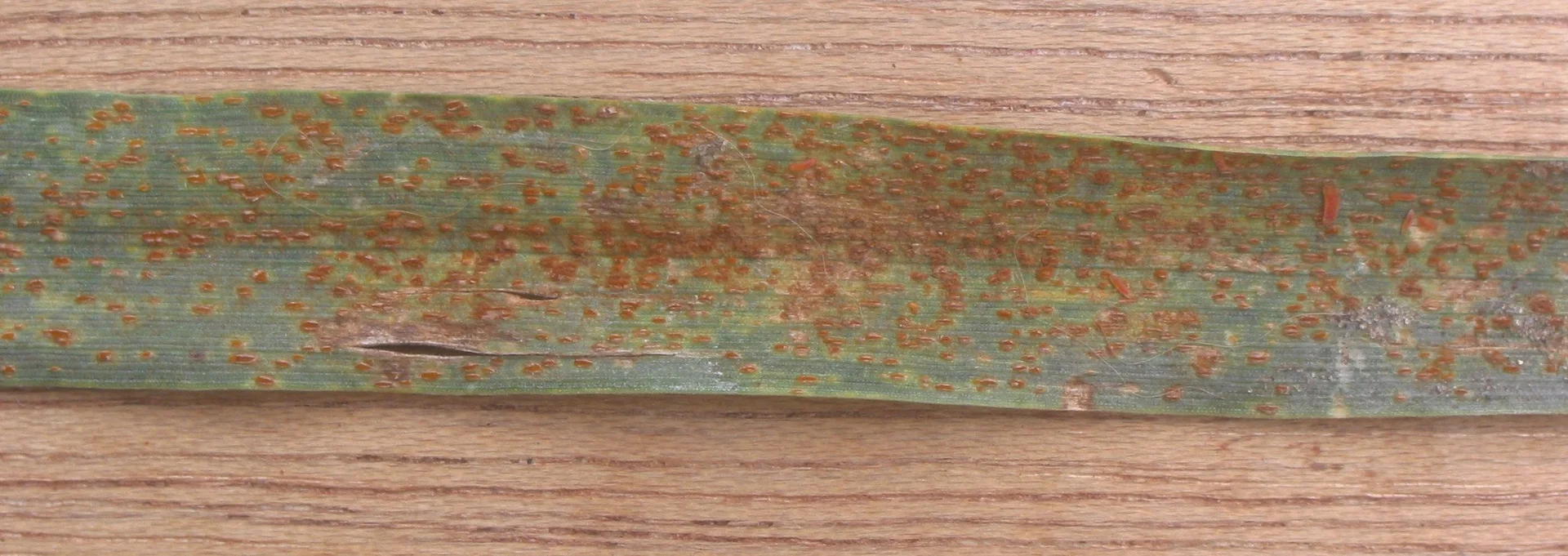
small orange-brown, rusty spots on the upper side of the leaves, scattered and separate like grains of chilli powder or brick dust. Rub your thumb across them — they smear an orange-rust powder onto your skin. That powder is the spores.
As it spreads
the spots (called pustules — little blisters that have burst the leaf skin) grow more numerous, and the leaf around them yellows and dries early. Under a heavy attack the lower leaves brown off and die while the plant is still trying to fill grain. Late in the season the pustules darken from orange to black.
Where it sits
mostly on the leaf blade, spread over the flat upper surface in no set pattern. This matters — leaf rust rarely gets onto the stem.
Tell it apart from look-alikes
stem rust makes bigger, darker brick-red pustules mainly on the stem and leaf sheath, and they tear the skin roughly. Stripe (yellow) rust lines its yellow pustules up in neat stripes between the leaf veins, not scattered. If your spots are orange, round, powdery and scattered on the upper leaf blade, it is leaf rust. Plain yellowing with no powder that rubs off is hunger (nitrogen) or drought, not rust.
Scout for it
When
start walking the field once the crop is jointing and building height (the development stage) and keep going hard through heading and grain-fill (mid-season) — these are the stages when rust does the most damage, and warm, misty, dewy mornings after mild nights are exactly the weather it loves. Check after every such spell.
How to walk
cross the field in a big "W" so you hit all four corners and the middle, not just the headland by the path where you always look.
How many
make about 10 stops along the W. At each stop look closely at the top two or three leaves of 5–10 plants — the upper leaves, and above all the flag leaf (the top leaf that feeds the head).
What to check
turn the leaf to the light and look for the first orange, powdery spots; rub a finger over any suspect spot — orange dust that comes off confirms live rust. Pay special attention to plants of a known susceptible variety.
The number that means act
you are already at threshold when you find the first rust pustules on the upper leaves at or just before heading, especially on a susceptible variety — in plain terms, even 1 in 10 flag leaves showing fresh orange pustules as the head emerges → act now, because from there it explodes. Waiting until half the field is orange is waiting too long.
Control it
Prevent first — grow a resistant variety (your strongest tool):
plant a wheat or barley variety bred with durable leaf-rust resistance. This is the single most effective control — it cuts rust roughly two times out of three on its own, costs nothing extra at spraying time, and protects even when the weather turns against you. Ask your seed supplier or extension officer which local varieties still hold up to rust.
Prevent with good habits (cultural control)
plant early so the crop passes through heading before the main rust weather builds up; pull out or plough down volunteer wheat and barley and roadside cereal regrowth — this "green bridge" is where rust survives between seasons and re-infects your new crop; and do not overdo the nitrogen, because lush, soft, over-fed leaves catch rust worse. These habits together take the edge off the pressure before rust ever arrives.
Act early, while leaves are still green
there is no biological spray or handpicking for rust — the two things that stop it are the resistant variety above and, if you planted a susceptible one, spraying at the very first pustules. A spray protects the green leaf you still have; it cannot bring back leaf that has already dried, so timing is everything. Once you see those first spots on a susceptible variety, decide quickly.
Chemical — a triazole fungicide, as a last resort:
if you are stuck with a susceptible variety and rust appears, spray a triazole fungicide (a systemic product — meaning it moves inside the leaf, unlike a contact spray that only coats the surface). Time it to protect the flag leaf at the first pustules; well-timed it controls rust strongly (about eight times out of ten). Safety: cover your skin, eyes, nose and mouth, spray in the cool of the day with the wind at your back, keep it off food, drinking water, children and bees, wash yourself and your clothes afterwards, and respect the pre-harvest interval (the number of days the label says you must wait between the last spray and cutting the crop) so no residue reaches the grain. Resistance: don't lean on the same product every season — rotate to a different chemical group so the fungus doesn't learn to survive it.
If it keeps spreading
re-check the flag leaves a week after spraying; if fresh orange pustules keep appearing on the green leaves and the weather stays mild and dewy, a second, well-timed triazole spray on a different group may still save the flag leaf and the grain-fill. But once the flag leaves are already brown and dry and the heads are near ripe, stop — no spray will heal them. Cut your losses, harvest promptly to save what grain has filled, and then break the cycle for next season: clear every volunteer cereal, rotate to a non-cereal crop, and plant a resistant variety so rust has nothing to carry over on.
Catch Leaf rust before it costs you the harvest
This guide is the general answer. Divisi works out yours — the week to scout your own field for Leaf rust, and what to do the day you find it.


Crops it affects
Plan the crops it attacks

All planting calendars, country by country
Get Insights by email
A short digest of new Divisi articles. No email on quiet weeks.
Frequently asked questions
How do I identify Leaf rust?
The first sign. small orange-brown, rusty spots on the upper side of the leaves, scattered and separate like grains of chilli powder or brick dust. Rub your thumb across them — they smear an orange-rust powder onto your skin. That powder is the spores.
When should I take action against Leaf rust?
first rust pustules on the upper leaves before or at heading, particularly on a susceptible variety
How do I control Leaf rust?
Prevent first — grow a resistant variety (your strongest tool):. plant a wheat or barley variety bred with durable leaf-rust resistance. This is the single most effective control — it cuts rust roughly two times out of three on its own, costs nothing extra at spraying time, and protects even when the weather turns against you. Ask your seed supplier or extension officer which local varieties still hold up to rust.
Which crops are attacked by Leaf rust?
Among the crops covered here: Wheat.