 Divisi
Lethal yellowing
· Bacterial
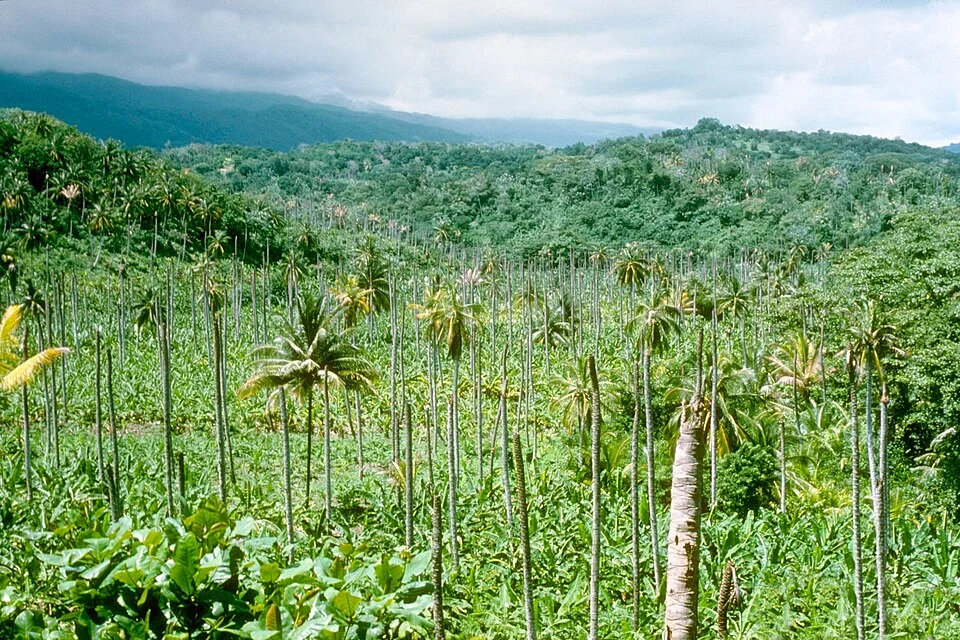
Photo: USDA Forest Service · CC BY 3.0
Lethal yellowing is a fatal disease of coconut palms caused by a phytoplasma — a tiny bacteria-like germ, with no proper cell wall, that lives inside the palm's sap-pipes (the tubes that carry its food). You cannot see the germ. It is carried from palm to palm by a small sap-sucking insect called a planthopper (the vector — the insect that spreads the germ). Once a palm is infected there is no cure: it drops its nuts, its new flowers die, its leaves yellow from the bottom up, and within a few months the whole crown falls and the palm dies. Left unchecked it can wipe out an entire grove.
USDA Forest Service · CC BY 3.0 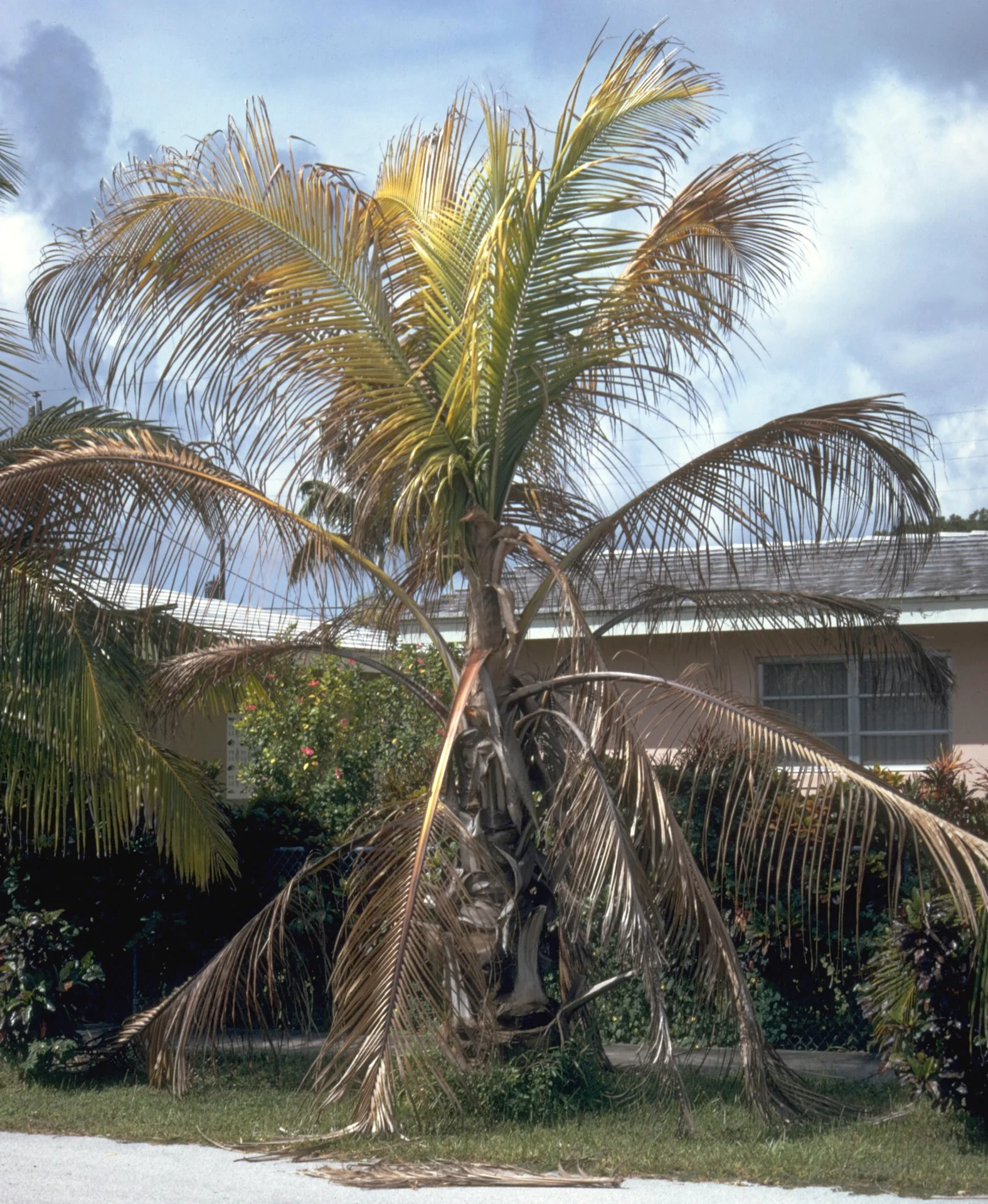
USDA Forest Service · Public domain
Why it matters
Lethal yellowing can kill every coconut palm it reaches — that is a 100% loss, not a bad harvest but the death of the tree you waited years to bring into bearing, and often its neighbours too. It matters because a palm takes 5–7 years to grow back, so a lost palm is lost income for many seasons. It is hard to fix because by the time you see the yellowing the germ is already deep in the palm's sap and the planthopper has almost certainly carried it to nearby palms — there is no spray or medicine that saves an infected palm, so your only weapons are catching it early, cutting it out, and planting resistant types.
When to act
any palm showing premature nutfall or fronds yellowing from the bottom up should be flagged and reported immediately, as spread is by leafhopper vectors
This guidance is general, compiled from published agronomic references including FAO and CABI. Thresholds and timing shift with your crop, your variety and the season.
In much of the region a spray is simply called mushonga — medicine. But a chemical group you cannot name is one you cannot rotate, and a product you did not write down has no pre-harvest interval you can observe. Mushonga, and other farming words →
The full Lethal yellowing field guide
Identify it
The first and clearest sign is nutfall
the palm suddenly drops most or all of its nuts at once, and they fall at every size — tiny green buttons, half-grown, and near-ripe all on the ground together. Look at a fallen nut's stem end: you often see a brown, water-soaked rot ring where it broke off. A healthy palm never sheds all ages of nut at the same time.
Next, look at the newest flower spikes
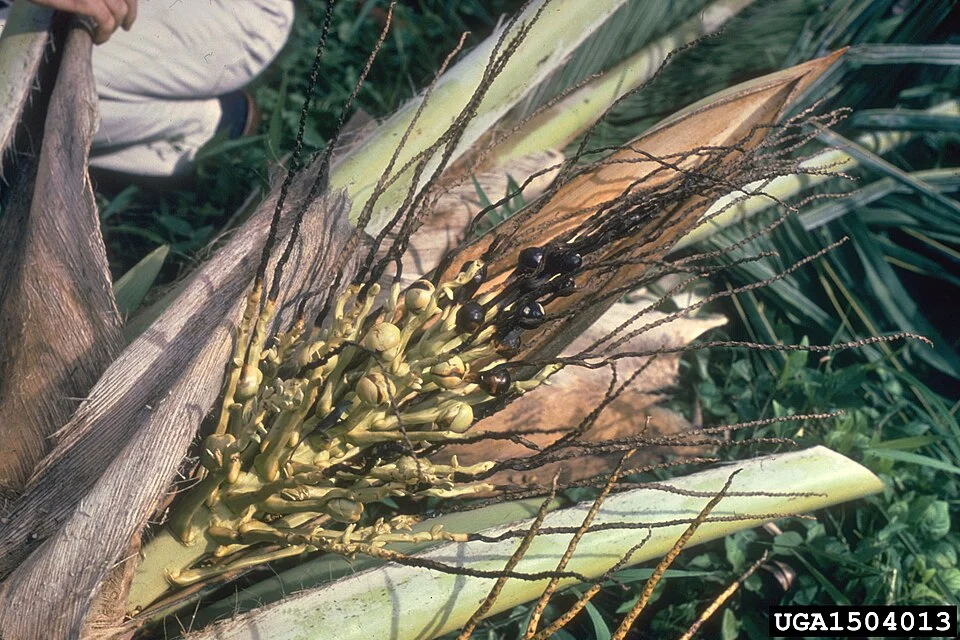
(the young flower branches just coming out of their sheath). On a sick palm these turn black and dead at the tips, as if scorched by fire, and they set no fruit. Blackened new flowers together with the nutfall is the strongest early clue.
Then the fronds yellow — and the order matters
The oldest, lowest fronds go golden-yellow first, then the yellow climbs upward toward the crown, leaf by leaf. Yellowed fronds turn brown, dry out, droop and hang down against the trunk like a dead skirt.
Finally the crown collapses
The topmost spear leaf dies, the whole cluster of fronds falls away, and you are left with a bare grey trunk standing like a telephone pole. From first nutfall to a dead palm is usually only 3 to 6 months.
Tell it apart from look-alikes
Plain potassium or nutrient hunger also yellows old fronds, but it does not cause all-ages nutfall or blackened new flowers, and the yellowing is often speckled or orange-spotted rather than an even golden sheet climbing upward. Drought or salt stress wilts and browns fronds but, again, no sudden nutfall of every size and no blackened flower spikes. Normal ageing yellows only the one or two lowest fronds and stops there. It is the combination — nutfall of all sizes + black dead new flowers + yellowing that climbs up — that means lethal yellowing, not any one sign alone.
Scout for it
When to look
watch your mature, nut-bearing and flowering palms — the older palms in their bearing years are the ones this disease strikes and kills. Walk your grove to check them at least once a week, and step up to twice a week if a neighbouring farm or nearby wild palm has shown the disease, because the planthopper flies the germ across from there.
How to walk it
don't just look at the palms along the path. Walk a big "W" pattern across the whole grove so you pass the four corners and the middle, and make about 8 to 10 stops, checking the nearest few palms at each stop — you want eyes on every block, not only the edge.
What to check at each palm, in order
(1) the ground under the crown for freshly fallen nuts of mixed sizes; (2) the newest flower spikes for black, dead tips; (3) the lowest fronds for the first golden yellowing; (4) the spear and crown for any collapse. Use the same three-part signature every time — nutfall, black flowers, climbing yellow.
The action number — act on even ONE palm
This disease has no cure and spreads fast by insect, so the threshold is not a percentage — it is a single palm. The moment even 1 palm shows premature nutfall or fronds yellowing from the bottom up, flag that palm, mark it, and report it to your plant-health / extension service immediately. Do not wait to see if more appear.
While you wait for advice, isolate it in your mind as already lost
and keep checking the palms around it every few days — the neighbours of a sick palm are the most likely to fall next.
Control it
PREVENT
-
plant resistant palms (your strongest tool)
When you establish or replant, choose resistant or tolerant coconut types — selected dwarf varieties and hybrids are far less likely to die of this disease than the tall local coconuts. Always get your seednuts and seedlings from a disease-free area, never from a grove where palms have been dying, so you don't carry the germ home in the planting material.
-
deny the insect a home
The planthopper that spreads the germ breeds in grasses and weeds under and around the palms, and its young feed there. Keep the grove floor mowed short and weeded, and remove any wild, volunteer or ornamental palms nearby that can host the disease and the insect. A clean, open grove gives the vector far fewer places to build up.
ACT EARLY — cut out and burn sick palms (roguing)
There is no medicine that cures an infected palm, so the sick palm's real job now is to stop being a source of germ for the rest. As soon as a palm is confirmed, cut it down and burn it — this is called roguing. Doing this early, while only one or two palms are affected, removes the reservoir the insect feeds on and is the single most useful thing you can do to protect the grove. Do not leave a dying palm standing.
CHEMICAL — last resort, and only against the insect
An insecticide for vector control (sprayed to knock down the planthopper) gives only partial, temporary protection — it does not cure any palm and cannot be relied on alone; it is the weakest of your options for good reason. If a technician advises it during an outbreak, treat it as a short-term way to slow the insect while you rogue and replant, not a solution.
SAFETY when you spray
Cover your skin, eyes, nose and mouth; spray in the cool of early morning or evening with the wind at your back so it blows away from you; keep it off food, drinking water, children and animals, and avoid spraying flowering plants where bees are working. Wash yourself and your clothes afterwards, and respect the pre-harvest interval (the number of days the product says you must wait between spraying and eating or selling the nuts). Rotate to a different chemical group each time rather than using the same product over and over, so the insect does not build up resistance (stop being killed by it).
If it keeps spreading despite roguing → cut your losses and reset
When palm after palm keeps falling in a block even after you remove the sick ones, stop pouring effort into the standing crop: clear the affected block, burn the debris, and replant the whole area with resistant dwarf or hybrid coconut sourced from a clean area — and keep the grove floor mowed to starve the insect. A fresh, resistant stand is worth far more than nursing palms that will die anyway.
Catch Lethal yellowing before it costs you the harvest
This guide is the general answer. Divisi works out yours — the week to scout your own field for Lethal yellowing, and what to do the day you find it.


Crops it affects
Plan the crops it attacks

All planting calendars, country by country
Get Insights by email
A short digest of new Divisi articles. No email on quiet weeks.
Frequently asked questions
How do I identify Lethal yellowing?
The first and clearest sign is nutfall. the palm suddenly drops most or all of its nuts at once, and they fall at every size — tiny green buttons, half-grown, and near-ripe all on the ground together. Look at a fallen nut's stem end: you often see a brown, water-soaked rot ring where it broke off. A healthy palm never sheds all ages of nut at the same time.
When should I take action against Lethal yellowing?
any palm showing premature nutfall or fronds yellowing from the bottom up should be flagged and reported immediately, as spread is by leafhopper vectors
How do I control Lethal yellowing?
PREVENT — plant resistant palms (your strongest tool). When you establish or replant, choose resistant or tolerant coconut types — selected dwarf varieties and hybrids are far less likely to die of this disease than the tall local coconuts. Always get your seednuts and seedlings from a disease-free area, never from a grove where palms have been dying, so you don't carry the germ home in the planting material.
Which crops are attacked by Lethal yellowing?
Among the crops covered here: Coconut.