 Divisi
Passion fruit brown spot
Alternaria passiflorae · Fungal
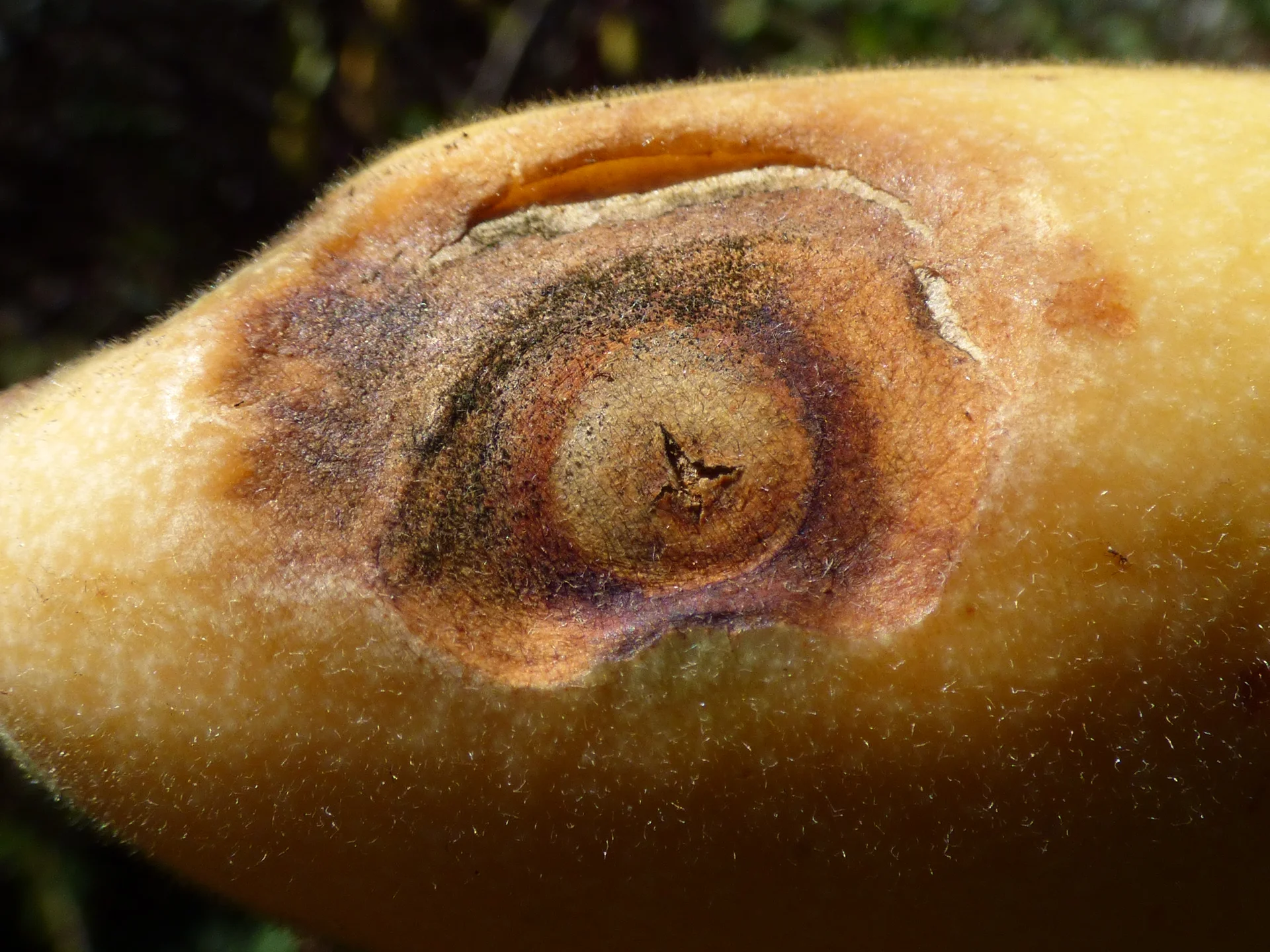
Photo: Forest and Kim Starr · CC BY 3.0 us
Brown spot is the most serious fungal disease of passion fruit. The fungus Alternaria passiflorae attacks the leaves, stems and fruit of the vine. Its spores are splashed up by rain and blown on the wind from old spotted leaves and fruit, and in warm, humid, wet weather they settle on wet foliage and start new spots within days. It strips the leaves that should be feeding the crop, rings and kills the fruiting shoots, and pits the fruit so it shrivels, drops early and cannot be sold.
Forest and Kim Starr · CC BY 3.0 us
Why it matters
Brown spot is the disease most likely to wreck a passion-fruit vine, and once it takes hold in warm, wet weather it can cost you up to 7 in every 10 fruit (70% of your crop). It hits you three ways at once: it kills the leaves that feed the plant so the whole vine weakens, it rings and kills the fruiting shoots so they die back and drop everything beyond the sore, and it pits the fruit so it wrinkles, falls early and cannot be sold. Worst of all, the vine lives on the same spot for 2–3 years, so the disease sits in the old spotted leaves and fruit on the ground and comes back at the crop again every wet season unless you keep on top of it.
When to act
start protecting the crop at the very first brown ring-marked spots on the leaves, stems or fruit — do not wait for more; and when warm, wet, humid weather is set to persist, protect the vine before any spots show
This guidance is general, compiled from published agronomic references including FAO and CABI. Thresholds and timing shift with your crop, your variety and the season.
In much of the region a spray is simply called mushonga — medicine. But a chemical group you cannot name is one you cannot rotate, and a product you did not write down has no pre-harvest interval you can observe. Mushonga, and other farming words →
The full Passion fruit brown spot field guide
Identify it
The first thing you see — on the leaves:
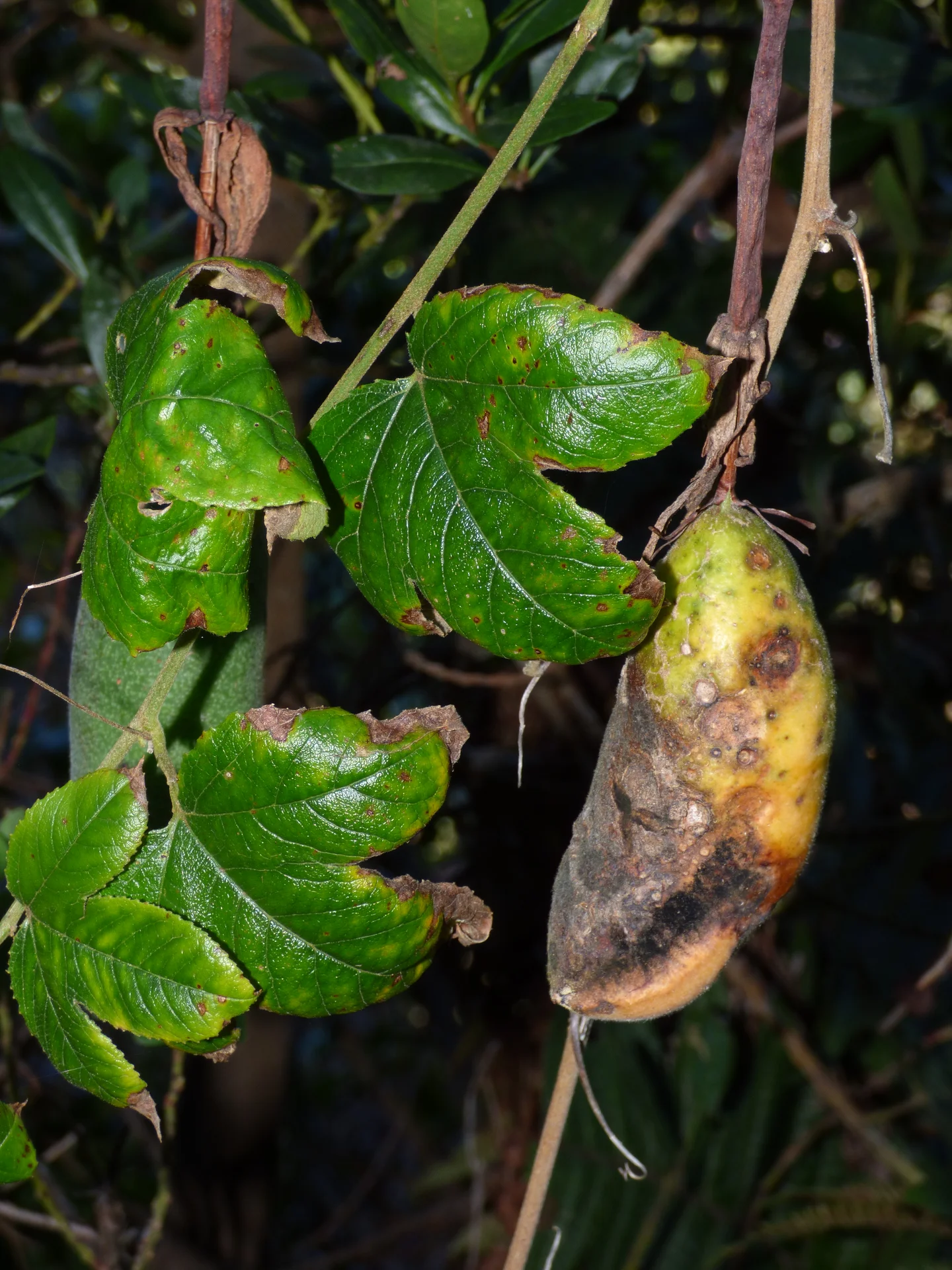
small brown spots that start pinhead-size and grow into round-to-irregular brown patches, often with a paler tan centre and faint rings inside, like a target or an archery board. Each spot is usually ringed by a yellow halo where the green fades. As spots join up the leaf yellows and falls, and a badly hit vine loses much of its leaf.
On the stems, tendrils and fruiting shoots
long, dark brown, sunken streaks, most often right at a node or where a leaf or tendril joins the stem. A streak that runs right round the stem rings it (girdles it) and kills everything beyond — the shoot and its flowers or fruit wilt and die back. This stem attack is what makes brown spot so costly.
On the fruit
round, sunken brown spots that start small and slightly greasy, then spread, with the centre going wrinkled and leathery. The fruit shrivels, rots and drops early, and even lightly spotted fruit is scarred and cannot be sold fresh.
Don't confuse it
Woodiness virus gives a patchy light-and-dark mosaic mottling and hard, misshapen fruit with no defined spots — brown spot makes clear brown spots with rings and a yellow halo. A bacterial (greasy) spot looks wet, oily and angular, following the leaf veins, with no dry target rings; brown spot spots are dry and brown with rings. Sunburn or drought browns a leaf evenly but does not make sunken, girdling streaks on the stems or sunken pits on the fruit — those stem and fruit sores are the sure sign of brown spot.
Scout for it
When to look hardest
from the stage when the vine is building its leafy framework along the wire (development), right through flowering (mid-season) and fruit fill (late season) — from then on there are always leaves and fruit for it to attack. Step up your checks the moment the weather turns warm, humid and wet (about 20–30 degrees C), with rain, heavy dew, or a dense, damp canopy, because that is when it explodes.
How to walk the vines
every week, walk a big "W" shape across the plot so you cross all four corners and the middle — not just the row nearest the path. Make about 10 stops along the way.
What to check at each stop
look over the tops and undersides of the leaves for the brown ring-marked spots, run your eye down the stems and the nodes for dark sunken streaks, and check the hanging fruit for sunken pits. Open up the dense, damp inside of the canopy — that still, wet air is where the disease starts before it shows on the outside.
The number that means act now
the threshold is the very first spots — 1 spotted leaf, stem or fruit is enough to start protecting the crop, because the copper spray only shields healthy tissue and cannot cure a spot already there, so there is no safe waiting. And when warm, wet, humid weather is forecast to settle in, protect the vine before any spots appear rather than waiting to find them.
Control it
Prevent it first
-
grow an open, airy, dry canopy (your strongest non-spray tool):
brown spot needs still, damp air and wet leaves. Give the vines their full wide spacing (about 3 big strides / 3 m in the row), train one clean stem up to the wire and clear all growth below it, and every couple of weeks pull out the tangled tendrils so the hanging fruiting shoots hang free like a loose curtain. Leaves that dry fast after rain get far less disease — this open canopy is the single most effective thing you can do without a sprayer.
-
sanitation and the right variety:
the disease overwinters in old spotted leaves and fruit. Pick off and destroy badly spotted leaves, dieback shoots and pitted fruit, and clear every fallen leaf and fruit off the ground — burn or bury them deep, well away from the plot, so the spores can't splash back up onto the vine. Water at the base, never over the top of the leaves, and water early so the foliage dries by night. Where you can, plant the tougher yellow passion fruit (or a grafted purple-on-yellow vine) — the yellow type stands up to the disease better than the sweeter purple one.
Act early — cut out the first sick growth:
the moment you find spotted, girdled or dying-back shoots, prune them out and destroy them on a dry day so you don't spread wet spores by hand. Disinfect your knife or secateurs between vines — wipe with bleach or pass the blade through a flame — because dirty tools carry both this disease and the incurable woodiness virus from a sick vine to a healthy one. Never throw the diseased prunings on the compost or leave them lying in the plot.
Chemical as a last resort — copper protectant:
at the very first spots, start a copper-based (protectant / contact) fungicide. "Protectant" means it coats the leaf and fruit surface and stops new spores getting in — it shields healthy tissue but cannot cure a spot already there, so it must go on at the first sign (or before spots in wet weather), cover the new growth, and be re-applied every 2–3 weeks through humid spells and after rain washes it off.
Spray safely
cover your skin, eyes, nose and mouth; spray in the cool of the morning or evening with the wind at your back; keep the spray off ripe fruit you will pick soon, off food, off drinking water and rivers, and away from children and bees. Respect the pre-harvest interval — the number of days the label says you must wait between the last spray and picking or selling the fruit. Wash yourself and your clothes afterwards.
Fight resistance
don't lean on one product forever — rotate to a different chemical group each time (for example, alternate the copper with another registered protectant such as mancozeb) so the fungus can't get used to it. The open, airy canopy and the clearing of fallen leaves and fruit are the backbone; the spray only tops it up.
If it keeps spreading — open it up hard and clean up:
if the canopy is browning and dropping leaves even with spraying, prune hard to open the vine right up, cut out all the diseased and girdled wood well below the sore, and clear every fallen leaf and fruit from the ground so there is nothing to splash spores back up. Keep the protectant going on the fresh regrowth. Never carry spotted or rotting fruit into store — sort it out, because it will spoil the sound fruit around it.
Catch Passion fruit brown spot before it costs you the harvest
This guide is the general answer. Divisi works out yours — the week to scout your own field for Passion fruit brown spot, and what to do the day you find it.


Crops it affects
Plan the crops it attacks

All planting calendars, country by country
Get Insights by email
A short digest of new Divisi articles. No email on quiet weeks.
Frequently asked questions
How do I identify Passion fruit brown spot?
The first thing you see — on the leaves:. small brown spots that start pinhead-size and grow into round-to-irregular brown patches, often with a paler tan centre and faint rings inside, like a target or an archery board. Each spot is usually ringed by a yellow halo where the green fades. As spots join up the leaf yellows and falls, and a badly hit vine loses much of its leaf.
When should I take action against Passion fruit brown spot?
start protecting the crop at the very first brown ring-marked spots on the leaves, stems or fruit — do not wait for more; and when warm, wet, humid weather is set to persist, protect the vine before any spots show
How do I control Passion fruit brown spot?
Prevent it first — grow an open, airy, dry canopy (your strongest non-spray tool):. brown spot needs still, damp air and wet leaves. Give the vines their full wide spacing (about 3 big strides / 3 m in the row), train one clean stem up to the wire and clear all growth below it, and every couple of weeks pull out the tangled tendrils so the hanging fruiting shoots hang free like a loose curtain. Leaves that dry fast after rain get far less disease — this open canopy is the single most effective thing you can do without a sprayer.
Which crops are attacked by Passion fruit brown spot?
Among the crops covered here: Passion fruit.