 Divisi
Avocado sunblotch viroid
Avocado sunblotch viroid · Viral
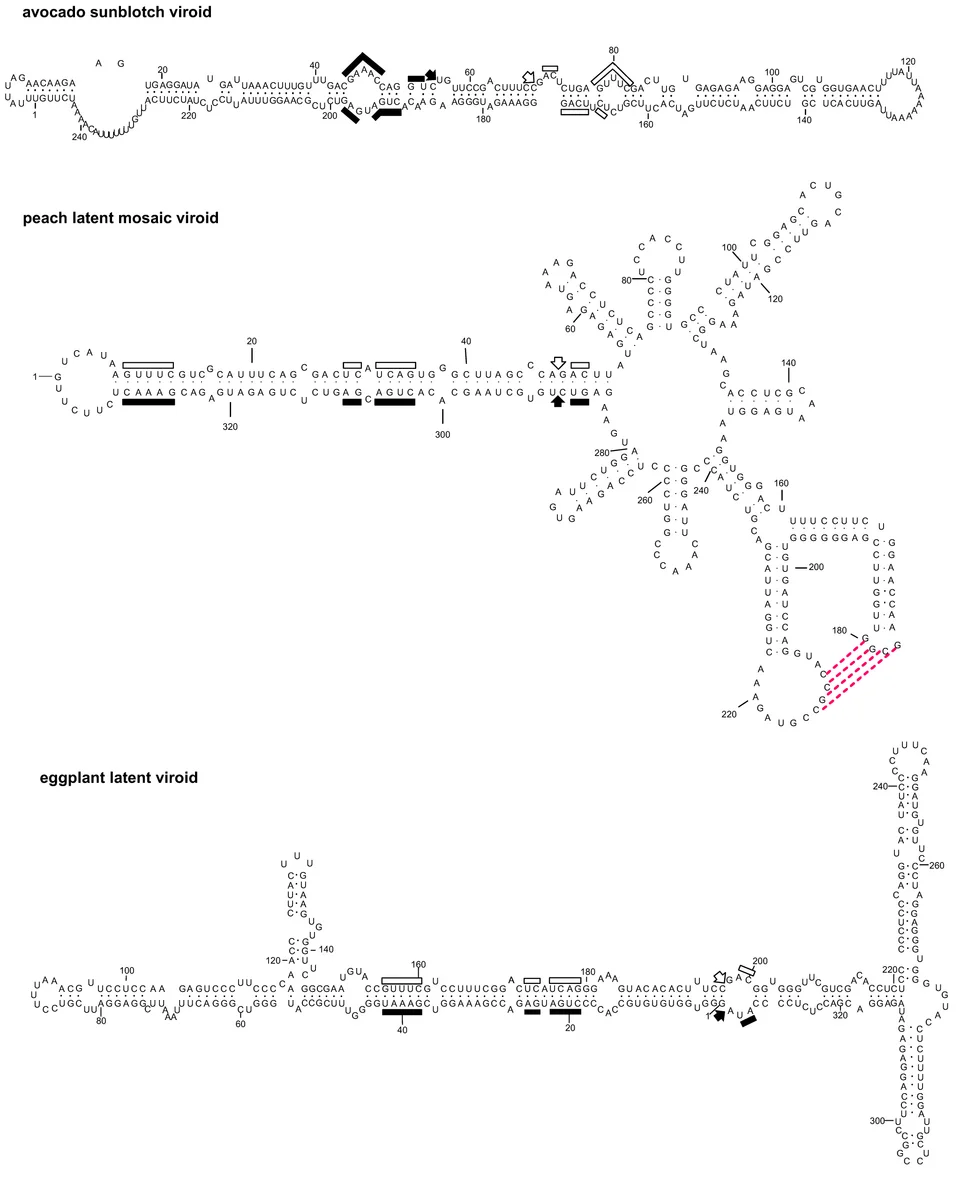
Photo: Francesco Di Serio, Shi-Fang Li, Jaroslav Matoušek, Robert A. Owens, Vicente Pallás, John W. Randles, Teruo Sano, Jacobus Th. J. Verhoeven, Georgios Vidalakis, Ricardo Flores · CC BY-SA 4.0
Avocado sunblotch is caused by a viroid — a tiny piece of infectious RNA, even smaller than a virus — that lives inside every part of an avocado tree for the rest of its life. It does not blow in on the wind or come from insects. You carry it into your orchard yourself: on grafting and pruning knives, in budwood or cuttings taken from a sick tree, through roots that touch and join underground, and in seed from an infected tree. The cruel part is that many infected trees look perfectly healthy (they are called symptomless carriers) yet still pass it on and still give a poor crop.
148LENIN · CC BY-SA 4.0
Why it matters
Once a tree has sunblotch it has it for good — there is no spray and no cure, and the tree will quietly give you a smaller, scarred, unsellable crop for the rest of its life. A run of infected and hidden-carrier trees can cost you up to 30% of your harvest. It is so hard to beat because it spreads invisibly — on your own knife, through touching roots, and in trees that look green and healthy but are secretly infected — so by the time you see the streaks, it has often already moved to other trees.
When to act
Any tree showing sunblotch symptoms or any confirmed positive symptomless carrier is removed; there is no in-tree cure.
This guidance is general, compiled from published agronomic references including FAO and CABI. Thresholds and timing shift with your crop, your variety and the season.
In much of the region a spray is simply called mushonga — medicine. But a chemical group you cannot name is one you cannot rotate, and a product you did not write down has no pre-harvest interval you can observe. Mushonga, and other farming words →
The full Avocado sunblotch viroid field guide
Identify it
The first thing you notice
bright yellow, cream or pink streaks running along young green stems and along the fruit — long marks that follow the length of the shoot, not round spots. The streaks often look slightly sunken, like a shallow scratch pressed into the skin.
On the leaves
affected shoots push out narrow, strap-like, twisted leaves — much thinner and more crooked than the broad, flat healthy leaves around them — sometimes with pale bleached blotches. That deformed new growth keeps coming back on the same branch.
On the fruit
infected fruit is cracked, scarred and blotchy, with the same yellow-cream-pink sunken streaks. It is misshapen and downgraded — buyers reject it.
On the bark (the sneaky sign)
some carrier trees show no streaks at all, only rectangular cracking of the bark on the trunk or limbs, and generally weak, stunted growth with a poor crop for no obvious reason.
Don't confuse it with look-alikes
sunburn/scald bleaches the side of fruit and leaves facing the sun (sunblotch marks appear anywhere, in streaks). Iron shortage yellows between the leaf veins while the leaf keeps its normal broad shape — that is a good way to rule it out. Zinc shortage is trickier: it also makes leaves small and narrow (called 'little-leaf'), so leaf shape alone will fool you — but zinc-short leaves stay an even pale-green with no coloured streaks, whereas sunblotch always adds yellow-cream-pink lengthwise streaks on the shoot and fruit. Herbicide drift and wind-rub scar fruit but do not make the long coloured streaks or the twisted strap leaves. Sunblotch is the one that gives coloured lengthwise streaks + narrow twisted leaves on the same shoot.
Scout for it
When to look
walk your orchard whenever new growth (flush), sizing fruit and mature fruit are on the tree — that is the tree's development, mid-season and late-season stages, when the streaks show most clearly. Look at least once each of these times every year, and always before you cut budwood or take cuttings.
How to walk it
cross the block in a big "W" so you pass through all four corners and the middle, not just the row by the path. Stop and inspect around 10 trees spread across the W.
What to check on each tree
the new shoots for yellow-cream-pink streaks, the leaves for the narrow twisted strap shape, the fruit for coloured sunken streaks and scarring, and the trunk and lower sprouts for rectangular bark cracking. Bend down and check low water-sprouts too — signs often show there first.
When to act — lead with the number: even 1 tree
Unlike a caterpillar you tolerate up to a threshold, there is no safe number here. Find even a single tree with these signs → mark it and act now. Any tree you suspect of being a mother (budwood) tree must be indexed (laboratory-tested for the viroid) before you ever cut wood from it — a healthy-looking carrier will infect every tree you graft from it.
Control it
Prevent first — this is your strongest tool (it works about 9 times in 10):
only ever plant or graft from viroid-indexed, certified-clean budwood and rootstock. "Indexed" means the mother tree was laboratory-tested and proven free of the viroid. Never take budwood, cuttings or seed from a tree that has not been tested — that one shortcut is how most orchards get infected.
Stop tool spread (works well — cuts a big share of new infections):
the viroid rides on blades. Disinfect every knife, secateur and pruning saw with household bleach (sodium hypochlorite), about 1 part bleach to 9 parts water, between every single tree. Prune your known-healthy trees first and any suspect trees last, so you never carry it from sick to clean. Safety with bleach: wear gloves, keep it off your skin, eyes and nose, mix and work in a well-aired spot, keep it away from children, and wash your hands and tools with clean water after.
Buy clean (backs up the two steps above)
source your young trees only from a clean nursery that runs a tested mother-block scheme (a set of proven-clean parent trees kept only for propagation). Ask to see their indexing records before you buy — it is the same principle as planting indexed budwood, just moved back to where your trees are raised.
Act by removing, not spraying — there is honestly no cure:
no chemical, no spray and no medicine can clear a viroid from a tree, whatever a seller may claim — do not waste money on one. The only real action is to rogue the tree: cut it right out and destroy it (burn it or bury it well away from the orchard). Take out the stump and as many roots as you can, because roots of neighbouring avocados grow together underground (root grafts) and pass the viroid tree-to-tree — a live infected stump keeps infecting its neighbours.
If it keeps spreading → tighten the loop and cut your losses
Remove every confirmed and symptomatic tree plus any neighbour sharing its roots; stop taking any budwood from your own orchard until the source tree is indexed clean; and re-plant the gaps only with certified-clean, indexed stock. When a tree is a proven carrier there is nothing to save — replacing it early protects the up-to-30% of your crop the whole orchard would otherwise keep losing.
Catch Avocado sunblotch viroid before it costs you the harvest
This guide is the general answer. Divisi works out yours — the week to scout your own field for Avocado sunblotch viroid, and what to do the day you find it.


Crops it affects
Plan the crops it attacks

All planting calendars, country by country
Get Insights by email
A short digest of new Divisi articles. No email on quiet weeks.
Frequently asked questions
How do I identify Avocado sunblotch viroid?
The first thing you notice. bright yellow, cream or pink streaks running along young green stems and along the fruit — long marks that follow the length of the shoot, not round spots. The streaks often look slightly sunken, like a shallow scratch pressed into the skin.
When should I take action against Avocado sunblotch viroid?
Any tree showing sunblotch symptoms or any confirmed positive symptomless carrier is removed; there is no in-tree cure.
How do I control Avocado sunblotch viroid?
Prevent first — this is your strongest tool (it works about 9 times in 10):. only ever plant or graft from viroid-indexed, certified-clean budwood and rootstock. "Indexed" means the mother tree was laboratory-tested and proven free of the viroid. Never take budwood, cuttings or seed from a tree that has not been tested — that one shortcut is how most orchards get infected.
Which crops are attacked by Avocado sunblotch viroid?
Among the crops covered here: Avocado.