 Divisi
Taro leaf blight
Phytophthora colocasiae · Fungal

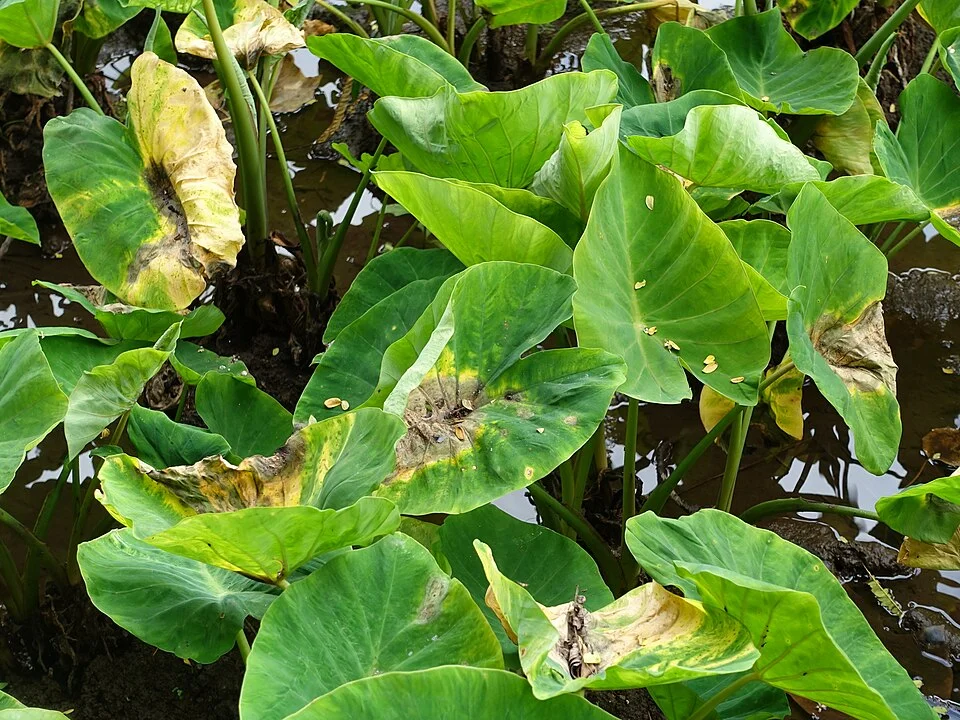
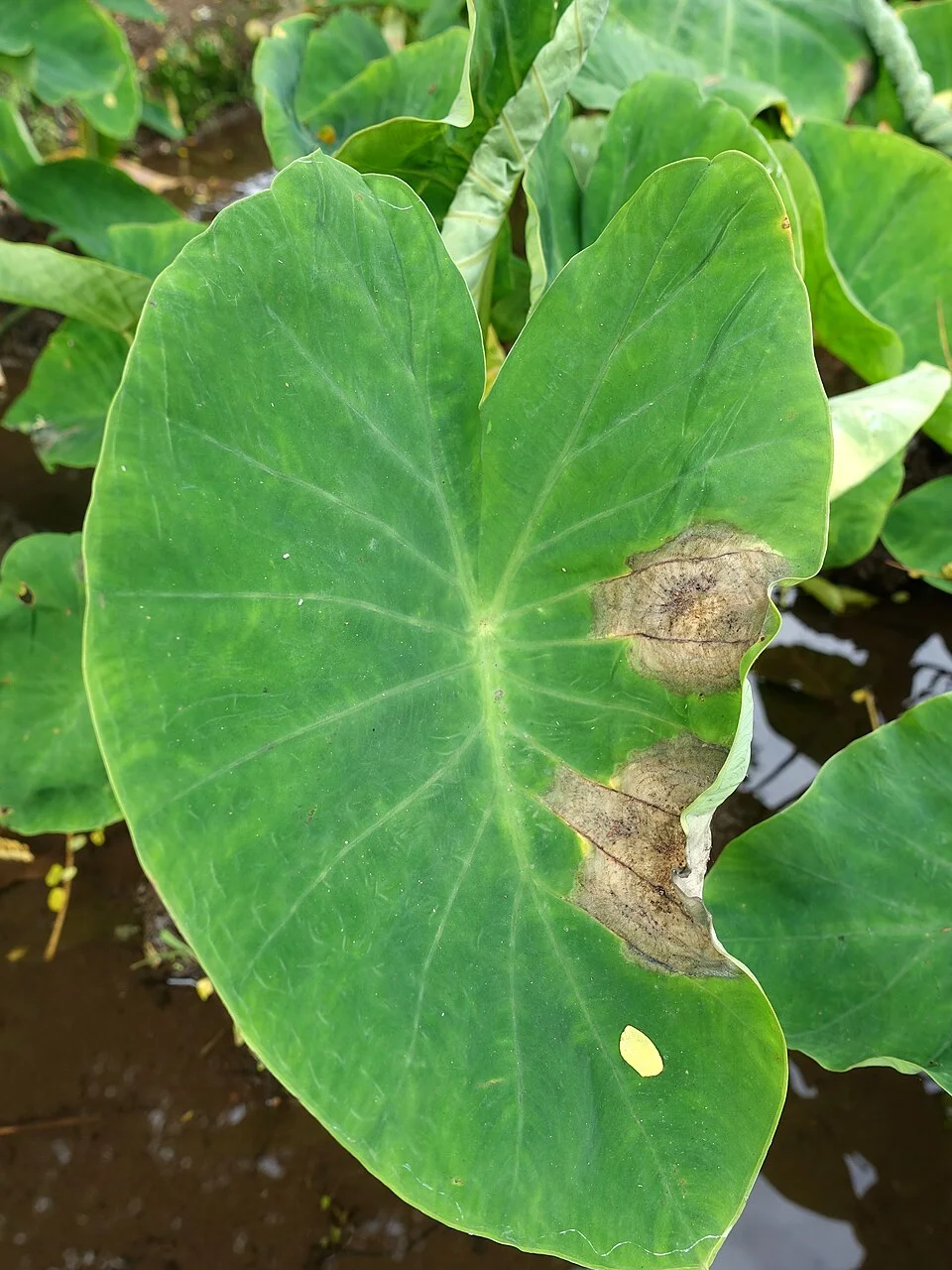
Photo: Scot Nelson from Honolulu, Hawaii, USA · CC0
Taro leaf blight (Phytophthora colocasiae) is the most damaging disease of taro. It is not a true fungus but a water mould — a germ that swims. In warm, wet weather it makes swimming spores that ride on splashing rain, dew and wind and reinfect fresh leaves within days, so a healthy field can be stripped bare almost overnight. It rides between crops on infected corms (the underground food store) and on stray volunteer taro plants.
Why it matters
Taro leaf blight is the number-one killer of taro. In warm wet weather it moves so fast it can strip your leaves in a matter of days, and once the leaves are gone the plant cannot feed its corm — a bad attack can cost you up to 9 in every 10 tubers (90%), and rot the corms you do dig up. It is hard to beat once it takes hold because it spreads invisibly in every splash of rain and drop of dew, and it hides in the soil on old corms and volunteer plants to strike your next crop. That is why stopping it starts before you see it — with a resistant variety and a dry, open canopy — not after.
When to act
Begin protective sprays and sanitation at the first water-soaked lesions, particularly in warm wet weather with a susceptible variety, because the disease can defoliate a crop within days.
This guidance is general, compiled from published agronomic references including FAO and CABI. Thresholds and timing shift with your crop, your variety and the season.
In much of the region a spray is simply called mushonga — medicine. But a chemical group you cannot name is one you cannot rotate, and a product you did not write down has no pre-harvest interval you can observe. Mushonga, and other farming words →
The full Taro leaf blight field guide
Identify it
The first thing you see
small dark, water-soaked spots on the leaf — they look wet, greasy and slightly sunken, as if a drop of oily water soaked in. They often start at the leaf edge or tip where dew sits longest.
As it spreads
the spots swell into large brown, dead patches, often with faint rings inside them like a target and a yellow border around the edge. Whole leaves then flop, rot and hang in tatters.
The tell-tale sign — look early morning:
a fine white, downy ring of fuzz on the growing edge of the lesion (that is the mould making its swimming spores in the night's dampness), and sometimes beads of amber (honey-coloured) ooze on the spot. Both dry up and vanish by midday, so check at dawn.
Don't confuse it
with sun scorch or fertiliser burn (dry, crisp, brown from the tip, no wet edge, no white fuzz, no target rings) or with old insect holes (clean-cut, no rot spreading out from them). Blight is wet-looking, fast-spreading, and grows a white downy ring overnight.
Scout for it
When
walk your crop at least once a week from the time the plants are putting out big leaves right through mid- and late-season until harvest — and step it up to every 2–3 days whenever the weather turns warm (about 20–28 °C) and wet, with rain, heavy dew or fog. That warm-and-wet spell is when blight explodes.
How
walk a big "W" across the field so you cover all four corners and the middle, not just the row by the path. Make about 10 stops along the W.
What to check
at each stop turn over the newest fully-open leaves and look at leaf edges and tips for fresh water-soaked spots. Go early in the morning while the dew is still on, so you can catch the white downy ring and the amber ooze before they dry.
When to act — lead with the number:
the threshold is the very first spot. If you find even 1 leaf with a fresh water-soaked lesion — especially in warm wet weather on a variety you know is susceptible — act that same day. Do not wait for a count of many leaves; blight can defoliate the field within days, so the first lesion is your alarm.
Control it
Prevent it first
-
plant a resistant variety (your strongest tool):
grow a blight-resistant or tolerant taro variety. This is the foundation of control and works far better than anything you spray on later — a good resistant variety stops most of the disease before it starts.
-
keep the canopy dry and clean (cultural):
plant only clean, disease-free setts (planting pieces) from a healthy crop; give plants wide spacing and good drainage so the leaves dry out quickly after rain and dew; do not plant next to an old taro field and rotate to a different crop; pull up and destroy any volunteer taro — these carry the germ from one season to the next.
Act early — cut out the first disease you find:
as soon as you spot lesions, remove and destroy the infected leaves (rogueing) — carry them out of the field in a bag and burn or bury them; never drop them on the ground or the compost where spores wash back to the crop. Avoid overhead watering, which splashes spores from leaf to leaf; water at the base instead.
Chemical — a last resort, and only preventively:
if blight keeps coming in a wet spell, protect the crop with a phosphonate fungicide (an oomycete-specific product; copper is a protective alternative). These work best sprayed before heavy infection to shield healthy leaves, on a preventive schedule in wet weather — they cannot raise leaves that are already dead. Safety: cover your skin, eyes, nose and mouth; spray in the cool of the day with the wind at your back; keep it off food, water sources, children and livestock; wash yourself and your clothes afterward; and respect the pre-harvest interval (the minimum number of days the label says you must wait between spraying and harvesting). Resistance: don't lean on one product — rotate between different chemical groups so the germ doesn't learn to survive them.
If it keeps spreading
tighten the loop — spray protectively ahead of each wet spell, rogue harder, and open up the canopy by removing the worst plants so air moves through. If it's already too late and most leaves are dead, cut your losses: harvest the corms early before corm rot sets in, then clean up completely — destroy all crop debris and volunteers, rotate the land away from taro, and start your next crop with a resistant variety and clean setts.
Catch Taro leaf blight before it costs you the harvest
This guide is the general answer. Divisi works out yours — the week to scout your own field for Taro leaf blight, and what to do the day you find it.


Crops it affects
Plan the crops it attacks

All planting calendars, country by country
Get Insights by email
A short digest of new Divisi articles. No email on quiet weeks.
Frequently asked questions
How do I identify Taro leaf blight?
The first thing you see. small dark, water-soaked spots on the leaf — they look wet, greasy and slightly sunken, as if a drop of oily water soaked in. They often start at the leaf edge or tip where dew sits longest.
When should I take action against Taro leaf blight?
Begin protective sprays and sanitation at the first water-soaked lesions, particularly in warm wet weather with a susceptible variety, because the disease can defoliate a crop within days.
How do I control Taro leaf blight?
Prevent it first — plant a resistant variety (your strongest tool):. grow a blight-resistant or tolerant taro variety. This is the foundation of control and works far better than anything you spray on later — a good resistant variety stops most of the disease before it starts.
Which crops are attacked by Taro leaf blight?
Among the crops covered here: Cocoyam / Taro.