 Divisi
Teff rust
Uromyces eragrostidis · Fungal
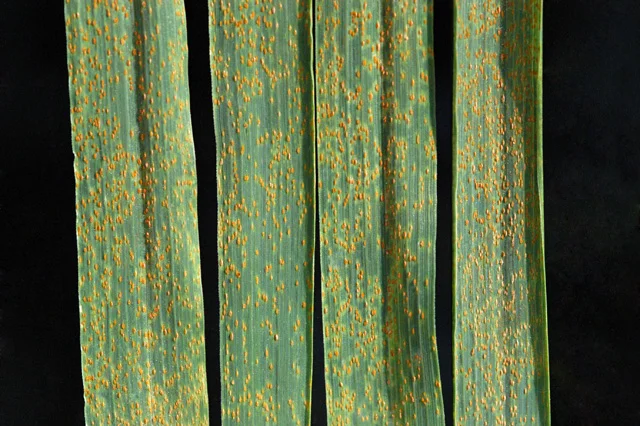
Photo: James Kolmer · Public domain
Teff rust is a fungal disease of teff (caused by Uromyces eragrostidis). Wind-blown spores land on the leaves and, wherever dew or humid air keeps the leaf wet for hours, they germinate and infect, breaking out as rusty, powdery pustules that shed yet more spores. In cool, dewy weather the disease repeats cycle after cycle, working up the plant to the flag leaf and head, starving the grain as it fills. It survives between crops on volunteer teff, wild Eragrostis grasses and old crop residue.
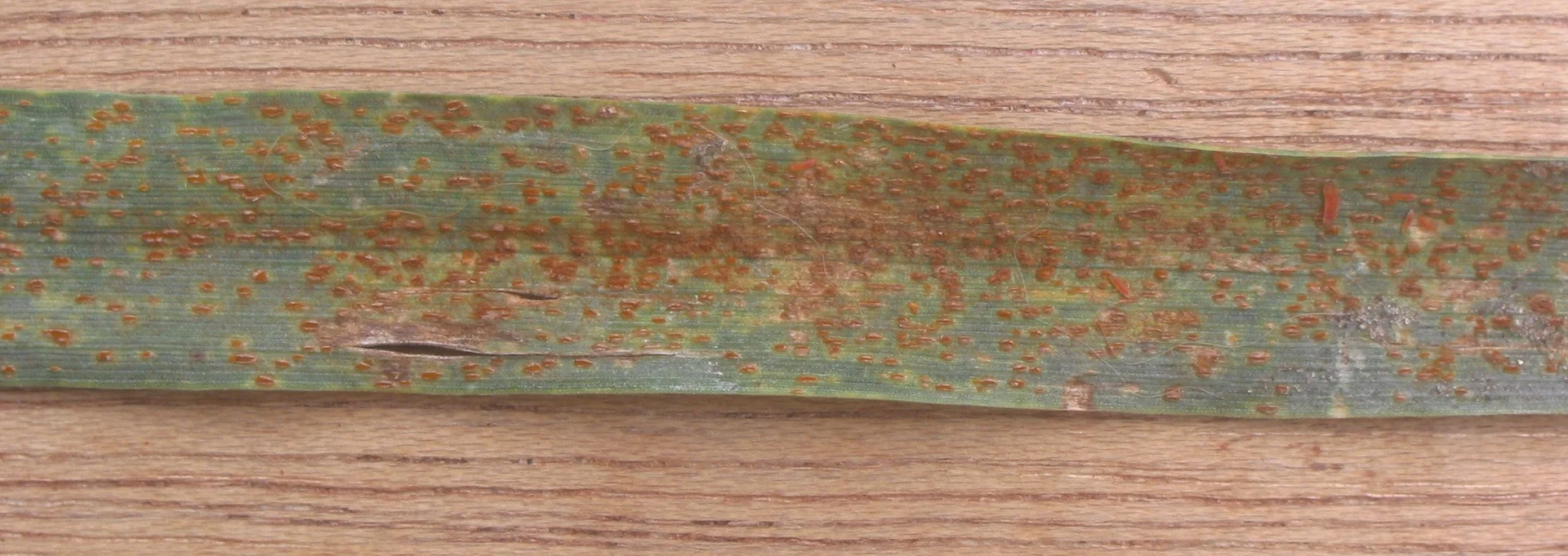
Rasbak · CC BY-SA 3.0 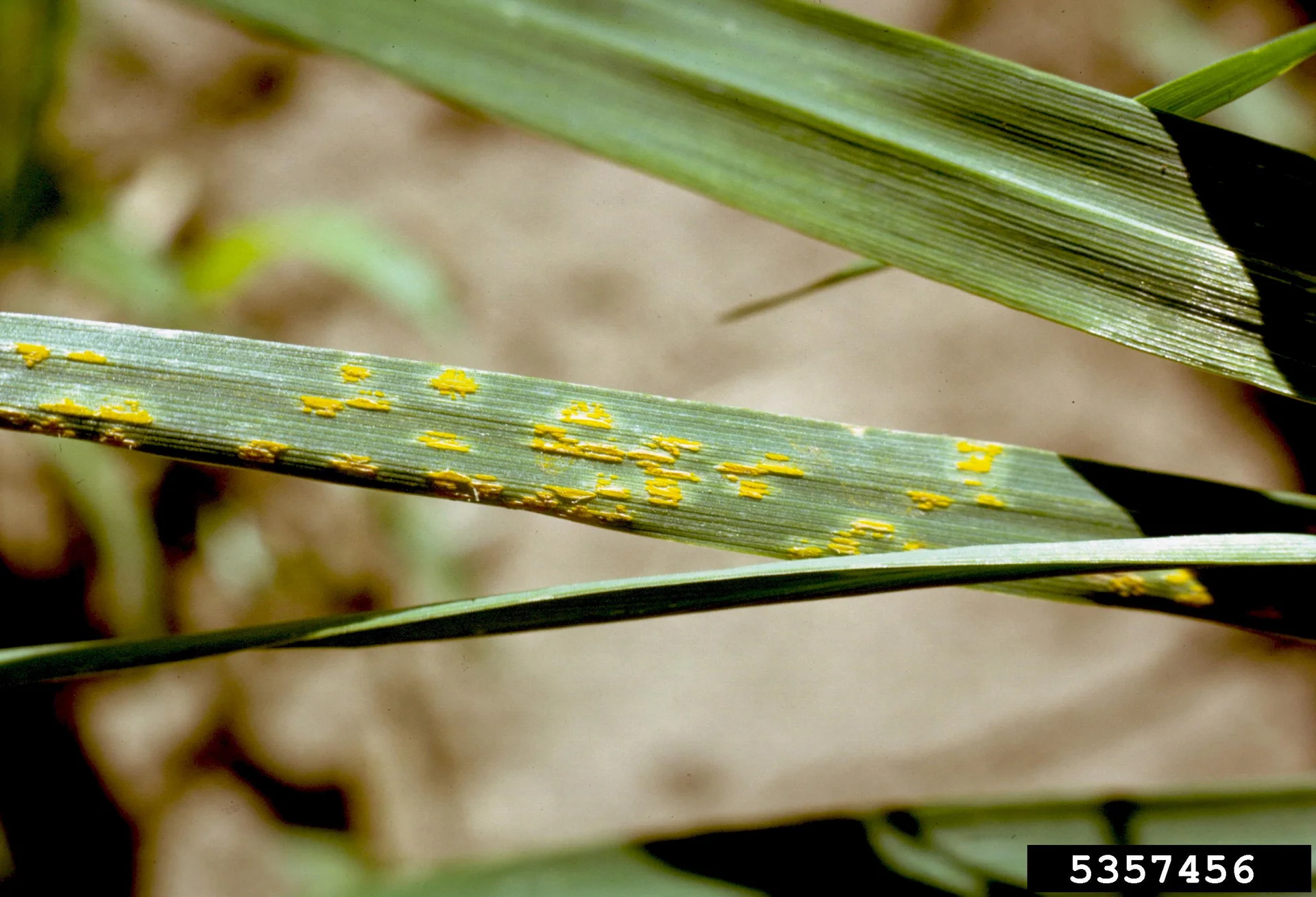
Howard F. Schwartz, Colorado State University, Bugwood.org · CC BY 3.0 us
Why it matters
Teff rust robs the leaves the plant needs to fill its tiny grain. In a bad, damp season it can take up to 40% of your harvest — nearly half — leaving shrivelled, light grain and lodged, tangled stalks that are hard to cut and thresh. It is hard to stop once it takes hold because every pustule you see is already firing off thousands of new spores on the wind, so the disease climbs from the lower leaves to the flag leaf and head faster than you can react. The only real wins come from getting ahead of it — before it reaches the top leaves that feed the grain.
When to act
Consider a fungicide when rust pustules become common on the upper leaves before or during heading, especially on a susceptible variety in cool, humid, dewy weather.
This guidance is general, compiled from published agronomic references including FAO and CABI. Thresholds and timing shift with your crop, your variety and the season.
In much of the region a spray is simply called mushonga — medicine. But a chemical group you cannot name is one you cannot rotate, and a product you did not write down has no pre-harvest interval you can observe. Mushonga, and other farming words →
The full Teff rust field guide
Identify it
The first thing you see
small rusty, powdery spots (pustules) scattered on the leaves and leaf sheaths, starting on the older lower leaves. Rub one with your finger and it leaves an orange, reddish-brown or brown dust on your skin — that dust is the spores. This rubbing-off dust is the surest sign it is rust and not something else.
How it spreads and worsens
the pustules are round to slightly stretched-out, often with a yellow halo around them. As more appear the leaf yellows, then dries and dies from the tip; badly hit upper leaves die early. Late in the season the pustules turn darker, almost black as the fungus makes its tough, over-wintering spores, and heavy stands may lodge (fall over) with shrivelled, light grain.
Where to look
check both sides of the leaf and the sheath. Rust hits leaves and stems, not the grain directly — but by killing the top leaves it starves the grain as it fills.
Don't confuse it with
simple nitrogen or age yellowing (an even, all-over pale colour with no raised spots and no dust that rubs off), or dark leaf-spot diseases (flat, dry, dead blotches that do not leave coloured powder on your finger). If it is powdery and rust-coloured and rubs off, it is rust.
Scout for it
When
teff rust threatens from development (tillering) right through mid- and late-season heading and grain fill — the whole standing crop. Start looking as the crop bushes out and canopy closes, and step up checks the moment you get a cool, humid spell with heavy morning dew or light rain, which is exactly the weather rust loves.
How often
walk the field at least once a week during these stages, and again a day or two after any run of dewy or wet mornings.
How to walk it
cross the field in a big "W" shape so you cover all four corners and the middle — not just the edge nearest the path, where you always look. Make about 10 stops along the W.
What to check at each stop
turn over the leaves on a few plants and look at both surfaces and the sheaths for the rusty, powdery pustules. Especially watch the upper leaves — the flag leaf and the two below it — and the head, because those are the leaves that fill the grain.
The number that tells you to act
rust is a threat once the pustules become common on the upper leaves around heading. As a plain count: if about 1 in 5 of the upper leaves (2 in 10) already carry fresh rusty pustules before or during heading — act now, and treat this as urgent on a susceptible variety in cool, dewy, humid weather. A few old spots low down on a dry, warm crop is not yet an emergency.
Control it
Prevent it first (your strongest tool)
grow a rust-resistant or tolerant teff variety suited to your area — this is the single best defence, cutting the disease by around two-thirds with no spraying and no cost each season. If rust hits your fields most years, ask your extension officer or seed supplier which local variety stands up to it.
Farm so the crop stays drier and cleaner (cultural control)
sow at the recommended time and seeding rate so the stand isn't so thick and lush that it traps damp air — a crowded, over-humid canopy stays wet longer and feeds the rust. Don't overdo nitrogen, which makes soft, leafy growth rust loves. Between and before crops, pull out volunteer teff and wild Eragrostis grasses nearby and plough in or remove old infected residue, and rotate to another crop so the fungus has no green teff to carry over on.
Chemical — a triazole fungicide, as a last resort:
only where the crop's value justifies it and rust is building on a susceptible variety in dewy weather, spray a triazole fungicide at the first onset of rust, before or at early heading — spraying early, while only the lower leaves are hit, protects the flag leaf and head; once the top leaves are covered it is largely too late to save that grain. (A triazole is a fungicide type that moves a short way inside the leaf, not just sitting on the surface.)
Spray safely
cover your skin, eyes, nose and mouth; spray in the cool of the morning or evening with the wind at your back so the mist blows away from you; keep the spray off food, drinking water, children, animals and bees; wash yourself and your clothes afterwards; and respect the pre-harvest interval — the minimum number of days the label says you must wait between spraying and cutting the crop — so no chemical remains in the grain you eat or sell.
Guard against resistance
if you must spray more than once, rotate to a fungicide from a different chemical group rather than using the same triazole again and again, so the fungus cannot get used to it and stop responding.
If it keeps spreading
if rust has already engulfed the flag leaves and heads across the field and grain is filling, spraying will no longer save this crop — cut your losses: harvest promptly before the stand lodges further and the grain shrivels more, thresh and store the grain dry, and destroy or plough in the infected residue so spores don't carry into next season. Then switch to a resistant variety and a clean rotation next year — that, not more spray, is how you break the cycle.
Catch Teff rust before it costs you the harvest
This guide is the general answer. Divisi works out yours — the week to scout your own field for Teff rust, and what to do the day you find it.


Crops it affects
Plan the crops it attacks

All planting calendars, country by country
Get Insights by email
A short digest of new Divisi articles. No email on quiet weeks.
Frequently asked questions
How do I identify Teff rust?
The first thing you see. small rusty, powdery spots (pustules) scattered on the leaves and leaf sheaths, starting on the older lower leaves. Rub one with your finger and it leaves an orange, reddish-brown or brown dust on your skin — that dust is the spores. This rubbing-off dust is the surest sign it is rust and not something else.
When should I take action against Teff rust?
Consider a fungicide when rust pustules become common on the upper leaves before or during heading, especially on a susceptible variety in cool, humid, dewy weather.
How do I control Teff rust?
Prevent it first (your strongest tool). grow a rust-resistant or tolerant teff variety suited to your area — this is the single best defence, cutting the disease by around two-thirds with no spraying and no cost each season. If rust hits your fields most years, ask your extension officer or seed supplier which local variety stands up to it.
Which crops are attacked by Teff rust?
Among the crops covered here: Teff.