 Divisi
Tobacco brown spot
Alternaria alternata · Fungal
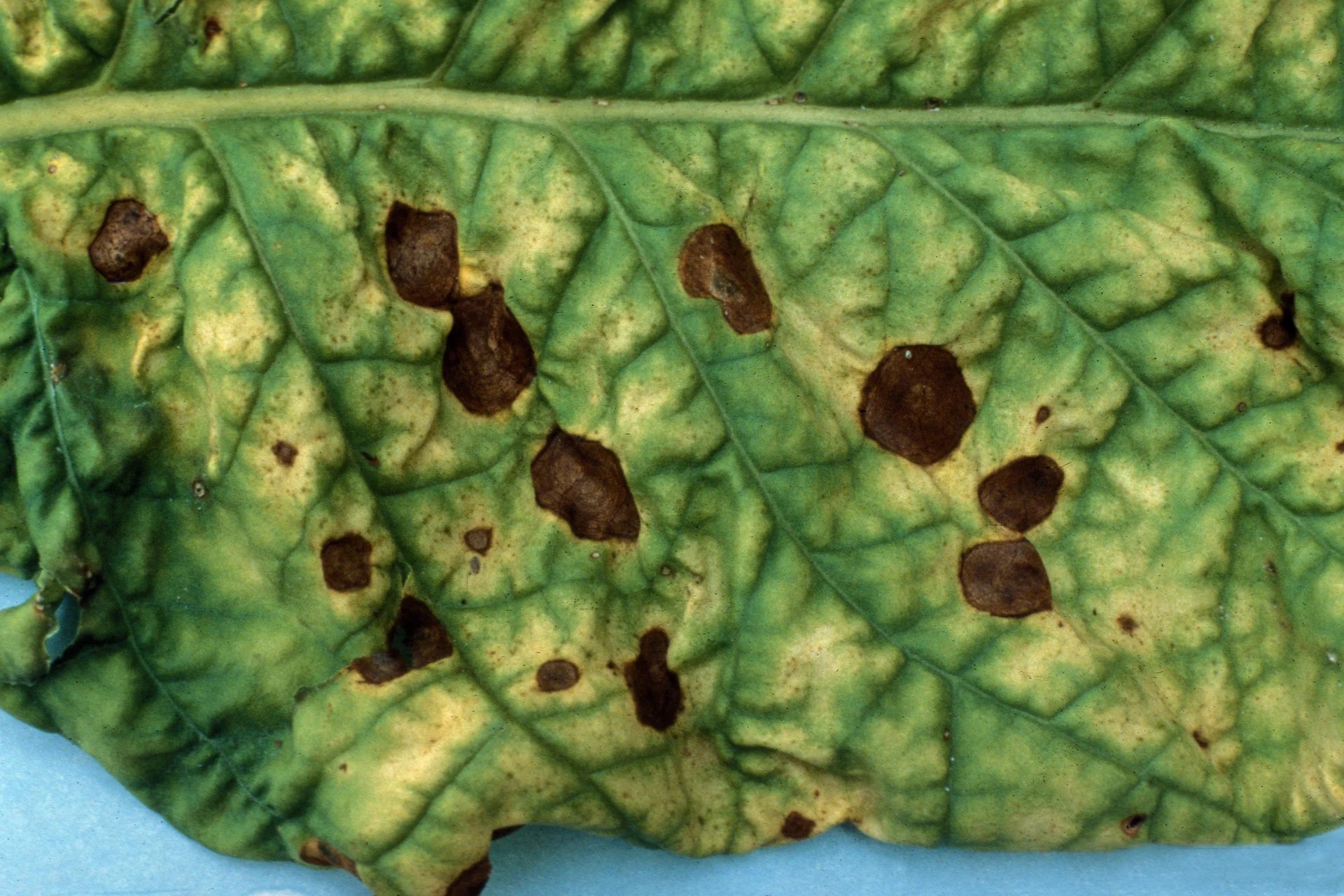
Photo: R.J. Reynolds Tobacco Company Slide Set, R.J. Reynolds Tobacco Company, Bugwood.org · CC BY 3.0 us
Tobacco brown spot is a leaf-spot fungus (Alternaria alternata) that feeds mainly on old, ripening and over-ripe tobacco leaves. It is a weak fungus — it rarely troubles young, healthy, fast-growing leaf, but once the bottom leaves start to age, ripen or get damaged it moves in, especially in warm, humid weather with heavy dew. It makes the tell-tale target-ring spots on the lower leaves — the very leaves that are your first harvest — and it keeps working on picked leaf in the curing barn, so the loss can follow the crop indoors.
Why it matters
Tobacco brown spot hits you where it hurts most — the lower leaves that ripen first and are your earliest harvest. In a bad year, on an over-ripe, humid crop, it can rot and downgrade up to 3 in every 10 leaves (30% of your crop), and even light spotting drops a leaf into a cheaper grade so buyers pay you less. The worst of it is that it does not stop at harvest: the fungus keeps eating picked leaf in the curing barn if the leaf goes in damp or spotted, so a leaf that looked saved can still be lost. Because it feeds on ageing leaf, the clock is your enemy — leaf left too long on the plant is exactly what it wants.
When to act
first target-ring spots found on the ripening lower leaves — pick those leaves promptly; if spots appear on the lower leaves of about 1 in 10 plants (10%) while warm, humid weather holds and the leaf is not yet ready to pick, start protectant sprays
This guidance is general, compiled from published agronomic references including FAO and CABI. Thresholds and timing shift with your crop, your variety and the season.
In much of the region a spray is simply called mushonga — medicine. But a chemical group you cannot name is one you cannot rotate, and a product you did not write down has no pre-harvest interval you can observe. Mushonga, and other farming words →
The full Tobacco brown spot field guide
Identify it
The first thing you see
round brown spots on the older, lower leaves, usually 1 to 3 cm across (about the size of a fingernail to a large coin). Look closely and each spot has rings inside it, one inside the other, like a target or an archery board (this is 'target spot'), and each spot is ringed by a yellow halo where the green fades. It always starts low down, on the oldest, most ripe leaves first — not on the young top leaves.
As it spreads
the spots grow, join up and dry out, and the papery dead centres crack and fall out so the leaf looks shot full of holes and tears easily. It is worst on over-ripe leaf left too long on the plant, and after warm, humid, dewy weather you may find dozens of spots on a single bottom leaf.
It follows the leaf into the barn
picked leaf that goes in damp or already spotted keeps rotting during curing — spots spread and the leaf goes brown and brittle. This 'barn rot' is the same fungus carrying on indoors.
Don't confuse it
with frogeye leaf spot, whose spots are smaller with pale grey or white papery centres and a dark brown ring, but NO target rings inside. Also not angular leaf spot (a bacterial disease) — those spots are angular and water-soaked, boxed in by the leaf veins, with no rings and no yellow halo. And not weather fleck / ozone injury, which is fine white-to-brown speckling scattered over the top leaves with no round spots and no halo. Brown spot is the one with round target rings and a yellow halo, low on the oldest leaves.
Scout for it
When to look hardest
from topping and the start of ripening onward — the mid-season and late-season stages — because that is when the lower leaves begin to age and ripen, which is the only leaf this weak fungus can attack. Step up your checks the moment the weather turns warm and humid, or after rain, mist or a heavy dew, since those wet nights are when the spots multiply.
How to walk the field
every few days walk a big "W" shape so you cross all four corners and the middle — not just the row nearest the path. Make about 10 stops along the way.
What to check at each stop
look at the lowest, oldest, most ripe leaves first (turn a few over too), hunting for the round target-ring spots with the yellow halo. Those bottom leaves ripen and age first, so that is where brown spot always shows up first.
The number that means act now
the very first target-ring spots on the ripening lower leaves are your signal to pick those leaves promptly — do not wait for them to over-ripen. If spots are showing on the lower leaves of about 1 in every 10 plants (10%) while the weather stays warm and humid and the leaf is not yet ready to pick, that is the point to start protectant sprays to protect the leaf still on the plant.
Control it
Prevent it first
-
pick ripe leaf on time (your strongest tool, no sprayer needed):
brown spot lives on over-ripe, ageing leaf, so prime (pick) the lower leaves as soon as they are ripe and never leave ripe leaf hanging on the plant to over-ripen. Picking on time simply starves the fungus of the old leaf it needs — this one habit prevents most of the damage.
-
keep the crop clean, healthy and airy:
feed the crop in balance — do not over-apply nitrogen (soft, lush leaf is more prone) and keep potassium up, because well-fed, firm leaf resists the fungus. Give plants enough spacing so leaves dry quickly and air moves through the rows, and clear away and destroy old diseased leaf and last season's crop stalks and debris where the fungus survives between crops. Where you can get one, plant a variety known to tolerate brown spot.
Act early — remove the affected leaf:
the moment you find spotted lower leaves, pick and remove them — take the ripe ones to cure and destroy (bury or burn) any that are too rotten to use, well away from the field and the barn. Getting the diseased leaf off the plant and out of the crop cuts down the spores that would spread to the leaf above.
Chemical as a last resort — protectant fungicide:
if warm, humid weather is holding and spots are appearing before the lower leaves are ready to pick, use a protectant (contact) fungicide such as mancozeb. "Protectant" means it coats the leaf and stops new spores taking hold — it shields healthy leaf but cannot cure a spot already there, so it must go on before or at the very first spots and be re-applied on a regular schedule (about every 7 to 10 days) through the humid spell and after rain washes it off.
Spray safely
cover your skin, eyes, nose and mouth; spray in the cool of the morning or evening with the wind at your back; keep the spray off drinking water and rivers, and away from children and bees. Respect the pre-harvest interval — the number of days the label says you must wait between the last spray and picking the leaf — this matters doubly for tobacco because the leaf is cured and smoked. Wash yourself and your clothes afterwards.
Fight resistance
do not lean on one product forever — rotate to a fungicide from a different chemical group each time so the fungus cannot get used to it. Protectant sprays like mancozeb used before symptoms are the backbone; never rely on a single product spray after spray.
If it keeps spreading — harvest and cure the smart way:
when the lower leaves are spotting faster than you can hold, pick the ripe and lightly-spotted leaves early rather than losing them to over-ripening, and keep them apart from clean leaf. Cure with plenty of ventilation and never load damp or wet leaf into the barn, because the fungus carries on rotting leaf indoors. When grading, sort brown-spotted leaf out into its own lower grade — one rotten leaf packed with good leaf pulls the whole lot down.
Catch Tobacco brown spot before it costs you the harvest
This guide is the general answer. Divisi works out yours — the week to scout your own field for Tobacco brown spot, and what to do the day you find it.


Crops it affects
Plan the crops it attacks

All planting calendars, country by country
Get Insights by email
A short digest of new Divisi articles. No email on quiet weeks.
Frequently asked questions
How do I identify Tobacco brown spot?
The first thing you see. round brown spots on the older, lower leaves, usually 1 to 3 cm across (about the size of a fingernail to a large coin). Look closely and each spot has rings inside it, one inside the other, like a target or an archery board (this is 'target spot'), and each spot is ringed by a yellow halo where the green fades. It always starts low down, on the oldest, most ripe leaves first — not on the young top leaves.
When should I take action against Tobacco brown spot?
first target-ring spots found on the ripening lower leaves — pick those leaves promptly; if spots appear on the lower leaves of about 1 in 10 plants (10%) while warm, humid weather holds and the leaf is not yet ready to pick, start protectant sprays
How do I control Tobacco brown spot?
Prevent it first — pick ripe leaf on time (your strongest tool, no sprayer needed):. brown spot lives on over-ripe, ageing leaf, so prime (pick) the lower leaves as soon as they are ripe and never leave ripe leaf hanging on the plant to over-ripen. Picking on time simply starves the fungus of the old leaf it needs — this one habit prevents most of the damage.
Which crops are attacked by Tobacco brown spot?
Among the crops covered here: Tobacco.