 Divisi
Carrot fly
Chamaepsila rosae · Insect
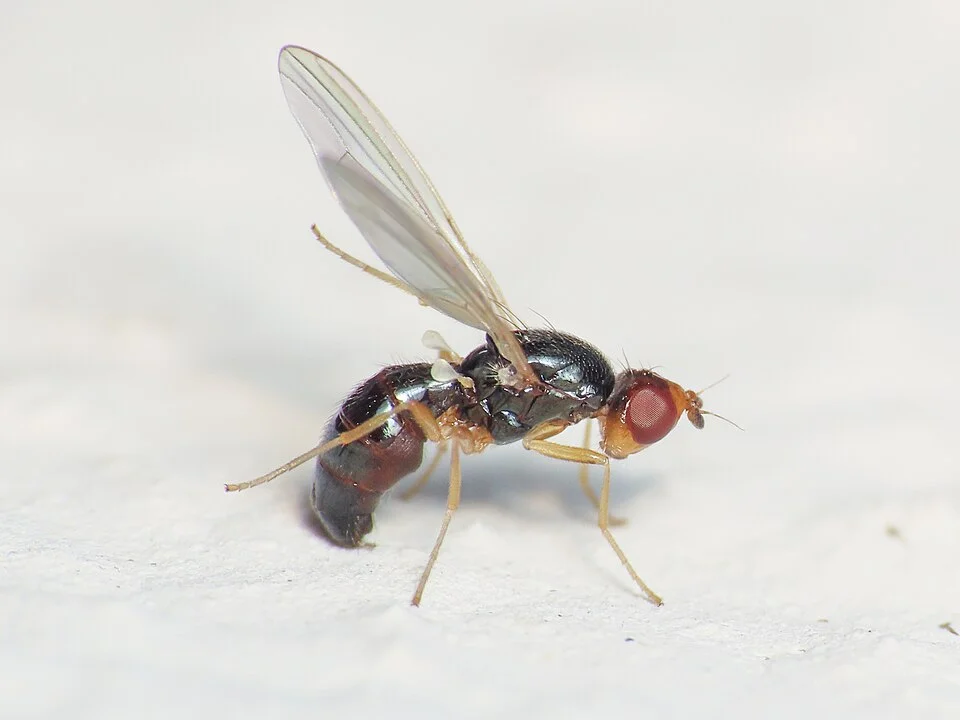
Photo: Emanuele Santarelli · CC BY-SA 4.0
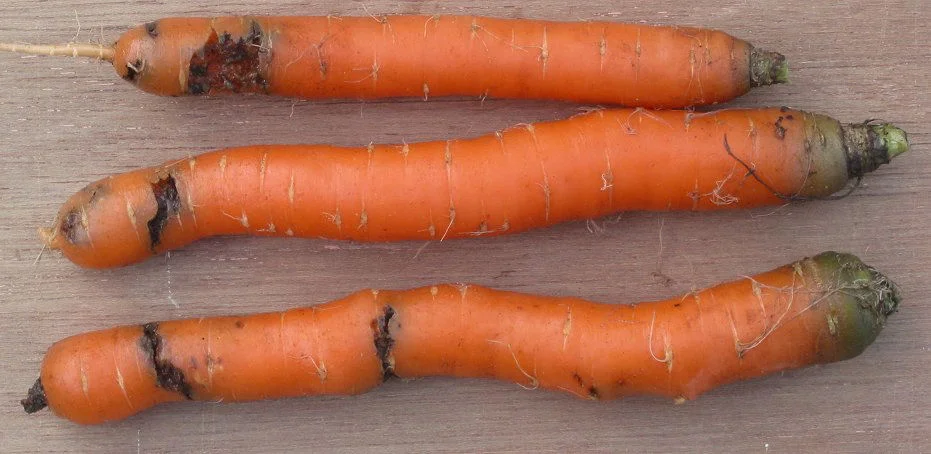
Carrot fly (Chamaepsila rosae) is a small, low-flying fly whose maggots tunnel through the roots of carrots and their close relatives — parsnip, celery and parsley. The females are drawn by the scent of the foliage, strongest when the leaves are bruised during thinning or weeding, and lay their eggs in the soil at the base of the plant. The maggots that hatch mine down into the root, leaving rusty-brown tunnels that spoil the crop for sale and storage and open the way to rots.
Why it matters
Carrot fly is the pest that ruins your carrots from the inside. Its maggots bore rusty tunnels through the roots so they can't be sold, stored or eaten, and a bad attack can spoil up to 2 in every 5 roots (40%). You won't see the damage until you pull a root up — and once the maggot is tunnelling inside, no spray can reach it. That is why, with carrot fly, keeping the fly out is not just one option, it is the whole battle.
When to act
adult flies caught on yellow sticky traps, or first rusty tunnels seen when sample roots are lifted
This guidance is general, compiled from published agronomic references including FAO and CABI. Thresholds and timing shift with your crop, your variety and the season.
In much of the region a spray is simply called mushonga — medicine. But a chemical group you cannot name is one you cannot rotate, and a product you did not write down has no pre-harvest interval you can observe. Mushonga, and other farming words →
The full Carrot fly field guide
Identify it
The first thing you notice (above ground)
scattered single plants whose leaves turn a dull red-bronze, then yellow, sometimes stunted or wilting in the heat of the day while the plants right around them stay green. Reddening in odd patches like this is your warning — the real trouble is hidden below, in the root.
In the root
pull one up and look for rusty-brown, winding tunnels just under the skin, mostly around the crown (the shoulders at the top) and the lower part of the root. Slice it and the channels run orange-brown, often with soft rot following behind; badly hit carrots are scarred, cracked and forked.
The maggot inside
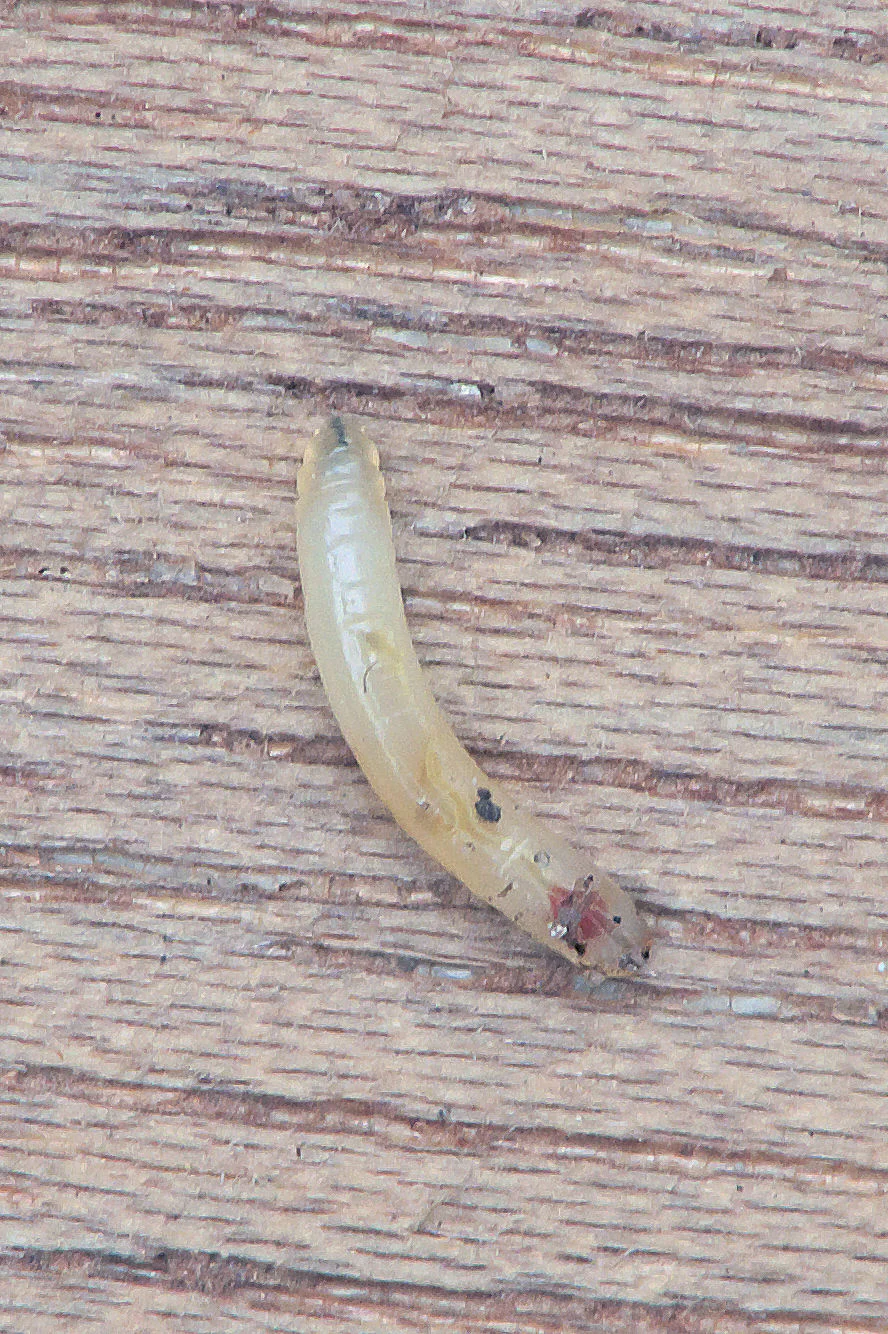
in a fresh tunnel you'll find a thin, creamy-white maggot (the young grub) about 1 cm long — roughly the length of a grain of rice — pointed at the head end, with no legs and no hard shell, soft and shiny.
The fly itself
(you rarely catch sight of it, but you'll see it on a trap): a small, shiny black fly, only about 4–5 mm — smaller than a housefly, more like a little black ant with wings — with a reddish-orange head and yellow legs. It flies low, close to the ground, along edges and shelter, mostly in the cool of morning and evening.
Don't mix it up with wireworm
— a hard, shiny, orange, jointed grub with legs that bores a clean, straight, round hole deep into the root. Carrot-fly maggots are the opposite: soft, pale, legless, making shallow, winding rusty tunnels near the surface. And a root that is simply forked or split (from stony ground or fresh manure) has no tunnels and no maggot — that is not carrot fly.
Scout for it
When to look
start as soon as the roots begin to swell (the development stage) and keep watching right through mid- and late-season up to harvest — the maggots go on tunnelling the whole time, and the longer roots sit in the ground the worse the damage gets. Look hardest during cool, moist spells (around 12–22°C), which is when the flies lay their eggs.
Set yellow sticky traps at the edges of the bed
, just above the top of the leaves — the flies come in low from hedges, shelter and last season's carrot ground. Check the traps every few days.
Walk a big "W"
across the bed every week or two, so you cover all four corners and the middle — not just the row beside the path.
At about 5 stops, gently lift one sample root
and check the shoulders and lower root for fresh rusty tunnels, slicing one open to be sure. At the same stops, note any plants with red-bronze or wilting leaves.
The trigger — act on the FIRST sign
Unlike a leaf pest where you can allow a little damage, with carrot fly one maggot ruins a whole root. So the moment you catch even one fly on a trap, or find the very first rusty tunnel in a lifted root → act now. Do not wait for the numbers to build up.
Control it
Prevent
-
cover the bed (your best defence)
Put fine insect-proof mesh or fleece over the bed from the day you sow, tucked in and weighted down all round so no fly can creep under the edge. The females simply cannot reach the plants to lay — this is the single most reliable control a smallholder has against carrot fly. Because the fly flies so low, a mesh barrier about knee-to-waist high (60–75 cm) around a small bed works the same way, walling the low-flying females out.
-
break the cycle
Rotate: never plant carrots — or their relatives parsnip, celery and parsley, which the fly also attacks — where any of them grew last season, because the pupae (the resting stage) overwinter in that soil; move the bed as far away as you can. Sow thinly so you barely have to thin, because thinning is what calls the fly in — the bruised leaves release the scent she follows.
-
thin and weed carefully
When you must thin or weed, do it in the evening when few flies are about, firm the soil back around the plants, and carry every thinning right off the plot rather than leaving it on the ground. Handle the plants gently — crushing or brushing the foliage spreads the scent that draws the fly. A gentle watering afterwards helps settle the smell.
-
grow a resistant variety
Where you can get the seed, sow a partially resistant carrot variety; the maggots do noticeably less damage on these. On its own it only reduces harm, so use it together with the mesh and rotation, not instead of them. You can also time your sowing so the roots are not swelling during the main cool, moist egg-laying spells where your local season allows, and lift maincrop roots promptly instead of leaving them long in the ground for late maggots to find.
When it keeps spreading — and why there is no rescue spray
Once the maggots are inside the root, no spray can reach them, so there is no chemical cure for carrot fly — the fight is won only by keeping the fly out. If you are still finding fresh tunnels under the mesh, hunt for the gap: flies slip through any loose edge or hole, and the mesh must go on before the first flights, not after damage shows. If damage is spreading and roots are being ruined, lift the crop early and use or sell the sound roots at once — every extra week means more tunnelling. Never store or replant damaged roots, and clear away every leftover and self-sown carrot, because the maggots and pupae in old roots and soil become next season's flies. Then next season, commit to the mesh from day one, rotate the bed, and sow a resistant variety — that combination is what truly beats carrot fly.
Catch Carrot fly before it costs you the harvest
This guide is the general answer. Divisi works out yours — the week to scout your own field for Carrot fly, and what to do the day you find it.


Crops it affects
Plan the crops it attacks

All planting calendars, country by country
Get Insights by email
A short digest of new Divisi articles. No email on quiet weeks.
Frequently asked questions
How do I identify Carrot fly?
The first thing you notice (above ground). scattered single plants whose leaves turn a dull red-bronze, then yellow, sometimes stunted or wilting in the heat of the day while the plants right around them stay green. Reddening in odd patches like this is your warning — the real trouble is hidden below, in the root.
When should I take action against Carrot fly?
adult flies caught on yellow sticky traps, or first rusty tunnels seen when sample roots are lifted
How do I control Carrot fly?
Prevent — cover the bed (your best defence). Put fine insect-proof mesh or fleece over the bed from the day you sow, tucked in and weighted down all round so no fly can creep under the edge. The females simply cannot reach the plants to lay — this is the single most reliable control a smallholder has against carrot fly. Because the fly flies so low, a mesh barrier about knee-to-waist high (60–75 cm) around a small bed works the same way, walling the low-flying females out.
Which crops are attacked by Carrot fly?
Among the crops covered here: Carrot.