 Divisi
Cassava mealybug
Phenacoccus manihoti · Insect
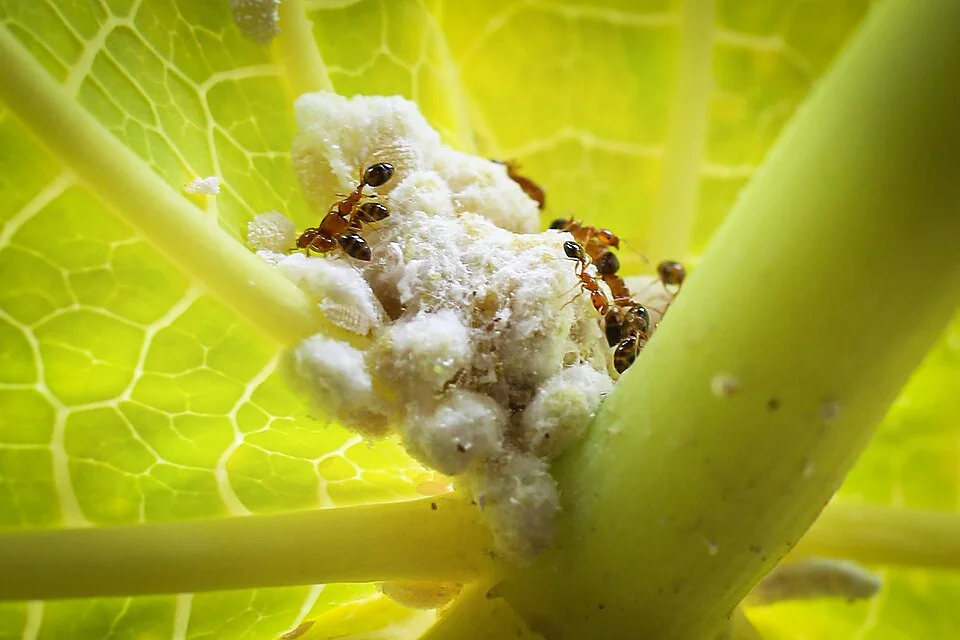
Photo: MJN2000 · CC0
Cassava mealybug (Phenacoccus manihoti) is a soft-bodied, sap-sucking insect, hidden under white powdery wax, that colonises the growing tips of cassava. As it feeds it injects a toxic saliva that shortens the stem joints, bunching the top leaves into a tight 'cabbage-head' rosette and stunting the whole plant. It multiplies explosively in the hot, dry season and spreads mainly on infested stem cuttings. It is the textbook success story of biological control in Africa: the introduced parasitoid wasp Anagyrus lopezi now holds it in check across the cassava belt wherever farmers avoid killing it with broad sprays.
Why it matters
Cassava mealybug can strip away up to 60% — well over half — of your cassava, shrinking both the roots you eat and the stems you keep for next season's cuttings. It attacks the soft growing tip, bunches the top into a useless 'cabbage head', and multiplies fast through the hot, dry months. It is hard to beat once it is in, because a waxy coat shields it from sprays and it travels hidden on the very cuttings you plant — so an infested field replants the problem year after year. The good news: your strongest ally is free — a tiny helper wasp already lives in Africa's cassava fields and will hold the pest down, as long as you do not kill it with broad poisons.
When to act
Colonies of pink-white mealybugs on shoot tips causing bunching of top leaves; scout during the dry season.
This guidance is general, compiled from published agronomic references including FAO and CABI. Thresholds and timing shift with your crop, your variety and the season.
In much of the region a spray is simply called mushonga — medicine. But a chemical group you cannot name is one you cannot rotate, and a product you did not write down has no pre-harvest interval you can observe. Mushonga, and other farming words →
The full Cassava mealybug field guide
Identify it
The damage you see first
the top of the plant stops stretching and the young leaves bunch into a tight, crumpled 'cabbage head' or shaving-brush tip — the joints between the leaves shrink so the leaves stack up in a little rosette. Below it, leaves yellow, curl and drop, the shoots die back, and the whole plant looks stunted.
Sticky and black
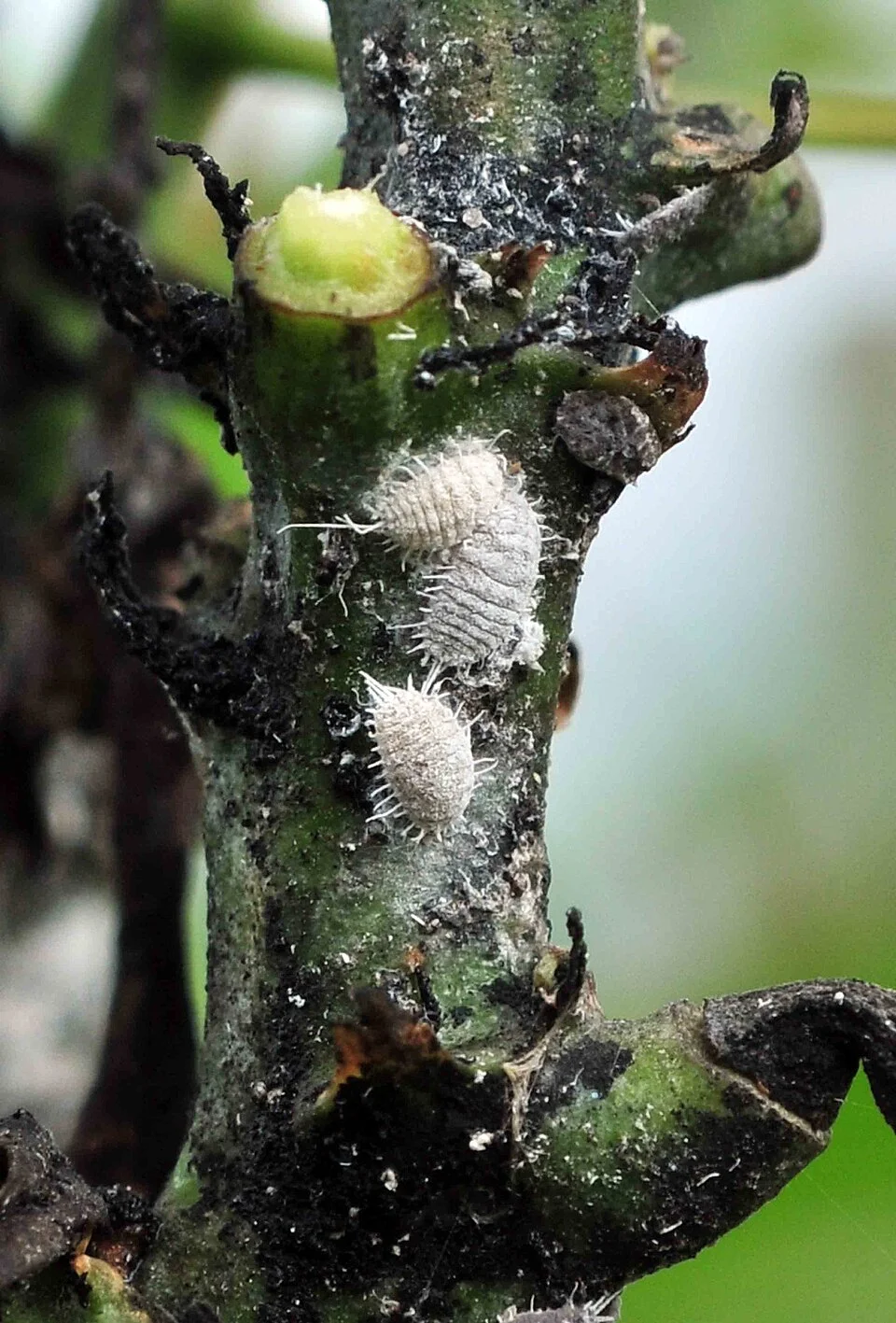
the bunched tips feel sticky with honeydew (the sweet waste the insects drip as they suck sap), and a black sooty mould grows on that stickiness. Ants often stream up and down the stem, farming the insects for their honeydew — a line of ants heading for the tips is a useful early clue.
The insect itself
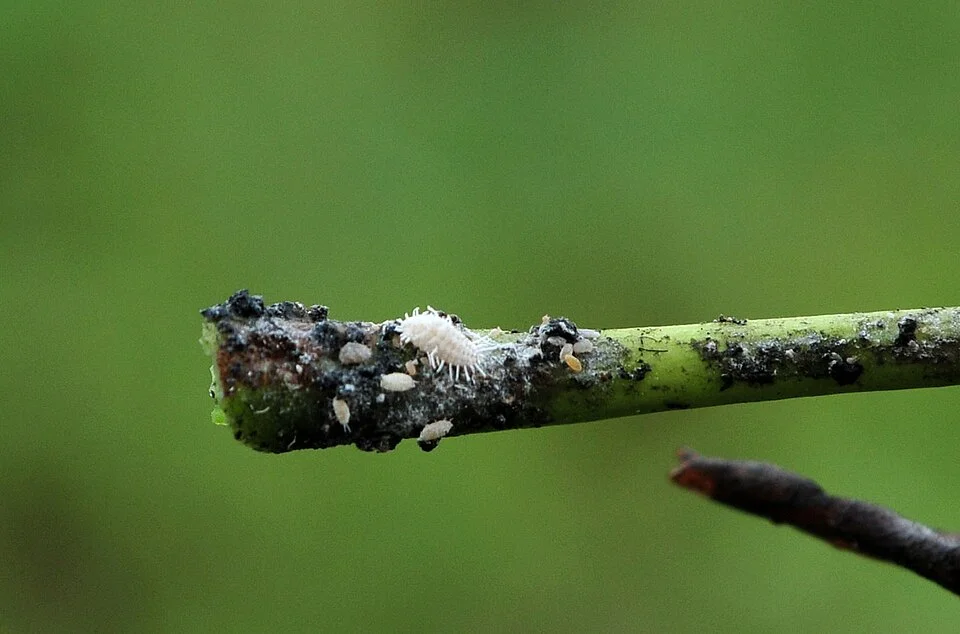
on the growing point and the youngest leaves you'll find white, mealy, cotton-wool or candle-wax clusters. Each insect is tiny — about a pinhead or a small sesame seed — soft-bodied and coated in white powdery wax. Wipe or crush a cluster and it smears pink (the body under the wax is pink-orange). They do not run or fly; they stay stuck to the plant, and they are worst in the hot, dry season.
Tell it apart from look-alikes
cassava green mite also attacks the tips in the dry season, but it leaves yellow speckling and a bleached, dusty look with NO white cotton and NO pink insects. Whiteflies are white too, but they fly up in a little cloud when you shake the plant — mealybugs stay put. Only the mealybug makes the white waxy clusters together with the bunched 'cabbage-head' tips.
Scout for it
When to look
check every week or two right through the hot, dry season, and most closely while the crop is building its canopy and bulking its roots — the development and mid-season months. That is when the plant has tender growing tips for the insect to attack and when its numbers explode.
How to walk
do not just look at the edge by the path. Walk a big 'W' across the field so you cover all four corners and the middle, stopping about 10 times. At each stop, check the top shoots of a few plants — around 10 plants in all.
What to check
look right into the growing point and the youngest, bunched leaves at the very top, and gently pull a bunched tip apart. That is where the white waxy colonies hide. Also watch for tips that are sticky, blackened, or crawling with ants.
When to act — lead with the count:
as soon as you find white mealy colonies on the tips of even 1 in 10 plants, or the very first bunched 'cabbage-head' tops, treat that as your action threshold and act now. In the dry season their numbers double fast, so early is everything — do not wait for a big share of the field to bunch up.
Control it
Prevent it
-
plant clean cuttings (your most important step):
the insect travels from field to field hidden on cassava stems. Take cuttings only from healthy plants with no white wax and no bunched tips, and throw away any stick that has mealybugs on it. Never carry, sell or share cuttings from an infested field — you would simply be planting the problem somewhere new.
-
beat the dry season and grow tough varieties:
plant early so the crop is well grown and hardy before the hot, dry months when the pest peaks. Where you can get them, choose tolerant or resistant cassava varieties, and intercrop (for example with a legume such as cowpea) to keep the field's helpful insects around.
Your best weapon is free — the helper wasp:
a tiny wasp called Anagyrus lopezi (smaller than an ant) was brought into Africa decades ago and now lives in cassava fields across the continent. It is a parasitoid — a helper insect whose young grow inside the mealybugs and kill them from the inside — and it quietly holds the pest down for you. Your job is simply to protect it: do NOT spray broad insecticides, which wipe out the wasp and make the next outbreak far worse. Ladybird beetles and lacewings help too.
Act early — cut out the colonies by hand:
when you find infested, bunched tips, cut them off and destroy them — burn or bury them. Do not drop them in the field or carry them to another plot. Taking out the worst tips early removes whole colonies before they spread and buys time for the wasp and the coming rains to catch up.
Why NOT to reach for a sprayer
this pest is a poor spray target. Contact sprays — poisons that only work where they land on the insect — slide straight off its waxy coat, and broad poisons also kill the very wasp and predators that are already winning for you, so the mealybug bounces back stronger (resurgence). If you ever must handle any farm chemical for another reason, follow the label and its pre-harvest interval (the required wait between spraying and eating or selling the crop), rotate to a different chemical group so pests do not build resistance (stop being killed by a poison they meet too often), cover your skin, eyes and nose, spray in the cool of the day with the wind at your back, keep it well away from food, water, children and bees, and wash afterwards. But for cassava mealybug, sanitation and the wasp beat spraying.
If it keeps spreading — and when it's too late:
widen your cutting-out and burning of infested tips, stop all movement of cuttings in and out, and let the rains help — heavy rain washes the young crawlers off and knocks the pest right back while the wasp builds up. If a field is badly bunched late in the season, cut your losses on the worst plants and harvest what roots you can. Most important of all: take next season's cuttings only from clean, healthy plants, so you do not replant the infestation.
Catch Cassava mealybug before it costs you the harvest
This guide is the general answer. Divisi works out yours — the week to scout your own field for Cassava mealybug, and what to do the day you find it.


Crops it affects
Plan the crops it attacks

All planting calendars, country by country
Get Insights by email
A short digest of new Divisi articles. No email on quiet weeks.
Frequently asked questions
How do I identify Cassava mealybug?
The damage you see first. the top of the plant stops stretching and the young leaves bunch into a tight, crumpled 'cabbage head' or shaving-brush tip — the joints between the leaves shrink so the leaves stack up in a little rosette. Below it, leaves yellow, curl and drop, the shoots die back, and the whole plant looks stunted.
When should I take action against Cassava mealybug?
Colonies of pink-white mealybugs on shoot tips causing bunching of top leaves; scout during the dry season.
How do I control Cassava mealybug?
Prevent it — plant clean cuttings (your most important step):. the insect travels from field to field hidden on cassava stems. Take cuttings only from healthy plants with no white wax and no bunched tips, and throw away any stick that has mealybugs on it. Never carry, sell or share cuttings from an infested field — you would simply be planting the problem somewhere new.
Which crops are attacked by Cassava mealybug?
Among the crops covered here: Cassava.