 Divisi
Citrus leafminer
Phyllocnistis citrella · Insect
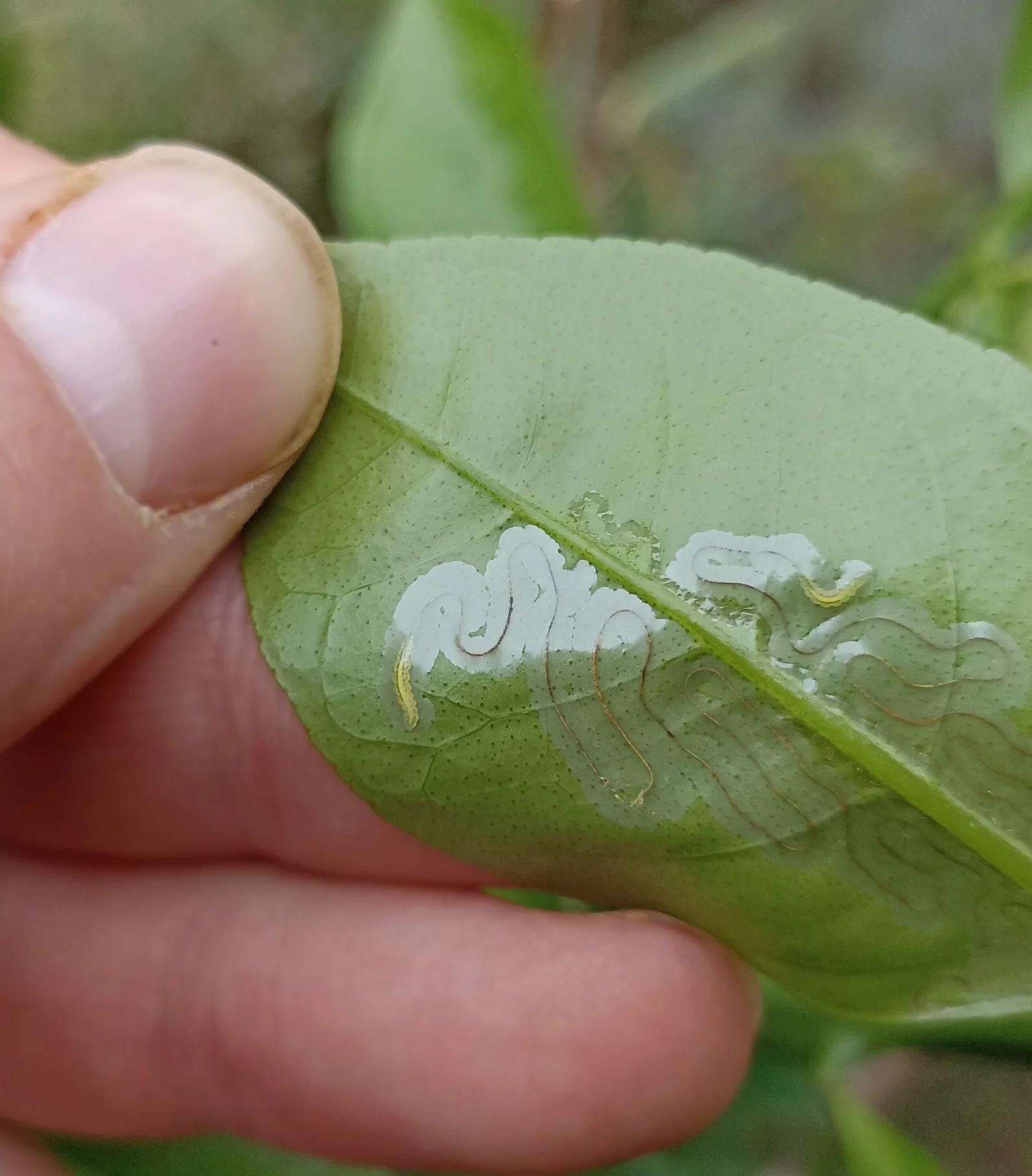
Photo: Eiku · CC BY 4.0
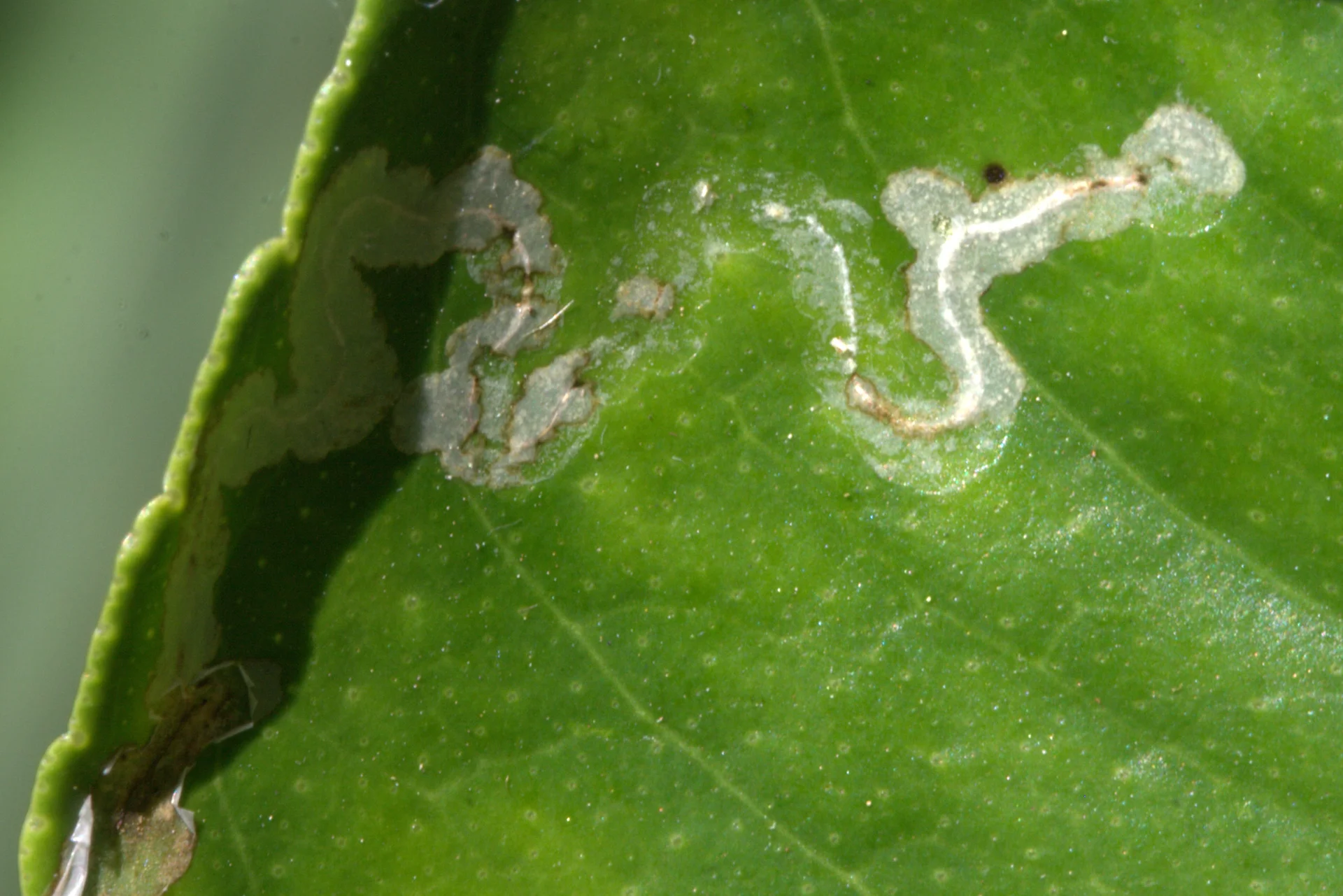
Citrus leafminer is a tiny silvery moth (Phyllocnistis citrella) whose grub tunnels just under the skin of soft, new citrus leaves, leaving a winding silvery trail with a fine dark line of droppings down the middle. It attacks only tender new flush on citrus, oranges, lemons and limes, so older hardened leaves and resting trees are safe. The mining curls and stunts young growth and opens wounds that let in citrus canker, and it hurts most on young trees and nursery seedlings that need every leaf to build their frame.
Toby Hudson · CC BY-SA 3.0 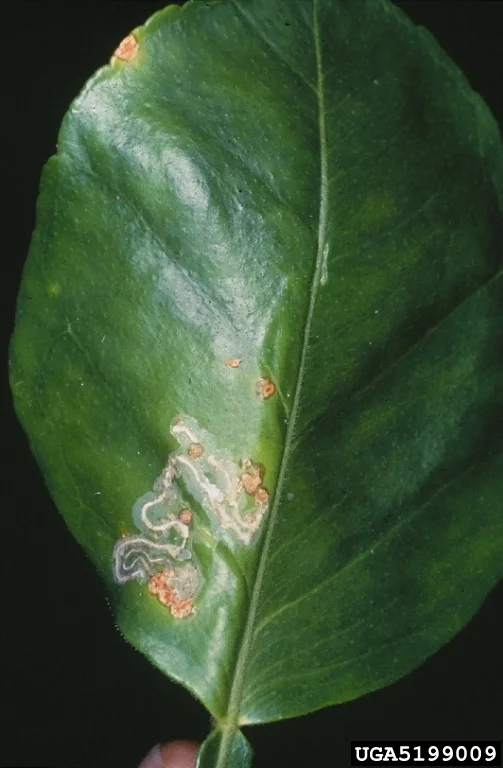
Jeffrey W. Lotz, Florida Department of Agriculture and Consumer Services, Bugwood.org · CC BY 3.0 us
Why it matters
On young citrus trees and nursery seedlings the leafminer can spoil up to 1 in 5 of the new leaves (about 20%) — twisting and stunting the very growth a young tree needs to build its frame, so it grows slowly and comes into fruit late. The grub does its damage hidden inside the leaf, in a tunnel just under the skin, where a spray that only wets the surface cannot reach it. Worse, every mine is an open wound that lets in citrus canker, a disease far harder to cure than the leafminer itself. Once a flush is heavily mined the leaves are already spoiled — so the whole game is protecting each new flush before the grubs get in.
When to act
Fresh flush present with serpentine mines appearing on new leaves; act on young trees and nursery stock when flush is actively mined.
This guidance is general, compiled from published agronomic references including FAO and CABI. Thresholds and timing shift with your crop, your variety and the season.
In much of the region a spray is simply called mushonga — medicine. But a chemical group you cannot name is one you cannot rotate, and a product you did not write down has no pre-harvest interval you can observe. Mushonga, and other farming words →
The full Citrus leafminer field guide
Identify it
The first thing you see is a silvery, winding line
on a young leaf — as if a tiny snail had drawn a shiny, twisting trail just under the skin of the leaf. This is the grub's tunnel (a mine). Look closely and a fine dark thread runs down the middle of the trail — that is the grub's droppings (frass) packed inside the tunnel.
Mined leaves curl, twist and crinkle up, and the shoot tips look puckered and stunted. Remember: only the soft, pale new leaves (the new flush — the tender growth a citrus tree pushes out) are attacked. The older, dark, hardened leaves are safe and never mined.
The grub itself is tiny
— smaller than a grain of rice, pale greenish-yellow and see-through. Hold a mined leaf up to the light and you can spot it at the growing front tip of the tunnel. Where a tunnel ends, the leaf edge is often rolled over into a little pocket — that is where the grub seals itself to turn into a moth (it pupates). The adult moth is rarely seen: smaller than a mosquito, silvery-white with a tiny black dot on each wingtip, flying only at dusk and in the night.
Don't confuse it with a real snail or slug trail
— that shiny slime sits on top of the leaf and rubs off with your finger, while the leafminer's tunnel is inside the leaf and will not wipe away. Leaf curling from aphids comes with clusters of soft insects and sticky leaves but no winding tunnel; thrips leave silvery patches and scabbing, not a single snake-like line.
Scout for it
Check only when there is new flush
This pest can attack only the soft, pale new leaves, so scout every time your young trees or nursery seedlings push fresh growth — after pruning, after fertilising, and after heavy watering — and all through warm, humid weather (about 20–32°C) when growth is fast. When the tree is resting with only old hardened leaves, there is nothing to check.
Walk a big "W" across the nursery bed or young block so you cover the middle and all four corners, not just the edge row by the path. Stop at about 10 plants. At each one go straight to the newest shoot tips — the floppy, pale leaves — turn them over and hold them up to the light.
At each stop look for the silvery winding mines, the dark frass line down the middle, curled tips, and rolled leaf edges. Tell fresh from old: a mine with the tiny grub still at its growing tip = active, still feeding (worth acting on); a mine on a hardened dark leaf, or one ending in an empty rolled edge = old and finished — don't waste spray on old mines.
Even 1 or 2 freshly-mined shoots in 10
on a young tree or nursery seedling is your signal to act now — on these small plants the tolerance is low, because they need every leaf to grow. On a big, bearing tree it is the opposite: mines on up to a fifth of the leaves do no real harm — don't spray, just let the tree carry it and let its natural helpers work.
Control it
Prevent it — don't push out soft growth you can't protect
Go easy on nitrogen fertiliser and on heavy watering of young trees: both force flush after flush of tender leaves, and every new flush is a fresh meal for the leafminer. Aim to make young trees flush all at once rather than a little at a time, so the tender window stays short and easy to guard.
Pinch off and burn or bury the worst-mined shoots
on young trees and nursery plants to cut down the next generation. But do not over-prune — cutting hard just triggers another soft flush and feeds the moths all over again.
Let the tiny wasps do the work (your best treatment on bearing trees)
Very small parasitic wasps — too small to sting you — lay their eggs inside the leafminer grubs and kill them from within. On bigger bearing trees they give good control on their own, so the best action is often to spray nothing and let them build up. Harsh, broad poisons kill these helpers too — avoid routine spraying so you keep them.
Act early with a soft spray oil on the flush you must protect
A light petroleum / mineral spray oil coats the new leaves so the moth won't lay her eggs on them. It is gentle on the helpful wasps and makes a good first spray — cover the new flush as it opens, and repeat on each new flush while the danger lasts.
Only if young trees or nursery stock keep getting hit — reach for a stronger spray as a LAST RESORT
Use an insect growth regulator (a spray that stops the young grub from growing up, instead of poisoning it on contact) or spinosad (a low-poison spray made from a soil germ / bacterium). Because the grub is hidden inside the leaf, a surface spray can't touch it — so time the spray to the new flush just as it opens, when the moths are laying, not after the mines are old. Safety: cover your skin, eyes, nose and mouth; spray in the cool of morning or evening with the wind behind you; keep it off food, water, children and bees — and never spray a tree in flower, since citrus blossom draws in bees; wash yourself after; and wait the number of days the label says before you pick fruit (the pre-harvest interval). Rotate the sprays — growth regulator one round, spinosad the next — so the fast-breeding pest doesn't get used to (resist) them.
If mines keep coming on every new flush
keep protecting each flush with the oil, and step up to the growth regulator or spinosad timed to the emerging flush, rotating the two. In canker areas, keep cutting out and burning badly-mined shoots — the tunnels are open doors for citrus canker, which is far worse than the leafminer. When it's too late — the flush has already hardened and the grubs have gone — stop spraying; those leaves are spoiled but the tree will harden them off and grow on. Cut your losses there and save your effort for the next flush.
Catch Citrus leafminer before it costs you the harvest
This guide is the general answer. Divisi works out yours — the week to scout your own field for Citrus leafminer, and what to do the day you find it.


Crops it affects
Plan the crops it attacks


All planting calendars, country by country
Get Insights by email
A short digest of new Divisi articles. No email on quiet weeks.
Frequently asked questions
How do I identify Citrus leafminer?
The first thing you see is a silvery, winding line. on a young leaf — as if a tiny snail had drawn a shiny, twisting trail just under the skin of the leaf. This is the grub's tunnel (a mine). Look closely and a fine dark thread runs down the middle of the trail — that is the grub's droppings (frass) packed inside the tunnel.
When should I take action against Citrus leafminer?
Fresh flush present with serpentine mines appearing on new leaves; act on young trees and nursery stock when flush is actively mined.
How do I control Citrus leafminer?
Prevent it — don't push out soft growth you can't protect. Go easy on nitrogen fertiliser and on heavy watering of young trees: both force flush after flush of tender leaves, and every new flush is a fresh meal for the leafminer. Aim to make young trees flush all at once rather than a little at a time, so the tender window stays short and easy to guard.
Which crops are attacked by Citrus leafminer?
Among the crops covered here: Lemon, Lime.