 Divisi
Coconut mite
Aceria guerreronis · Mite
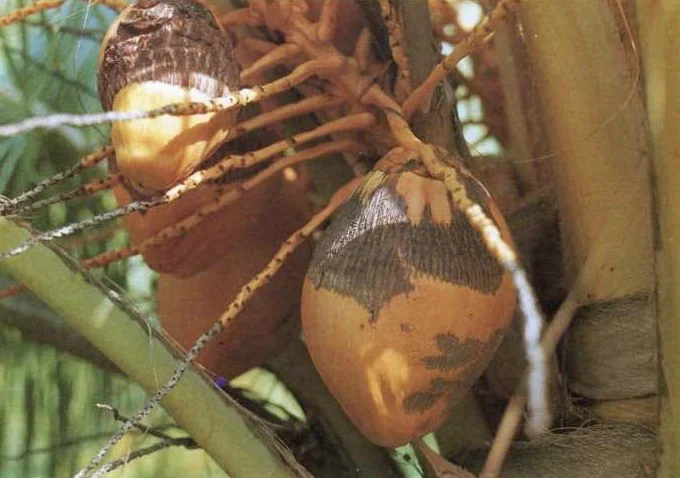
Photo: Hartford Hammond Keifer · Public domain
Coconut mite (Aceria guerreronis) is a mite so tiny you will never see it with your eyes. It lives in hidden colonies packed under the perianth — the 'cap' of hard, overlapping scales where a young coconut joins its stalk — feeding on the soft growing skin of the nut. As the nut swells, that feeding leaves pale triangular scars that harden into brown, corky, cracked patches, so nuts finish small, lopsided and light on flesh, and many drop before they mature. The mites drift on the wind and crawl onto fresh flowers and young nuts, so an attack creeps across a stand of palms bunch after bunch. It attacks only coconut.
Why it matters
Coconut mite can quietly steal up to a third (30%) of your nut harvest. The nuts it attacks come out small, cracked and light, so you get less copra (the dried coconut flesh you sell for oil) and less coconut water, and many young nuts simply drop before they ripen. It is so hard to beat once it settles in because the mites live hidden under the cap at the base of the nut, where sprays and even your own fingers cannot easily reach them, and because they blow from palm to palm on the wind, one infested palm slowly seeds your whole stand. Your two real weapons are catching it early and keeping your palms strong enough to shrug it off.
When to act
Pale triangular scarring visible on nuts under the perianth, or nut drop rising above normal.
This guidance is general, compiled from published agronomic references including FAO and CABI. Thresholds and timing shift with your crop, your variety and the season.
In much of the region a spray is simply called mushonga — medicine. But a chemical group you cannot name is one you cannot rotate, and a product you did not write down has no pre-harvest interval you can observe. Mushonga, and other farming words →
The full Coconut mite field guide
Identify it
The damage shows first — and it is the only thing you will actually see
On a young green nut, look right where it joins the stalk, just under the perianth (the 'cap' of hard, overlapping scales). A fresh attack shows as pale, whitish triangular patches creeping out from under the cap, like a pale triangle pointing down the nut. As the nut grows, those scars turn brown, corky and cracked, sometimes weeping a little gum, and the whole nut ends up small, lopsided and rough.
The mite itself is far too small to see
This is not a caterpillar or a beetle you can point at — one mite is a pale, worm-like speck several times thinner than a grain of sugar. Peel back the edge of the cap on an infested nut and look with a hand lens (a magnifying glass): the colony shows as a fine whitish, dusty or felty film on the soft skin underneath, always tucked into the dark, sheltered space under the cap. With bare eyes you will only ever see the scarring, never the mites themselves.
Tell it apart from the look-alikes
Sucking bugs also make young nuts drop, but you can plainly see those bugs and they leave dark, sunken spots, not a pale corky triangle from under the cap. Nuts lost to drought or poor pollination drop clean, with no corky scarring at all. Rats and squirrels leave tooth marks and gnawed holes. The pale triangle creeping out from under the cap of a young nut is the coconut mite's own signature — nothing else leaves that mark.
Scout for it
Look at the young nuts — they are all the mite wants
It only settles on young, green developing nuts, roughly 2 to 6 months old, while they are still filling out; it leaves the big mature nuts alone once their husk has hardened. A healthy palm almost always carries young bunches, so check them often — and check hardest during warm, dry spells (around 25–32°C), when the mite breeds fastest and its numbers build up.
Walk a big 'W' across your grove
so you cover the four corners and the middle, not just the palms lining the path. Stop at about 10 palms spread right across the plot.
At each palm, look over the youngest bunches you can reach with your eyes, and check any young nuts freshly dropped on the ground beneath it. On a few of those nuts, gently lift the edge of the cap (perianth) and look underneath for the pale triangular patches and that dusty film — a hand lens makes it far clearer.
Act on even 1 nut in 10
If even 1 young nut in every 10 you check shows the pale triangle under the cap — or if you notice more young nuts than usual dropping beneath your palms — the mite is established and it is time to act. Do not wait for a big count or for the scars to turn brown and corky: this pest is far easier to slow down early than to reverse once every bunch is scarred.
Control it
Prevent first
-
keep every palm strong
A well-fed, well-watered palm shrugs the mite off far better than a stressed one, and the mite does its worst when dry-weather stress has already weakened the palm's own defences. Give balanced fertiliser and, wherever you can, water during dry spells so the palms stay vigorous. Strong palms are your single most reliable lever against this pest.
-
cut off the source
Collect and destroy fallen and badly scarred nuts (burn or bury them) so the mites inside cannot crawl on to fresh bunches. Never plant seednuts taken from an infested palm, and never carry infested young palms into a clean field — that is exactly how the mite reaches new ground. Where tolerant coconut varieties are offered, choose them for any new planting.
Act early — protect the mite's own enemies
Tiny predatory mites (Neoseiulus) follow the coconut mite in under the same cap and eat it there for free — they are your allies. That is why you must avoid harsh, blanket sprays that would wipe them out along with the pest. Aim any treatment only at the palms already showing early, building damage; never blanket-spray a whole healthy grove.
Last resort — a mite spray, used with great care
Only where the loss truly justifies it, spray the crown and young bunches with an approved acaricide (a spray made specifically to kill mites); a neem-based (plant-based) acaricide is a gentler, locally available option. Know the limit going in: the cap physically shields the mites, so even a good spray struggles to reach them — target early build-up, never lean on the spray alone, and never answer failure by simply spraying more or stronger. Safety: cover your skin, eyes, nose and mouth; because you spray upward into the crown, stand well back and let the wind carry the mist away from your face; spray only in the cool of early morning or late evening; keep the spray off food, drinking water, children, animals and bees (coconut flowers feed bees — spray late, once they have stopped visiting); respect the pre-harvest interval (the number of waiting days printed on the pack between spraying and picking nuts); and wash yourself and your clothes straight afterwards. Rotate to a different chemical group of acaricide each time, so the mites do not become resistant — able to survive the spray because one chemical was used on them too often.
If it keeps spreading
first tighten your sanitation and palm feeding, and make sure you are hitting the young bunches early — not older nuts the mite has already abandoned. When a palm is too far gone — every bunch scarred, nuts small and dropping — accept that this season's nuts on that palm are lost: keep it fed and watered so it recovers for the coming bunches, harvest what copra you still can, and over time replace chronically poor old palms with tolerant planting material. Coconut mite is a pest you manage down and live with, not one you ever completely wipe out.
Catch Coconut mite before it costs you the harvest
This guide is the general answer. Divisi works out yours — the week to scout your own field for Coconut mite, and what to do the day you find it.


Crops it affects
Plan the crops it attacks

All planting calendars, country by country
Get Insights by email
A short digest of new Divisi articles. No email on quiet weeks.
Frequently asked questions
How do I identify Coconut mite?
The damage shows first — and it is the only thing you will actually see. On a young green nut, look right where it joins the stalk, just under the perianth (the 'cap' of hard, overlapping scales). A fresh attack shows as pale, whitish triangular patches creeping out from under the cap, like a pale triangle pointing down the nut. As the nut grows, those scars turn brown, corky and cracked, sometimes weeping a little gum, and the whole nut ends up small, lopsided and rough.
When should I take action against Coconut mite?
Pale triangular scarring visible on nuts under the perianth, or nut drop rising above normal.
How do I control Coconut mite?
Prevent first — keep every palm strong. A well-fed, well-watered palm shrugs the mite off far better than a stressed one, and the mite does its worst when dry-weather stress has already weakened the palm's own defences. Give balanced fertiliser and, wherever you can, water during dry spells so the palms stay vigorous. Strong palms are your single most reliable lever against this pest.
Which crops are attacked by Coconut mite?
Among the crops covered here: Coconut.