 Divisi
Oil palm leaf miner
Coelaenomenodera lameensis · Insect
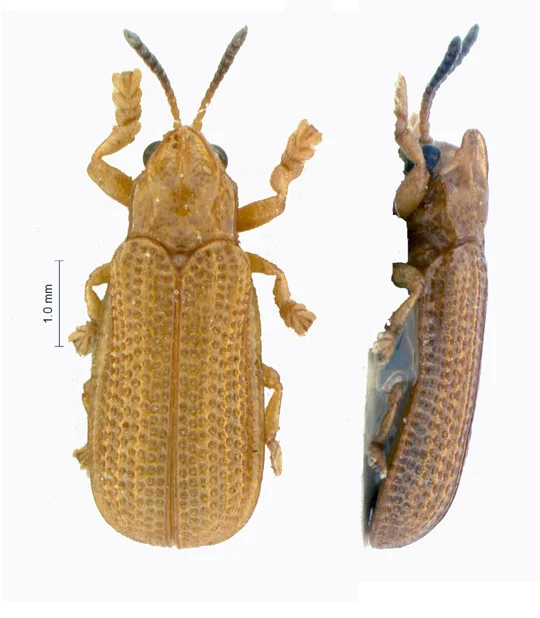
Photo: USDA · Public domain
The oil palm leaf miner (Coelaenomenodera lameensis) is a small leaf-eating beetle — not a caterpillar — and one of the worst pests of oil palm across West and Central Africa. The adult scrapes thin pale slits along the leaflets, while its flat, pale grubs tunnel and feed inside the leaf, hollowing out brown, blister-like pockets called 'mines'. Breeding in several overlapping generations, its numbers can suddenly explode into an outbreak that browns and dries whole blocks of palm, robbing them of the green leaf they need to fill their bunches. Tiny parasitic wasps normally keep it in check for free — the real trouble begins when careless spraying wipes those helpers out.
Why it matters
When this beetle gets out of hand it strips the green from your palms and can cut bunch yield by up to half — and because the palms stay weakened, that loss keeps dragging on for one to two years even after the beetles are gone. The grubs do their damage hidden inside the leaf, where an ordinary surface spray simply cannot reach them, so once an outbreak has built up across a block it is slow and costly to turn around. Your cheapest and strongest guard is the tiny wasps that quietly kill the miner for nothing — lose them to careless spraying and the beetle multiplies unchecked.
When to act
Rising larval mines on the fronds and visible browning of the canopy across a block; act on early build-up before an outbreak takes hold.
This guidance is general, compiled from published agronomic references including FAO and CABI. Thresholds and timing shift with your crop, your variety and the season.
In much of the region a spray is simply called mushonga — medicine. But a chemical group you cannot name is one you cannot rotate, and a product you did not write down has no pre-harvest interval you can observe. Mushonga, and other farming words →
The full oil palm leaf miner field guide
Identify it
The damage (look for this first)
thin, pale scrape-slits run along the leaflets where the adult beetles have rasped the surface, and right beside them sit brown, dry, blister-like patches — these are the 'mines', pockets where the grubs have eaten the leaf out from the inside. Where many palms are hit at once, the whole crown takes on a scorched, burnt-brown look, as if a grass fire had swept through it.
The beetle and its grub
the adult is a small, narrow beetle about the length of a grain of rice (roughly 6–8 mm), coloured reddish- to orange-brown, its hard back marked with neat rows of tiny pin-pricks. Tear open a fresh brown blister and you'll find the real culprit inside — a flat, pale, whitish-yellow grub (the young beetle, or larva) lying between the top and bottom skin of the leaf, exactly where no surface spray can touch it.
Don't confuse it
with the even browning of potassium or magnesium shortage or of dry-season scorch — those brown steadily along the leaflet edges or across whole fronds, with no scrape-slits, no blisters and no grub inside. It is also different from bagworms and nettle caterpillars, which chew ragged holes and notches from the outside. The one sure sign of leaf miner is a blister you can open to find a grub, together with the pale scraping on the leaf surface.
Scout for it
When to look
keep an eye on your producing palms all year (the beetle breeds in overlapping generations), but step up your checks through the mid- and late-season danger window and in the warm, humid months (around 24–32 °C), when its numbers climb fastest.
How to walk the block
cross it in a big "W" so you cover all four corners and the middle, not just the palms beside the road. Make about 10 stops, at least once a month — and step up to every two weeks the moment you see the count rising.
What to check at each stop
on two or three reachable mid-crown fronds, turn the leaflets over and look for fresh pale scrape-slits and fresh brown blister-mines, and open a blister to see whether a live grub is still inside. Then step back and read the colour of the whole canopy across the block.
Fresh vs old
a fresh mine is small, still spreading, and has a grub inside — the attack is live and growing. An old, dried, empty blister with no grub is past damage; don't panic over that.
When to act — a rising count, not one bad leaf:
mark the same few fronds and, each visit, count fresh mines on about 10 leaflets per frond. Act the moment that count is clearly higher than your last visit — for example climbing to several fresh mines on most of the 10 leaflets — or as soon as you see browning spreading from palm to palm across the block. That early build-up is your signal to act, before it becomes a full outbreak.
Control it
Prevent
-
don't trigger the outbreak yourself:
the miner is normally held down for free by tiny wasps, and the fastest way to spark an outbreak is a broad-spectrum spray (a broad poison that kills everything, the helpful wasps included). So do not routinely spray the crown, and don't let careless spraying by neighbours drift onto your palms.
-
keep palms strong and watch them:
well-fed palms with balanced nutrition (oil palm is especially hungry for potassium) shrug off light mining and stay green, so feed them properly and scout regularly to catch any build-up while it is still small and cheap to handle.
Act early — back the wasps (your main control):
protect and encourage the parasitic wasps — the tiny wasps that lay their own eggs inside the miner's eggs, grubs and pupae and kill it from within. Where an official programme offers reared wasps for release, take part. They are your strongest and cheapest control, and they work best while miner numbers are still low.
Last resort — a systemic insecticide, by trunk injection:
only for a confirmed outbreak. Systemic means the chemical is drawn up into the palm's own sap and carried out into the leaves, so it can reach the grubs hidden inside the mines — an ordinary surface (contact) spray, which only wets the outside of the leaf, cannot. Injecting the trunk also spares the wasps and avoids drift. This is toxic, specialist work: use a trained operator, cover skin, eyes, nose and mouth, keep it well away from food, water, children and bees, respect the pre-harvest interval (the set number of days you must wait after treating before you may cut and sell the bunches), wash thoroughly afterwards, and rotate to a different chemical group each time so the beetle never builds up resistance.
If it keeps spreading → treat it as a block-wide job
the beetle moves palm to palm, so call your extension or plantation service for a coordinated response (wasp releases plus targeted injection) rather than fighting it one palm at a time. When it's too late — the canopy already browned and dried — you cannot un-burn those fronds: cut your losses, feed the palms well to help the crown push out fresh leaf, and protect the wasps so numbers crash back down on their own. Expect bunch yield to stay down for one to two years, and whatever you do, do not keep blanket-spraying — that only kills the wasps and drags the outbreak out longer.
Catch oil palm leaf miner before it costs you the harvest
This guide is the general answer. Divisi works out yours — the week to scout your own field for oil palm leaf miner, and what to do the day you find it.


Crops it affects
Plan the crops it attacks

All planting calendars, country by country
Get Insights by email
A short digest of new Divisi articles. No email on quiet weeks.
Frequently asked questions
How do I identify oil palm leaf miner?
The damage (look for this first). thin, pale scrape-slits run along the leaflets where the adult beetles have rasped the surface, and right beside them sit brown, dry, blister-like patches — these are the 'mines', pockets where the grubs have eaten the leaf out from the inside. Where many palms are hit at once, the whole crown takes on a scorched, burnt-brown look, as if a grass fire had swept through it.
When should I take action against oil palm leaf miner?
Rising larval mines on the fronds and visible browning of the canopy across a block; act on early build-up before an outbreak takes hold.
How do I control oil palm leaf miner?
Prevent — don't trigger the outbreak yourself:. the miner is normally held down for free by tiny wasps, and the fastest way to spark an outbreak is a broad-spectrum spray (a broad poison that kills everything, the helpful wasps included). So do not routinely spray the crown, and don't let careless spraying by neighbours drift onto your palms.
Which crops are attacked by oil palm leaf miner?
Among the crops covered here: Oil palm.