 Divisi
When to plant Taro in Lekabi-Lewolo
These figures also cover Offoue-Onoye, where the engine returns the same answer.
Haut-Ogooue, Gabon
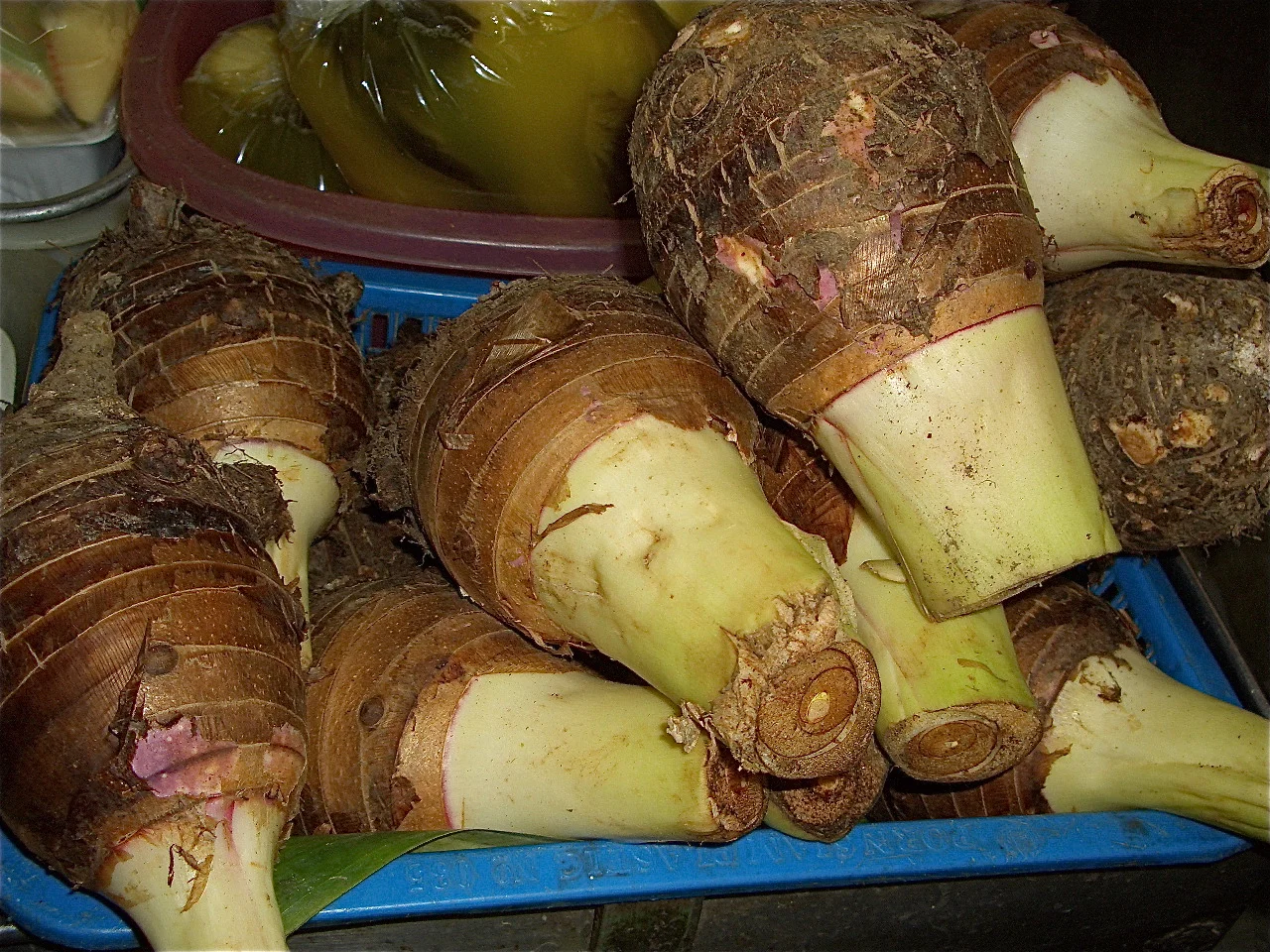
Cocoyam, or taro (Colocasia esculenta), is a broad-leaved plant grown for its corm — a heavy, potato-like food store that swells underground — and, in some types, for its tender young leaves.
| Measure | Rain-fed | With irrigation |
|---|---|---|
| Fit | Favourable | |
| When to plant (establish) | 6 Aug 2027 – 26 Aug 2027 opens in 44 weeks | 21 Jan 2026 – 1 Jan 2027 |
| Expected harvest | about 13.6 t/ha | about 23.1 t/ha |
| Bearing cycle | 180–540 days per crop once the plant is established. Planting to the first harvest takes longer than one cycle. | |
| Work it takes | 111–233 days per hectare, by hand | |
| Rain meets its needs | 88% | |
Rain-fed. These dates are worked out from each place's own rainfall, for a field watered by the season — with irrigation a window can open earlier, close later, or come round more than once a year. Check your own field under What grows, or get the Divisi app for a calendar dated to your farm.
If you only get one chance to plant, aim for around 6 Aug 2027. That is the point in the window where the rains are most reliably established.
This season's rainfall outlook for Lekabi-Lewolo leans dry, so these dates sit later than the long-run average. Planting on the date you are used to risks germinating into a false start and having to replant.
Planting after 26 Aug 2027 leaves the crop short of season: it runs into the dry months before it has finished filling.
What decides this in Lekabi-Lewolo
| Rain and temperature | 96% |
|---|---|
| The soil | 76% |
| The lie of the land | 45% |
For taro in Lekabi-Lewolo, the lie of the land is the tightest of the three at 45%. You cannot flatten it, but you can farm it: plant along the contour rather than up and down, ridge or tie ridges to hold water on the slope, and expect shallower rooting than the crop would manage on flat ground.
The 2026/27 season in Lekabi-Lewolo
| When the rains are expected | August 2026 to July 2027 |
|---|---|
| Rain in a typical year | About 1,708 mm |
| This season's rain | Leaning dry — September, October, November and December look short of rain. Plant at the early end of the window, favour quicker and more drought-tolerant crops, and keep moisture in the soil: mulch, and weed early. |
| This season's heat | Hotter than usual — about +0.9 °C over the growing months. Heat makes the same rain do less, so a dry spell bites sooner: do not plant late, and shade or mulch what you can. |
| What that supports | enough rain for a long crop, or two in a year, warm all year, so nothing but rain ends the season |
| Ground this covers | One kind of ground throughout. |
last updated 17 September 2026
Sloping ground holds back about 20% of yield here.
What taro needs to grow here
| Soil it likes | clay loam, clay or loam |
|---|---|
| Soil sourness (pH) | Happiest between pH 5.5 and 6.5 |
| Spacing | 70 cm between rows, 70 cm between plants |
| Feed it most with | potassium |
What it takes to grow taro in Lekabi-Lewolo
| Planting material | About 24,000 plants per hectare |
|---|---|
| Nitrogen (N) | About 61 kg per hectare |
| Phosphate (P₂O₅) | About 31 kg per hectare |
| Potash (K₂O) | About 102 kg per hectare |
| In the shops | A basal compound at planting — Compound D, or an NPK blend — covers the phosphate and potash. A nitrogen top dressing — urea or AN — goes on once the crop is established. |
| Hand work | 111–233 days per hectare, by hand |
These are the nutrients a taro crop of that size carries off the field. What you actually apply depends on what your soil already holds — which is what a soil test, or the app's field records, tell you.
What to watch for
Grow Taro with a plan, not a guess
Everything above describes Lekabi-Lewolo as a whole — your own soil, slope and rainfall will shift the dates. The Divisi app works them out for your field, and dates each job that follows.


Taro in nearby districts


This calendar moves
Planting windows shift with the forecast. Leave your email and we'll send what changed, and a note when planting time nears — a couple of emails a month at most.
Frequently asked questions
Will taro grow well in Lekabi-Lewolo?
Lekabi-Lewolo rates as favourable for taro.
When should I plant taro in Lekabi-Lewolo?
Typically 6 Aug 2027 to 26 Aug 2027, forecast-adjusted.
Is this exact for my own field?
No — these are readings taken across Lekabi-Lewolo, not on your field. Soil, slope and rainfall change from one farm to the next. Check your own location to see your own numbers.