 Divisi
Banana Xanthomonas wilt
Xanthomonas vasicola pv. musacearum · Bacterial
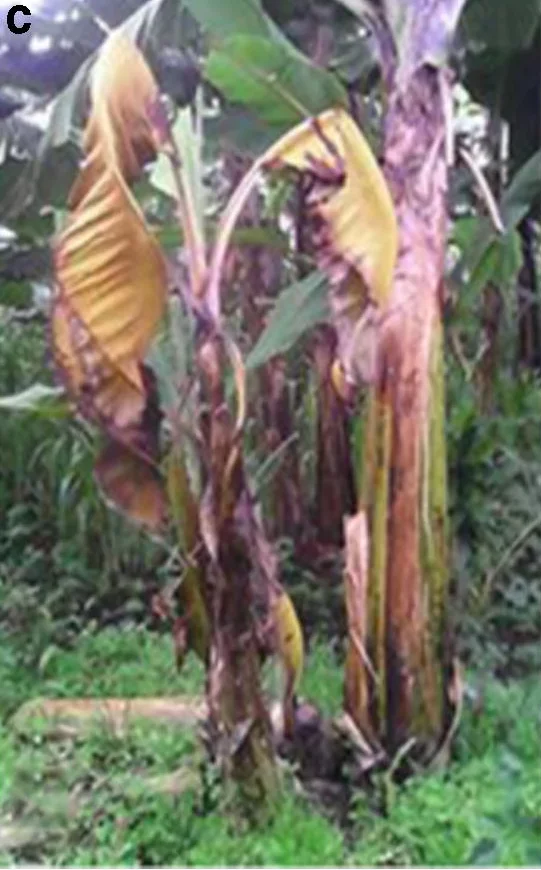
Photo: Florence Uwamahoro, Anna Berlin, Helena Bylund, Charles Bucagu & Jonathan Yuen · CC BY 4.0
Banana Xanthomonas wilt (BXW) is a highly destructive bacterial wilt of banana, plantain and enset, caused by the germ Xanthomonas vasicola pv. musacearum. The bacteria (tiny germs you cannot see) block the tubes that carry water up the plant, so the leaves yellow and collapse, the male bud rots, and the fruit ripens early and rotten inside. It spreads on contaminated cutting tools, on insects that visit the male flower, and in infected suckers — and it has no chemical cure, so it is beaten only by strict field hygiene.
Why it matters
Banana Xanthomonas wilt (BXW) is the deadliest disease of your banana plot. Once it gets in it can destroy the whole planting — up to 100% of your bananas — and because the germ grows inside the plant, no spray or medicine can cure it. It moves frighteningly fast: on the knife you prune and harvest with, on insects that visit the flower, and in the suckers you plant — so one dirty cut can carry it across the whole field in a single season. An infected mat, and the soil around its dead roots, stays dangerous for months, so the only way to win is to stop it spreading and cut out the very first sick plant the day you see it.
When to act
First wilting or yellowing plant triggers immediate action; cut and destroy affected plants and disinfect tools before any further work.
This guidance is general, compiled from published agronomic references including FAO and CABI. Thresholds and timing shift with your crop, your variety and the season.
In much of the region a spray is simply called mushonga — medicine. But a chemical group you cannot name is one you cannot rotate, and a product you did not write down has no pre-harvest interval you can observe. Mushonga, and other farming words →
The full Banana Xanthomonas wilt field guide
Identify it
The first sign
a plant that looked healthy suddenly has leaves that turn yellow, wilt and fold down against the trunk like a collapsing umbrella — even though the soil is still moist. The wilting often starts on the younger inner leaves and spreads to the rest.
On flowering and fruiting plants
the male bud — the hanging purple bell below the bunch — shrivels, blackens and rots, and the fruit ripens far too early and unevenly, with scattered yellow fingers among green ones. Cut one of those fingers and the flesh inside is rusty-brown and rotten, not creamy white.
The sure test — the ooze:
slice across the trunk, the fruit stalk or the bud and watch for a cream-to-yellow sticky slime (called bacterial ooze) weeping out within a minute. That yellow slime is the germ itself — healthy banana sap is clear and watery, so the yellow ooze is the one sign that confirms the disease.
Don't confuse it
with Panama disease (Fusarium wilt), where the yellowing starts on the old outer leaves first and a cut trunk shows dry brown streaks with NO slime, or with plain drought or hunger, which yellows the leaves but gives no rotten bud, no uneven fruit and no ooze. Yellow sticky ooze means Xanthomonas wilt.
Scout for it
When to look
the disease is most active once plants flower and carry fruit (its insect route runs through the male bud) and any time you cut with a dirty blade — so scout every week, from when the plant is building its stem and leaves right through flowering and fruiting to harvest (its development, mid- and late-season).
How to look
a banana plot is small, so don't just glance from the path — walk up and down every row and look closely at every mat (stool), giving extra attention to plants that are flowering or fruiting.
What to check on each plant
look up at the leaves for any yellowing or wilting, at the male bud for shrivelling and blackening, and at the bunch for early, patchy ripening.
Confirm safely
if a plant looks suspect, cut a thin slice to check for the yellow ooze — then sterilise the blade at once (pass it through fire or dip it in bleach) before it touches any other plant, because the very knife you test with can spread the disease.
Your threshold is ONE
unlike an insect pest, there is no safe number to tolerate. Even a single wilting, oozing or rotten-bud plant in the whole field is your trigger — the day you find that first plant, act immediately: cut it out and disinfect before doing any other work.
Control it
Prevent
-
clean your tools (the number-one spreader):
the germ travels from plant to plant on dirty blades. Before every cut on a new plant — desuckering, deleafing, harvesting — pass the blade through fire, or dip it for a few seconds in 1-part-bleach-to-100-parts-water (or strong local spirit / 70% alcohol). Keep one tool for your field only and never lend it out. Safety: keep bleach off your eyes and skin, mix it in the open air, keep the flame away from dry trash, and wash your hands after.
-
remove the male bud early, without a wound:
as soon as the last hand of fruit has formed, snap off the male bud (the hanging bell) with a forked stick — twist it off, do not cut it. A clean break leaves no knife wound and no oozing sap for insects to land on, shutting the door on the insects that carry the disease from flower to flower.
-
plant only clean material:
start new mats only from suckers (the young side-shoots you dig up to plant) taken off healthy, disease-free plants, or from tissue-culture plantlets (clean young plants grown in a lab). Never dig suckers from a field that has the disease, and never carry banana suckers, leaves or fruit stalks out of an infected field.
Act the day you see it — cut out the single diseased stem (Single Diseased Stem Removal, or SDSR):
at the very first affected plant, cut the diseased stem down at ground level, chop it into pieces, and leave them to dry and rot right where they fall — do not carry infected material around the farm or feed it to animals. Sterilise your tool straight after, and keep checking that mat and its neighbours every week.
There is no spray that cures it
bacterial wilt has no chemical cure — do not waste money on any pesticide, antibiotic or 'medicine' sold to treat it, and since nothing is sprayed on the fruit there is no waiting period before you eat or sell. The only things that work are clean blades, early debudding and clean planting material — prevention is the whole battle.
If it keeps spreading — tighten up, then cut your losses:
if new wilting plants keep appearing, you are almost certainly re-spreading it yourself — sterilise on every cut, debud every flowering plant, and get your neighbours doing the same, because it moves between fields. If most of the plot is already infected, cut your losses: uproot and destroy every mat in place, rest the land with no banana for several months so the germs in the old roots die, then replant with clean or tissue-culture material.
Catch Banana Xanthomonas wilt before it costs you the harvest
This guide is the general answer. Divisi works out yours — the week to scout your own field for Banana Xanthomonas wilt, and what to do the day you find it.


Crops it affects
Plan the crops it attacks


All planting calendars, country by country
Get Insights by email
A short digest of new Divisi articles. No email on quiet weeks.
Frequently asked questions
How do I identify Banana Xanthomonas wilt?
The first sign. a plant that looked healthy suddenly has leaves that turn yellow, wilt and fold down against the trunk like a collapsing umbrella — even though the soil is still moist. The wilting often starts on the younger inner leaves and spreads to the rest.
When should I take action against Banana Xanthomonas wilt?
First wilting or yellowing plant triggers immediate action; cut and destroy affected plants and disinfect tools before any further work.
How do I control Banana Xanthomonas wilt?
Prevent — clean your tools (the number-one spreader):. the germ travels from plant to plant on dirty blades. Before every cut on a new plant — desuckering, deleafing, harvesting — pass the blade through fire, or dip it for a few seconds in 1-part-bleach-to-100-parts-water (or strong local spirit / 70% alcohol). Keep one tool for your field only and never lend it out. Safety: keep bleach off your eyes and skin, mix it in the open air, keep the flame away from dry trash, and wash your hands after.
Which crops are attacked by Banana Xanthomonas wilt?
Among the crops covered here: Banana & plantain, Enset.