 Divisi
Black rot
Xanthomonas campestris pv. campestris · Bacterial
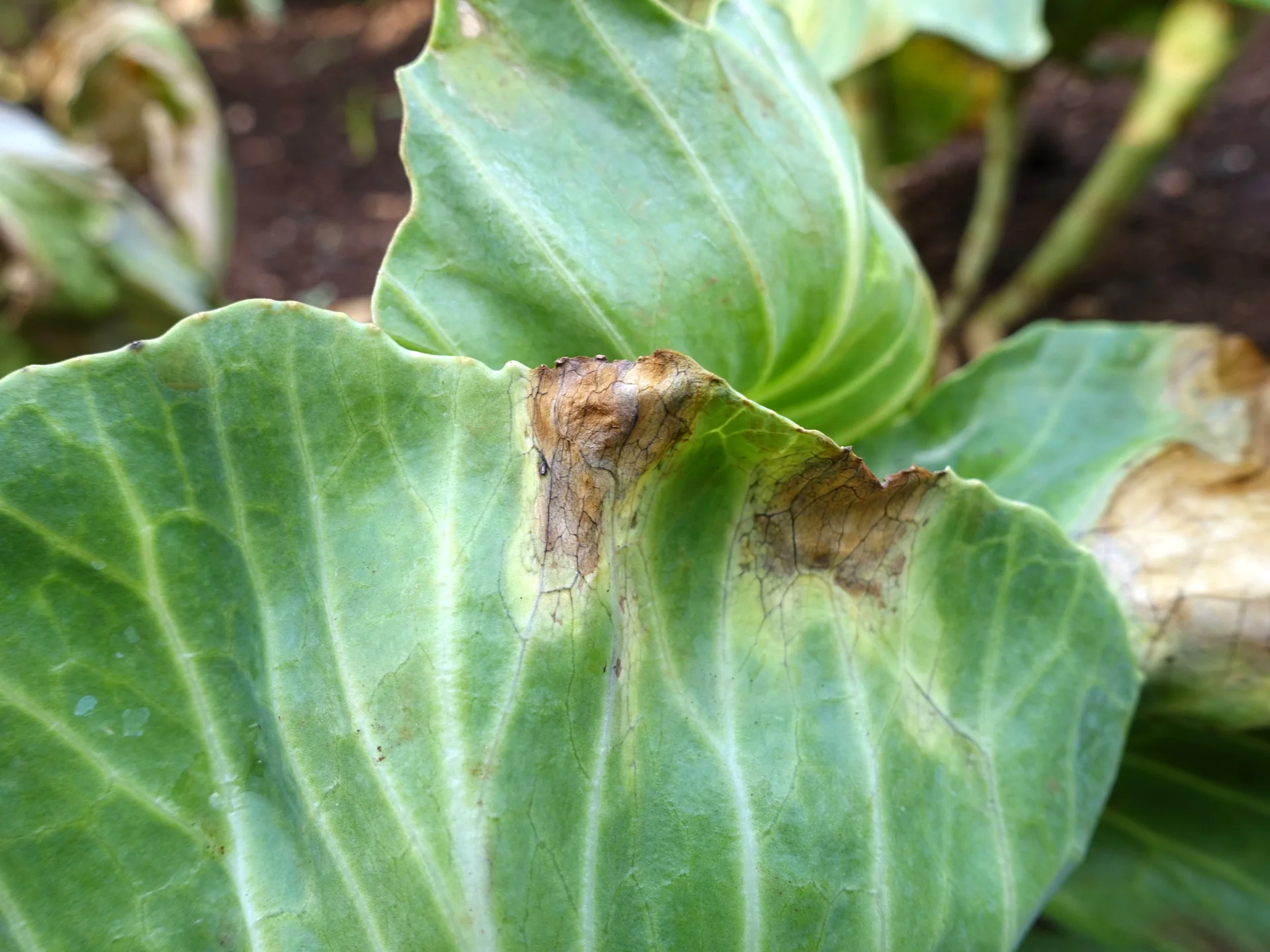
Photo: Scot Nelson · CC0
Black rot is a bacterial disease of cabbage and its close relatives — kale, broccoli and cauliflower. The germ (Xanthomonas campestris) rides in unseen on infected seed and splashes from plant to plant in rain and overhead-irrigation water. It slips in through the tiny water-pores along the leaf edges and through wounds, then works its way down the veins and into the plant's sap-system, turning the veins black and, in bad cases, rotting the plant from the inside out. It thrives in warm, wet, muggy weather and, once it is inside a plant, it cannot be cured.
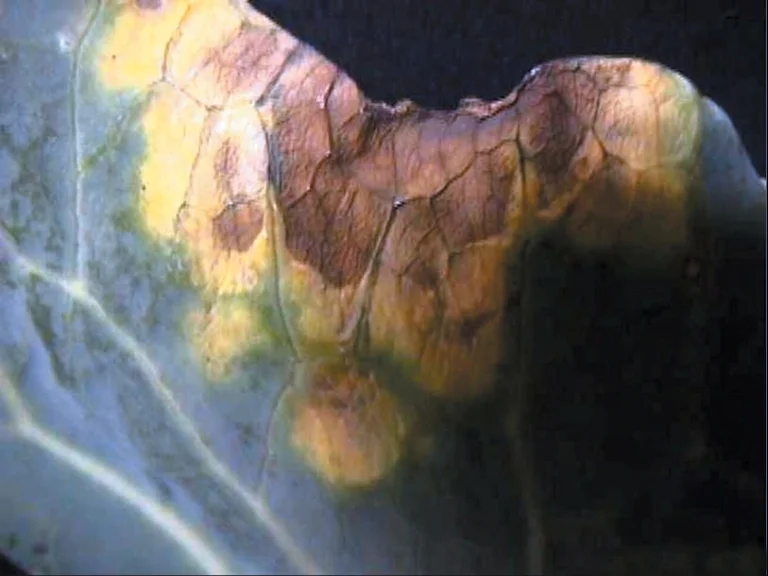
David B. Langston · CC BY 3.0 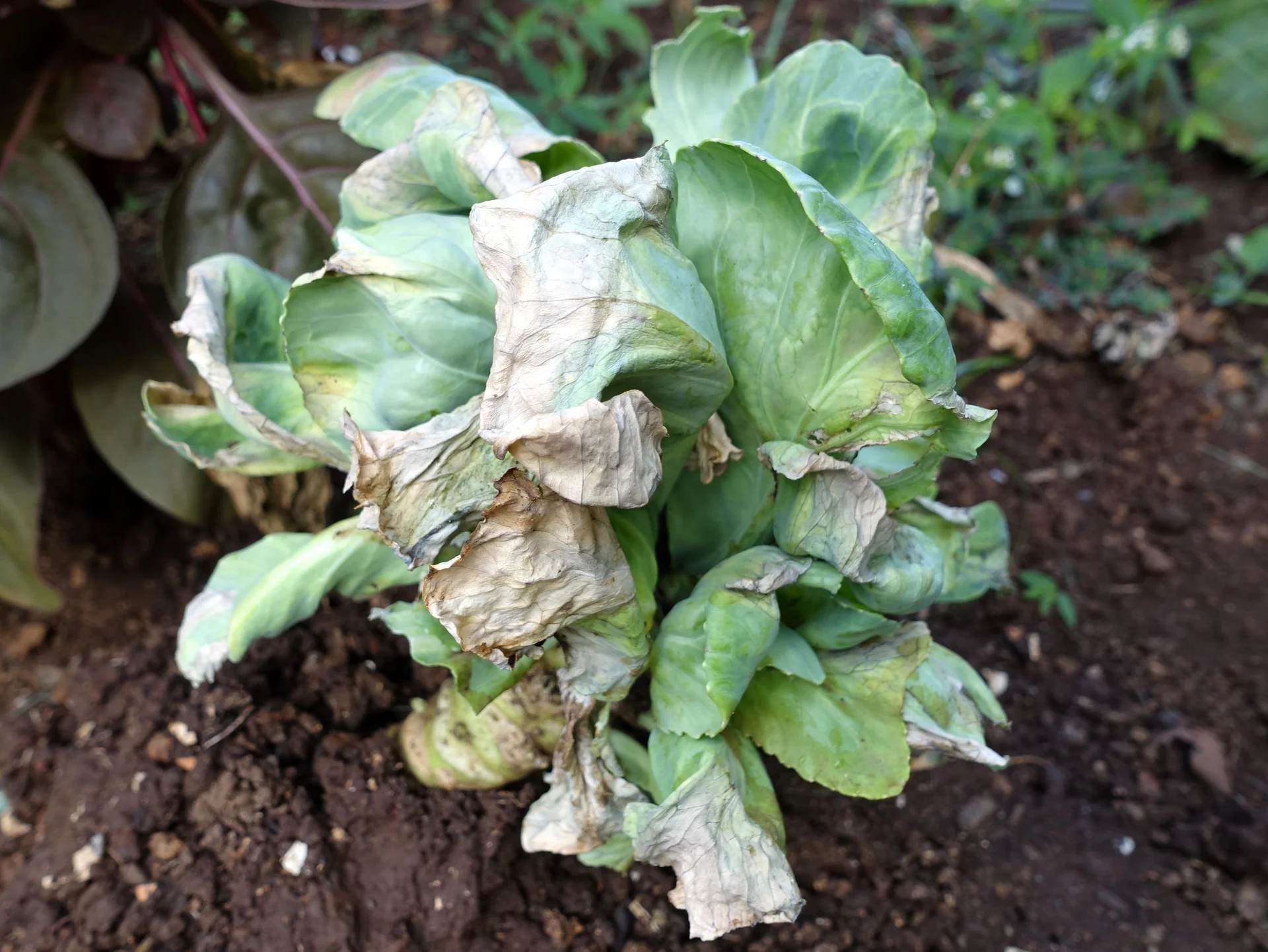
Scot Nelson · CC0
Why it matters
Black rot is the most destructive disease of cabbage, kale, broccoli and cauliflower. A bad outbreak can rot away up to 70% of your crop — more than two out of every three plants — and many heads that survive are too sick to sell. The trouble is that the germ is a bacterium that hides inside the plant's veins, where no spray can reach it, and it arrives unseen on the seed and spreads in rain-splash. Once a plant is infected there is no cure, so keeping it out and pulling the first sick plants the moment you see them is everything.
When to act
Rogue infected seedlings in the nursery on sight; once V-shaped lesions appear, remove affected plants and stop overhead irrigation.
This guidance is general, compiled from published agronomic references including FAO and CABI. Thresholds and timing shift with your crop, your variety and the season.
In much of the region a spray is simply called mushonga — medicine. But a chemical group you cannot name is one you cannot rotate, and a product you did not write down has no pre-harvest interval you can observe. Mushonga, and other farming words →
The full Black rot field guide
Identify it
The first sign
a yellow, V-shaped patch eating in from the edge of a leaf, with the point of the V aimed inward toward a vein — like a wedge or a slice cut out of the leaf margin. It usually shows on the older, outer leaves first.
The tell-tale sign
hold the leaf up to the sunlight and look inside that yellow V — the veins have turned black, like a net of dark ink lines. As the patch grows it turns brown, dry and papery, and the black vein-work reaches deeper into the leaf.
When it gets inside the plant
the whole plant turns stunted and lopsided — yellowing and wilting worse on one side. Cut across the stem near the base and you will see a black or brown ring in the middle where the sap-tubes have rotted. This means the germ has spread through the whole plant (gone "systemic") — that plant cannot recover.
Don't confuse it
with: downy mildew (yellow patches with a grey-white fuzz on the leaf underside, and no black veins); fertiliser or wind scorch (brown, dried leaf edges but no yellow V and no blackened veins); or plain nitrogen hunger (older leaves go yellow evenly all over, not in a wedge from the edge). Black rot is the one with the yellow V from the margin and the blackened veins inside it.
Scout for it
Start in the nursery and never stop
Check seedlings every few days from the moment they come up, again in the first weeks after transplanting, and right through heading — the disease does its worst when it gets in early, while plants are young.
Look hardest after warm, wet, muggy weather
The bacteria love heat (about 25-30°C) and heavy, damp air, and they travel in rain-splash and overhead-irrigation splash — so step up your checks after every rain, after every warm humid spell, and after any overhead watering.
Walk a big "W" across the field
so you cross all four corners and the middle, not just the row nearest the path. Make about 10 stops, and at each stop check 10 plants — look at the outer leaf edges, hold a leaf up to the light for black veins, and watch for lopsided, stunted plants.
One sick plant is your threshold — do not wait for a count
In the nursery, even a single seedling with a yellow V or a blackened vein means pull it and its close neighbours at once. In the field, the first V-shaped lesion you find is your signal to act that same day — because one infected plant becomes twenty after the next rain.
Control it
Start clean — this is your strongest tool
Sow only certified seed (seed that has been tested free of the disease), or treat your own seed with the hot-water method (soaking the seed in carefully warmed water to kill the bacteria carried on it). Raise your transplants on a clean nursery bed well away from old crucifer ground, and never lift seedlings from a bed that has any sick plants in it.
Rotate and clean up
Do not plant cabbage, kale, broccoli or cauliflower on the same land for 2-3 years — the bacteria survive on old crucifer debris and on weeds of the same family (wild mustard, wild rape), so pull those weeds out too. After harvest, remove and destroy every old stalk and leaf; do not leave them lying or compost them near the field.
Keep the leaves dry and keep your hands off wet plants
Stop overhead irrigation — water at the base of the plant so the leaves stay dry, and water in the morning so anything wet dries fast. Never weed, tie or handle the crop while it is wet with rain or dew: your hands and tools carry the bacteria from plant to plant. Give plants room to breathe rather than crowding them, so the leaves dry quickly.
Grow a tolerant variety
where one is available and suited to your area. Tolerant cabbage types do not get sick as badly and lose far less to the systemic rot — ask your local seed supplier or extension officer which variety is recommended for you.
Pull out sick plants the moment you see them ("roguing")
Remove any seedling or plant showing a yellow V or black veins, together with its nearest neighbours, and carry them right out of the field in a bag — do not drop infected leaves along the rows. Do this when the plants are dry, and wash your hands and tools afterwards so you don't spread it yourself.
Copper spray is only a back-up, not a cure
Copper gives only partial protection and works only as a shield on healthy leaves before infection — it cannot cure a plant the bacteria are already inside. If you use it, spray it preventively at the first sign of risk, and stay safe: cover your skin, eyes, nose and mouth, spray in the cool of the day with the wind at your back, keep it off food, off open water, and away from children and bees, wait the full pre-harvest interval (the set number of days you must leave between spraying and picking) before you harvest, and wash well afterwards. Don't lean on copper alone every season — rotate it with the clean-up steps above so the bacteria don't grow used to it.
If it keeps spreading
stop all overhead watering, and harvest any healthy heads early rather than risk losing them. Once a plant is stunted, lopsided, or shows the black ring in the stem, it is finished — pull it and destroy it, don't try to save it. If a whole block is lost, cut your losses: clear and burn or deep-bury every plant, keep that land out of cabbage, kale, broccoli and cauliflower for 2-3 years, and start your next crop with clean certified seed on a fresh, clean nursery site.
Catch Black rot before it costs you the harvest
This guide is the general answer. Divisi works out yours — the week to scout your own field for Black rot, and what to do the day you find it.


Crops it affects
Plan the crops it attacks


All planting calendars, country by country
Get Insights by email
A short digest of new Divisi articles. No email on quiet weeks.
Frequently asked questions
How do I identify Black rot?
The first sign. a yellow, V-shaped patch eating in from the edge of a leaf, with the point of the V aimed inward toward a vein — like a wedge or a slice cut out of the leaf margin. It usually shows on the older, outer leaves first.
When should I take action against Black rot?
Rogue infected seedlings in the nursery on sight; once V-shaped lesions appear, remove affected plants and stop overhead irrigation.
How do I control Black rot?
Start clean — this is your strongest tool. Sow only certified seed (seed that has been tested free of the disease), or treat your own seed with the hot-water method (soaking the seed in carefully warmed water to kill the bacteria carried on it). Raise your transplants on a clean nursery bed well away from old crucifer ground, and never lift seedlings from a bed that has any sick plants in it.
Which crops are attacked by Black rot?
Among the crops covered here: Cabbage, Rape / covo / kale.