 Divisi
Rice blast
Magnaporthe oryzae · Fungal
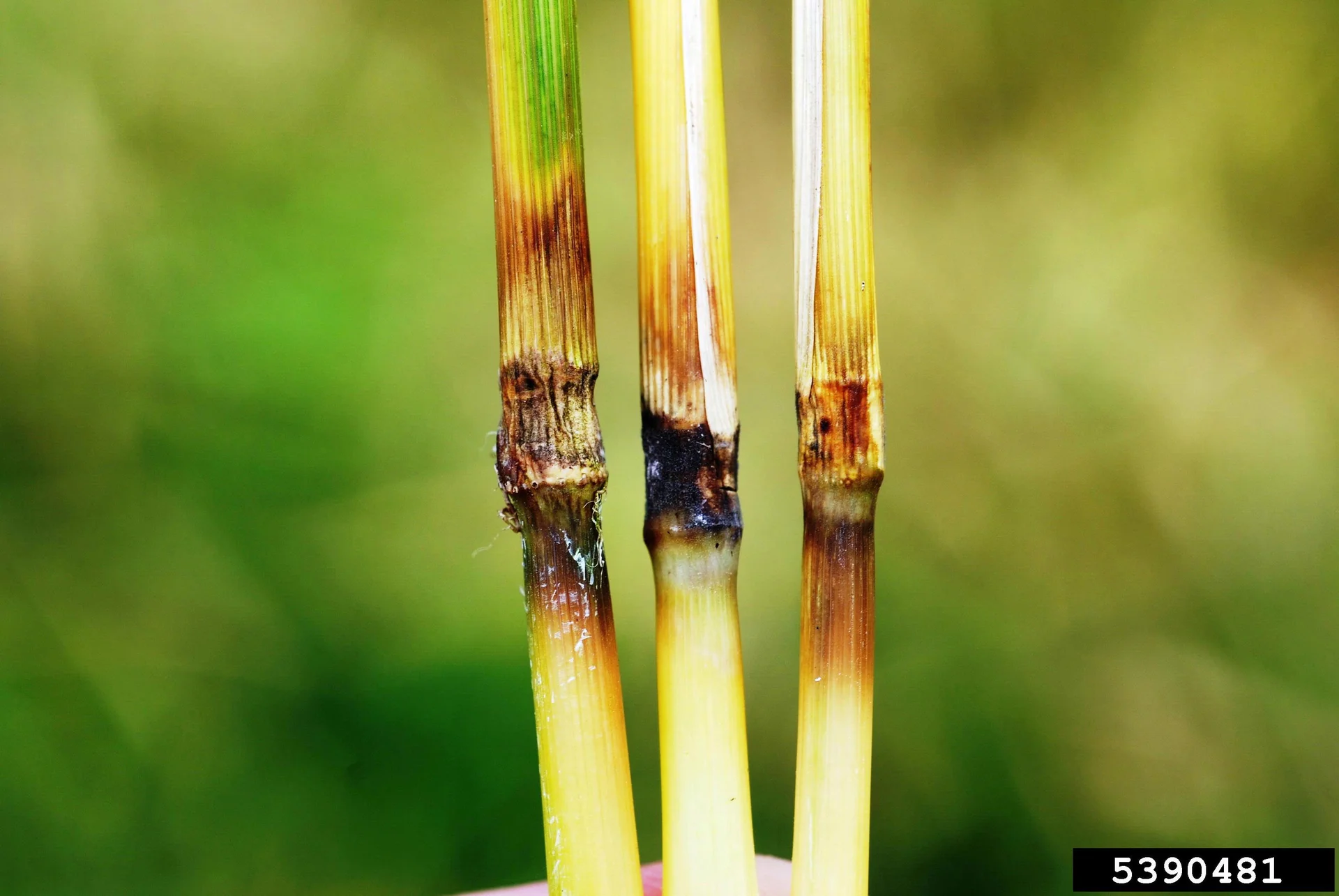
Photo: Donald Groth, Louisiana State University AgCenter, Bugwood.org · Public domain
Rice blast is a fast-moving fungal disease of rice (caused by the fungus Magnaporthe oryzae) that attacks the leaves, stem joints and — most damagingly — the neck just below the grain head. Its spores ride on wind and rain-splash and need a wet leaf to take hold, so it explodes in cool, cloudy, humid weather with long dews and on lush, over-fertilised crops. It is the single most destructive disease of rice worldwide.
Why it matters
On a susceptible crop in wet, humid weather, rice blast can destroy up to 80% of your harvest — more than almost any other rice disease. The cruellest damage comes late: the fungus rots the neck just below the grain head, so the head turns pale and empty and the grains never fill — a field that looked green and healthy can end up giving you almost nothing. Once the neck has rotted, no spray can bring the grain back, and the fungus lives on in the straw and seed to strike again next season. So blast has to be stopped early and prevented, not cured.
When to act
Spray when spindle-shaped leaf lesions spread on young crops, and protect the neck at heading if the field has any blast history under humid weather.
This guidance is general, compiled from published agronomic references including FAO and CABI. Thresholds and timing shift with your crop, your variety and the season.
In much of the region a spray is simply called mushonga — medicine. But a chemical group you cannot name is one you cannot rotate, and a product you did not write down has no pre-harvest interval you can observe. Mushonga, and other farming words →
The full Rice blast field guide
Identify it
The first thing you see (leaf blast)
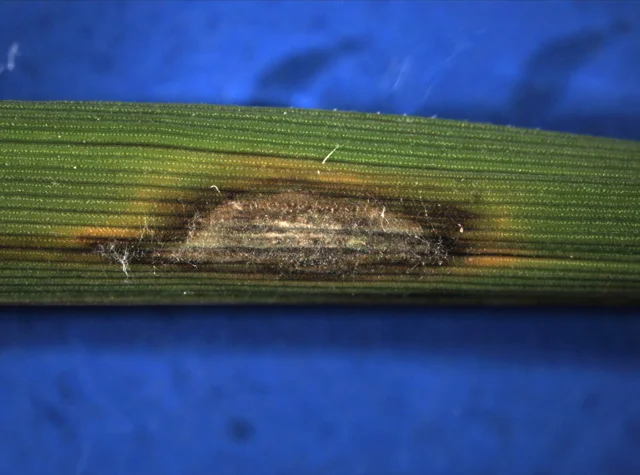
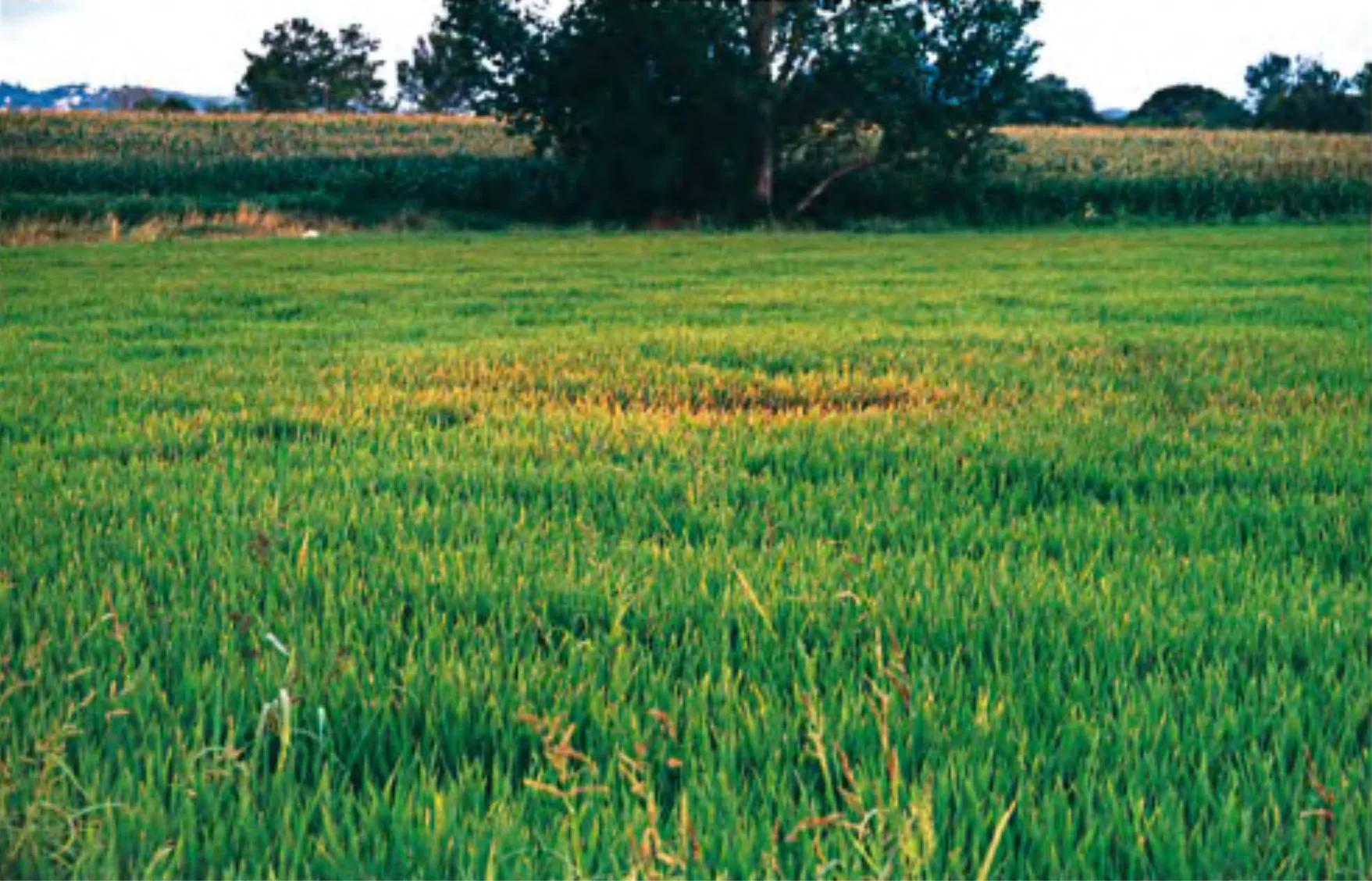
small spots on the leaves that grow into spindle- or diamond-shaped ('eye-shaped') lesions, pointed at both ends — from about the size of a rice grain up to your thumbnail. The centre is dead grey or ash-white, ringed by a brown to reddish-brown edge. When the weather stays wet the spots multiply and join up until whole leaves and patches of the field look scorched, as if burned.
The dangerous stage (neck blast)
as the crop heads out, look just below the grain head — the short 'neck' turns brown-black and rotten, choking off the head. The head then turns pale grey-white, stands up empty, and the grains stay blank and light (chaffy); rotten necks often snap and hang over. The stem joints (nodes) can also turn black and rot right through.
Don't confuse it
with brown spot, which makes small, even, round brown dots scattered like sesame seeds (no pointed ends), or with bacterial leaf blight, whose yellow-white streaks run in from the leaf tip and edges in long wavy lines. Blast's spots are diamond-shaped, with a grey dead centre, out on the flat of the leaf — that shape is the giveaway.
Scout for it
Walk a big 'W' across the field once or twice a week so you check all four corners and the middle — not just the edge by the path. Make about 10 stops, and look hardest in the lush, dark-green, crowded patches and low wet spots, where the fungus loves the extra nitrogen and moisture.
Blast can strike at every stage, so scout from seedling and tillering (when the plant throws out its side-shoots), right through to heading and grain-fill. Look hardest after cool, cloudy, humid spells with heavy dew or drizzle (around 20–28°C, air almost saturated at 90%+) — those long wet nights are when spores infect. Check the leaves early in the morning, while the dew still shows up the spots.
On the young crop, turn the leaves over and hunt for fresh, spreading diamond spots with grey centres (a still-growing spot has a soft grey middle; an old, stopped spot is dry and fully brown). At heading — as the grain heads push out — switch to the necks: check the short stalk just below each head for the first brown-black staining, especially if your field has ever had blast before.
Act as soon as fresh, spreading spindle spots show on about 1 in 10 leaves of a young crop while the weather stays wet
— blast explodes fast, so don't wait for more. And if your field has any past history of blast, treat the neck at heading as a must-protect even before you see any rot — once the neck rots, it is too late to save that head.
Control it
Prevent it — start with a resistant variety:
the strongest single defence is to plant a blast-resistant rice variety suited to your area (ask your extension officer or seed dealer which ones hold up locally). Because the fungus can slowly break a variety's resistance (learn to attack it), rotate or mix the varieties you grow rather than planting the same one every season.
Take away what the fungus feeds on (cultural steps)
go easy on nitrogen fertiliser — never dump it all at once or late, because soft, lush, over-fed leaves are the fungus's favourite. Split the nitrogen into small doses, and if your soil is poor add potassium and silicon to toughen the leaves. Keep the paddy evenly flooded (steady water; don't let it dry out and stress the crop — upland and un-flooded rice suffers most), and don't sow too thickly, so the canopy can dry out between dews.
Cut the carry-over
always plant clean, healthy, seed-treated seed — the fungus rides on infected grain. After harvest, plough in, remove or burn the old rice straw, stubble and volunteer plants where the fungus survives the dry season, so it can't jump into your next crop.
Act the moment you spot it
as soon as fresh spots appear, stop adding nitrogen and help the leaves dry faster (thin out any over-dense patches and cut the weedy grasses on the bunds that trap damp air and can also host blast). Pull out and remove the worst hotspot plants. Getting on it early, while it is still only a few leaf spots, is what keeps it from ever reaching the neck.
Last resort — a fungicide (tricyclazole):
if a resistant variety plus the steps above aren't holding it, use tricyclazole, a systemic fungicide (systemic means it moves inside the plant and protects new growth, unlike a contact spray that only coats the surface). Timing is everything: spray a young crop while the leaf spots are actively spreading, and — to save the grain — spray at late booting to early heading, just as the heads are pushing out and BEFORE any neck rot shows. Spray safety: cover your skin, eyes, nose and mouth, spray in the cool of the day with the wind at your back, keep it off food, drinking water, children, animals and bees, wash yourself and the sprayer afterwards, and respect the pre-harvest interval (the set number of days you must wait between the last spray and harvest so no chemical is left on the grain). To stop the fungus becoming immune (resistant), do not spray tricyclazole every time — rotate to a different fungicide group between sprays.
If it keeps spreading → change tack
if the spots keep multiplying after you spray and the wet weather holds, the strain may be resisting that fungicide — switch to a different chemical group and make sure the neck is protected at heading. When it's too late — the heads have already gone white and the grain is blank — no spray can refill them, so cut your losses: harvest whatever filled, and for next season fix the causes — switch to a resistant variety, cut back the nitrogen, plant clean seed, and destroy this crop's straw and stubble so blast can't carry over.
Catch Rice blast before it costs you the harvest
This guide is the general answer. Divisi works out yours — the week to scout your own field for Rice blast, and what to do the day you find it.


Crops it affects
Plan the crops it attacks


All planting calendars, country by country
Get Insights by email
A short digest of new Divisi articles. No email on quiet weeks.
Frequently asked questions
How do I identify Rice blast?
The first thing you see (leaf blast). small spots on the leaves that grow into spindle- or diamond-shaped ('eye-shaped') lesions, pointed at both ends — from about the size of a rice grain up to your thumbnail. The centre is dead grey or ash-white, ringed by a brown to reddish-brown edge. When the weather stays wet the spots multiply and join up until whole leaves and patches of the field look scorched, as if burned.
When should I take action against Rice blast?
Spray when spindle-shaped leaf lesions spread on young crops, and protect the neck at heading if the field has any blast history under humid weather.
How do I control Rice blast?
Prevent it — start with a resistant variety:. the strongest single defence is to plant a blast-resistant rice variety suited to your area (ask your extension officer or seed dealer which ones hold up locally). Because the fungus can slowly break a variety's resistance (learn to attack it), rotate or mix the varieties you grow rather than planting the same one every season.
Which crops are attacked by Rice blast?
Among the crops covered here: Finger millet, Rice.