 Divisi
Frogeye leaf spot
Cercospora sojina · Fungal
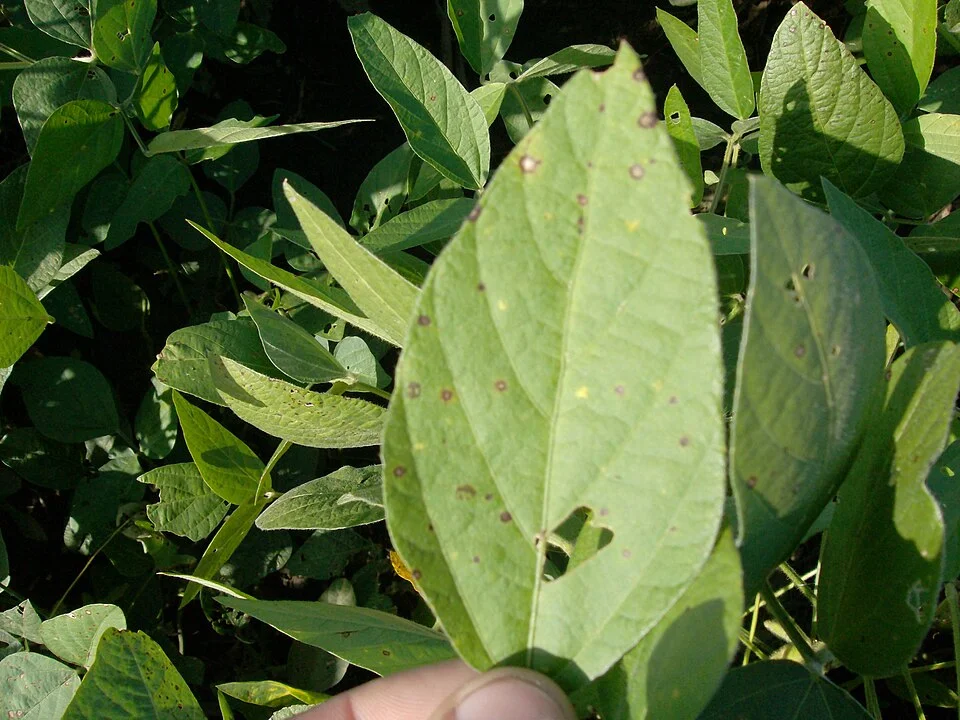
Photo: Maggilautaro · Public domain
Frogeye leaf spot is a fungal disease (Cercospora sojina) that is most damaging on soybean (and also spots tobacco). The fungus over-winters in old soybean stalks left in the field and hides inside the seed. In warm, wet weather it throws spores onto the leaves, where each spot makes more spores that rain and wind carry up onto the fresh top leaves. Cycle after cycle, the spots eat away the green, healthy leaf the plant needs to fill its pods, and can even blotch the pods and the seed you keep for next year.
Why it matters
Frogeye leaf spot robs your soybean of the healthy green leaf it needs to fill its pods, and a bad attack in a warm, wet year can take up to a third (30%) of your crop. It is hard to beat once it takes hold because it spreads fast up the plant in every rain, and it hides in your old stalks and even inside your saved seed — so it comes back next season before you even see it. Your best win comes from stopping it before it starts, not from chasing it once the top leaves are covered.
When to act
spots appearing on upper canopy leaves during flowering to pod-fill in warm, wet weather
This guidance is general, compiled from published agronomic references including FAO and CABI. Thresholds and timing shift with your crop, your variety and the season.
In much of the region a spray is simply called mushonga — medicine. But a chemical group you cannot name is one you cannot rotate, and a product you did not write down has no pre-harvest interval you can observe. Mushonga, and other farming words →
The full Frogeye leaf spot field guide
Identify it
What you see first
small round spots scattered on the upper leaves. Each spot is about the size of a match-head to a small pea, with a grey to light-brown dead centre ringed by a dark reddish-brown border — like a little eye staring back at you. That eye-in-a-ring look is where the name frogeye comes from.
As it spreads
the spots multiply and run together into larger dead brown patches, the leaf turns yellow around them, and badly hit leaves dry up and drop early. In a wet spell, turn a spot to the light and you may see a faint grey, dusty fuzz on the underside of the dead centre — that is the fungus making fresh spores.
On the pods and seed
late in the season look for grey to dark-brown blotchy patches on the pods, and on the beans inside, grey or brown smudges over the seed coat. Spotted seed carries the disease into next year's crop.
Don't confuse it
with other leaf spots. Frogeye spots have a clean grey centre with a sharp dark-red ring and sit mostly on the younger top leaves. Bacterial spots look wet, greasy and angular (boxed in by the leaf veins) and often have a yellow halo, not a grey centre. Simple sun-scorch or nutrient burn has no dark ring and no dusty fuzz underneath.
Scout for it
When to look
this disease hits during mid- and late season — from flowering through pod-fill — and it loves warm, wet weather (about 25-30 C with heavy dew, frequent rain or overhead watering, and muggy 90%-plus humidity). Start checking at flowering and step up your walks after every warm rainy spell.
How to walk the field
every week, walk a big "W" shape so you cover all four corners and the middle — not just the row nearest the path where you always look. Make about 10 stops along the W.
What to check at each stop
look at the upper and middle leaves of a few plants — the fresh top growth, not just the old bottom leaves. You are hunting for the small grey-centred, dark-ringed frogeye spots, and checking whether the newest top leaves are now getting hit (that means it is climbing and still active).
Your action number
the danger sign is new spots showing up on the upper-canopy leaves during flowering to pod-fill in warm, wet weather. In plain terms — if you start finding frogeye spots on the top leaves of about 1 in 10 plants while the weather is warm and wet and the crop is flowering to filling pods, act now, before it races up the whole canopy.
Control it
Prevent it first — plant a resistant variety (your strongest, cheapest tool):
choose a soybean variety bred to resist frogeye and suited to your area, and always plant clean, disease-free seed — never keep seed from a spotted, infected crop. Resistant seed is the single most reliable control and it costs you nothing extra at spraying time.
Break the cycle in the field (cultural steps)
rotate away from soybean for at least one full season onto a non-host crop like maize or a cereal, so last year's fungus in the residue dies off. Plough or dig the old soybean stalks down after harvest so infected trash rots away instead of throwing spores onto the new crop. Do not overhead-water late in the day (leaves that stay wet all night feed the fungus), and don't walk or work through the field while the leaves are wet — you carry spores from plant to plant on your hands and clothes.
Chemical — a triazole fungicide, only as a last resort:
if you grew a susceptible variety and spots are climbing onto the top leaves in warm, wet weather during flowering to early pod-fill, a triazole fungicide can hold it back (a triazole is a fungicide that moves a little way inside the leaf to protect new growth). Spray at early flowering to early pod-fill, when the disease is just developing — spraying once the whole canopy is already brown is money wasted.
Spray safely
cover your skin, eyes, nose and mouth; spray in the cool of the morning or evening with the wind at your back so the mist blows away from you; keep it off food, off drinking water, and away from children and bees; wash yourself and your clothes afterwards; and respect the pre-harvest interval — the number of days the label says you must wait between the last spray and picking your beans, so no chemical is left on the crop you eat or sell.
Guard against resistance
don't lean on one chemical group over and over. Rotate to a different fungicide group each time (and avoid relying only on the strobilurin group, which frogeye has already learned to beat in many places) so the fungus doesn't become immune to your spray.
If it keeps spreading
if spots still climb after you have sprayed and the weather stays warm and wet, do not just spray again and again — check you used a resistant variety and a rotating fungicide, and accept that once most of the upper leaves are dead the pods will no longer fill. At that point cut your losses on this crop: harvest what is sound, keep none of the spotted seed for planting, and plan next season around a resistant variety plus rotation so you start clean.
Catch Frogeye leaf spot before it costs you the harvest
This guide is the general answer. Divisi works out yours — the week to scout your own field for Frogeye leaf spot, and what to do the day you find it.


Crops it affects
Plan the crops it attacks


All planting calendars, country by country
Get Insights by email
A short digest of new Divisi articles. No email on quiet weeks.
Frequently asked questions
How do I identify Frogeye leaf spot?
What you see first. small round spots scattered on the upper leaves. Each spot is about the size of a match-head to a small pea, with a grey to light-brown dead centre ringed by a dark reddish-brown border — like a little eye staring back at you. That eye-in-a-ring look is where the name frogeye comes from.
When should I take action against Frogeye leaf spot?
spots appearing on upper canopy leaves during flowering to pod-fill in warm, wet weather
How do I control Frogeye leaf spot?
Prevent it first — plant a resistant variety (your strongest, cheapest tool):. choose a soybean variety bred to resist frogeye and suited to your area, and always plant clean, disease-free seed — never keep seed from a spotted, infected crop. Resistant seed is the single most reliable control and it costs you nothing extra at spraying time.
Which crops are attacked by Frogeye leaf spot?
Among the crops covered here: Soybean, Tobacco.