 Divisi
Pepper viruses
· Viral
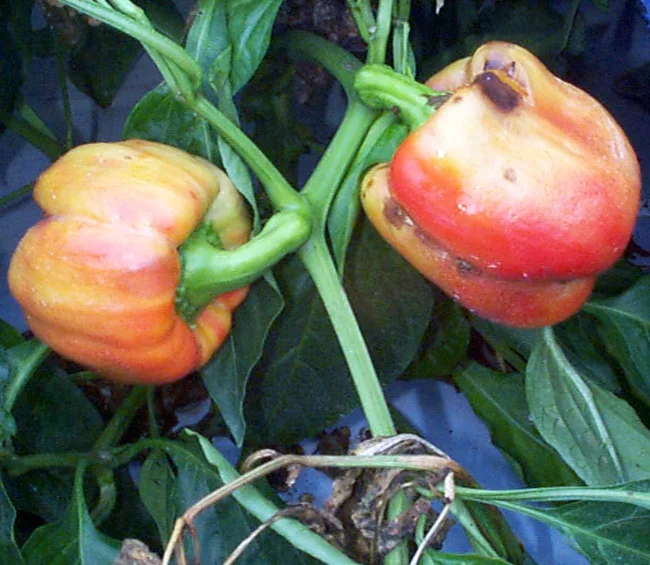
Photo: Image: UF/IFAS Pest Alert Web site/Pamela Roberts · CC BY 2.5
Pepper viruses are a group of plant viruses — mosaic viruses carried by aphids, spotted-wilt carried by thrips, and leaf-curl viruses carried by whiteflies — that get inside the whole plant through the bite of a tiny insect. Once a plant is infected it stays infected for life; there is no spray or medicine that can cure it. The younger the plant when it catches the virus, the more it loses.
Carlos Gonzalez · CC BY-SA 3.0 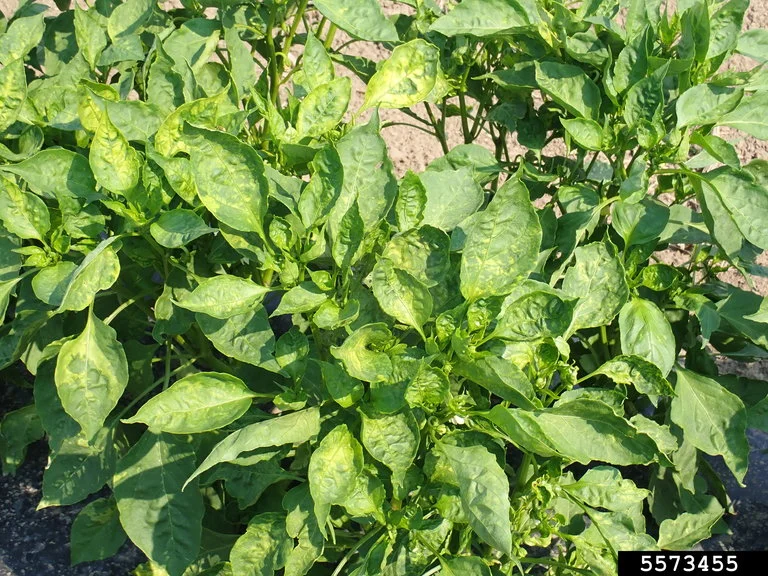
Whitney Cranshaw · CC BY 3.0 us
Why it matters
Pepper viruses can wipe out up to 80% of your crop — that is four plants in every five giving you little or no fruit. What hurts most is that there is no cure: once a plant is infected it stays sick for life, so no spray will bring it back, and every day a sick plant stands in your field the insects carry the virus on to healthy plants. Because the tiny insects that spread it are quick and hard to see, one infected seedling can seed a whole field before you notice. That is why your only real weapons are stopping the insects and pulling out sick plants early — before, not after, the damage shows.
When to act
First plants with mosaic or leaf distortion, or rising vector counts in the nursery or young crop; there is no cure, so act on vectors and roguing early
This guidance is general, compiled from published agronomic references including FAO and CABI. Thresholds and timing shift with your crop, your variety and the season.
In much of the region a spray is simply called mushonga — medicine. But a chemical group you cannot name is one you cannot rotate, and a product you did not write down has no pre-harvest interval you can observe. Mushonga, and other farming words →
The full Pepper viruses field guide
Identify it
The first thing you see is on the leaves
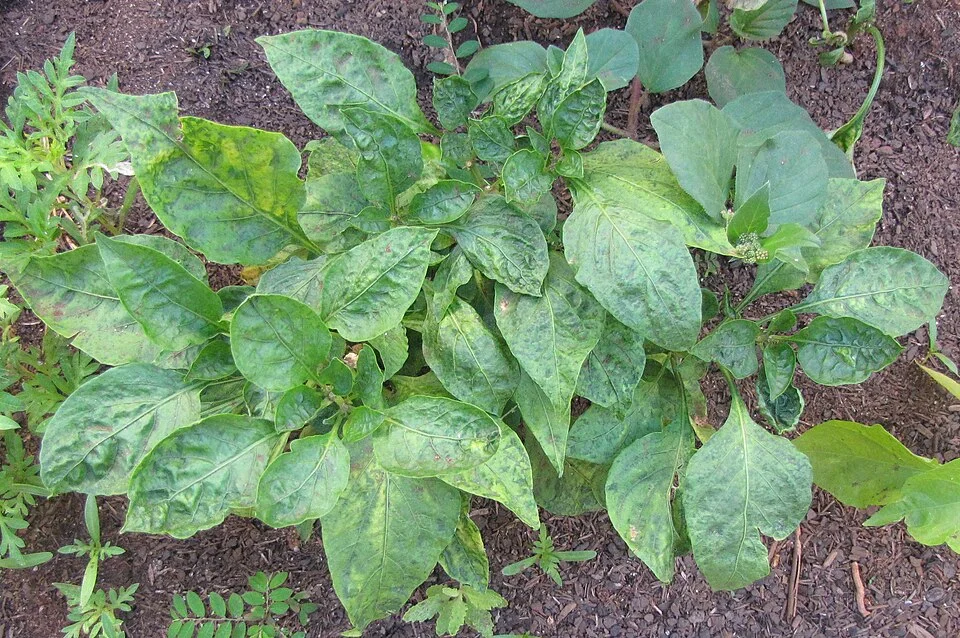
a light-and-dark mosaic or blotchy mottling — patches of pale yellow-green mixed with normal green, like a shadow map across the leaf instead of one even colour. Hold a young leaf up to the light and the uneven patchwork stands out.
As it spreads, the leaves change shape
they curl, pucker, crinkle or narrow into strap-like straps, and the plant becomes stunted and bushy, shorter than its healthy neighbours in the same row. With spotted-wilt you'll also see brown or bronze ring spots and dead (necrotic) flecks — small dry, dead marks — on leaves and stems.
Check the fruit too
peppers from a sick plant come out mottled, streaked, small, lumpy or twisted, or the plant fails to set fruit at all. That is money you can see missing.
Tell it apart from look-alikes
hunger (nutrient shortage) yellows leaves evenly, usually the older lower leaves first, and never curls or distorts them — virus mosaic is patchy and uneven and hits the young top growth. Spray or fertiliser burn leaves brown from the edges and tips inward; virus dead-spots sit as rings and flecks in the middle of the leaf. And unlike a fungus, a virus leaves no mould, no powder, no wet rot — the leaf surface stays dry, only its colour and shape are wrong.
Scout for it
Start in the nursery and don't stop until mid-season
Peppers are most easily wrecked when young, so watch hardest from seedling stage, through transplanting and early growth, right into mid-season (flowering and first fruit) — a plant infected early loses far more than one infected late.
Walk a big "W" across the field
so you cover all four corners and the middle, not just the row by the path where you always look. Make about 10 stops on each walk, and go through at least twice a week while vectors are active.
At each stop check about 10 plants — look at the youngest top leaves first
for mosaic, mottling, ring spots and curling, and turn leaves over to hunt the insects that carry the virus (the vectors): tiny soft green or black aphids, slender fast-moving thrips, and white moth-like whiteflies that fly up in a cloud when you shake the plant.
Your action number
the very first plant showing mosaic or leaf distortion is your trigger — pull it and step up vector control at once. Don't wait for a percentage: with a disease that has no cure, one sick plant left standing infects the rest. Likewise, if vector numbers are climbing in the nursery or young crop (more aphids, thrips or whiteflies each visit, or rising catches on a sticky trap), act now rather than later.
Hang yellow or blue sticky traps
among the plants to measure the insects you can't easily count by eye. A rising catch from one week to the next is your early warning that vectors — and the virus — are building, even before symptoms show.
Control it
Prevent first — this is where you win or lose (resistant varieties and clean culture are your strongest tools)
Where they are sold locally, grow varieties bred to resist the viruses common in your area — these plants fight the virus off on their own and are the single most reliable protection. Start with clean seed and healthy transplants from a trusted source; never take cuttings or seedlings from a field that had virus last season.
Keep the insects off the young plants
Raise seedlings under fine insect netting so aphids, thrips and whiteflies can't reach them before transplanting — the tender nursery stage is when infection does the most harm. Lay reflective or silver mulch between the rows: the shine confuses aphids and whiteflies and keeps them from landing on your plants.
Cut out the virus sources around your crop
Clear weeds in and around the field — many weeds hide the virus and feed the insects between crops. Keep new pepper, chilli and tomato plantings well away from older, already-infected ones, and leave a break between one solanaceous crop and the next (peppers, chillies and tomatoes are all in the same family and share these viruses) so the virus has no bridge from last season to this one.
Act early: rogue (pull out) sick plants the moment you spot them
As soon as a plant shows mosaic or distortion, uproot it and carry it right out of the field — bury it or burn it, don't drop it on the edge where insects keep feeding on it. Doing this the same day removes the virus store before the insects spread it further. Wash your hands and any knife afterwards, as some of these viruses spread on sap through handling.
Chemical is a last resort and only a helper, never a cure (insecticide — lowest of your options here)
No spray kills a virus; an insecticide (an insect-killing spray) only knocks down the vectors, and even then it works poorly — many of these viruses are passed on in seconds, before the insect dies. If vector pressure is very high, use a locally recommended insecticide to slow them, paired with the netting, mulch and roguing above — never alone. Safety: cover your skin, eyes, nose and mouth; spray in the cool of morning or evening with the wind at your back; keep it off food, water, children and bees; rotate to a different chemical group each time so the insects don't build resistance; respect the pre-harvest interval (the wait between spraying and picking, printed on the label) so treated fruit is safe to eat; and wash yourself and your clothes afterwards.
If it keeps spreading
step up roguing — walk the field daily and pull every new sick plant — and tighten vector control with netting, mulch and traps. When a plant is already infected there is nothing to save on that plant, so put your effort into protecting the healthy ones. If a young block is badly hit early, cut your losses: pull the worst plants out completely, and next season plant a resistant variety, on clean ground, away from old crops, under netting — prevention is the only thing that truly works against a disease with no cure.
Catch Pepper viruses before it costs you the harvest
This guide is the general answer. Divisi works out yours — the week to scout your own field for Pepper viruses, and what to do the day you find it.


Crops it affects
Plan the crops it attacks


All planting calendars, country by country
Get Insights by email
A short digest of new Divisi articles. No email on quiet weeks.
Frequently asked questions
How do I identify Pepper viruses?
The first thing you see is on the leaves. a light-and-dark mosaic or blotchy mottling — patches of pale yellow-green mixed with normal green, like a shadow map across the leaf instead of one even colour. Hold a young leaf up to the light and the uneven patchwork stands out.
When should I take action against Pepper viruses?
First plants with mosaic or leaf distortion, or rising vector counts in the nursery or young crop; there is no cure, so act on vectors and roguing early
How do I control Pepper viruses?
Prevent first — this is where you win or lose (resistant varieties and clean culture are your strongest tools). Where they are sold locally, grow varieties bred to resist the viruses common in your area — these plants fight the virus off on their own and are the single most reliable protection. Start with clean seed and healthy transplants from a trusted source; never take cuttings or seedlings from a field that had virus last season.
Which crops are attacked by Pepper viruses?
Among the crops covered here: Sweet pepper, Tomato.