 Divisi
Purple blotch
Alternaria porri · Fungal
Photo: honey-bee from Bangkok, Thailand · CC BY 2.0
Purple blotch (Alternaria porri) is a fungal leaf disease of onions, garlic and shallots. The fungus slips in through wounds — very often the silvery feeding scars left by thrips — during warm, humid, wet-leaf weather. Small spots grow into large purple, ringed patches that girdle and kill leaves and seed stalks, and the same fungus later rots stored bulbs at the neck.
Why it matters
Purple blotch is the disease that turns a green onion crop brown before it fills out. In a warm, wet season it can take up to 60% of your harvest — leaves die back early so the bulbs stay small, and the seed stalks snap before the seed sets. Worse, it follows the bulbs into the store and rots them at the neck weeks after harvest. Once the spots join up across the leaves the fungus is everywhere and sprays only slow it — so the whole game is stopping it early, before the first few spots spread.
When to act
First small water-soaked or purple lesions on older leaves during warm humid weather; start protectant sprays before lesions coalesce
This guidance is general, compiled from published agronomic references including FAO and CABI. Thresholds and timing shift with your crop, your variety and the season.
In much of the region a spray is simply called mushonga — medicine. But a chemical group you cannot name is one you cannot rotate, and a product you did not write down has no pre-harvest interval you can observe. Mushonga, and other farming words →
The full Purple blotch field guide
Identify it
The first thing you see
small water-soaked (wet-looking) flecks or tiny white sunken dots on the older, lower leaves — the leaves furthest from the centre. They often sit right where thrips have rasped silvery scratch-marks.
As it spreads
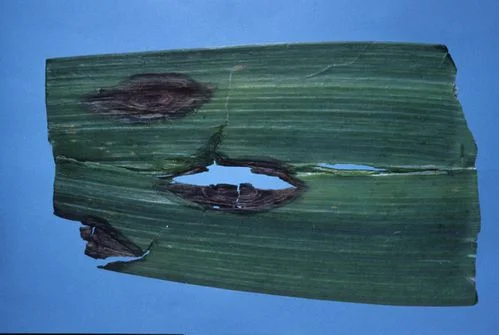
each fleck grows into an oval purple-to-brown patch, often with a yellow halo and faint rings inside it, like the rings of a cut onion or a target. In damp, misty mornings a fine, sooty-brown dust (the fungus's spores) can velvet the surface.
When it's bad
the patches join and girdle (wrap right around) the leaf or seed stalk, so it yellows, folds over and dies from the tip down. At harvest and in store the neck of the bulb goes soft, sunken and wine-red to dark brown — a neck rot.
Don't confuse it
with downy mildew (pale, fuzzy grey-violet growth in long patches, no target rings, thrives in cool damp — not warm), or with plain tip die-back from drought or salty water (dry brown tips, but no purple ringed patches and no yellow halo). Purple blotch always shows those ringed, target-like purple patches with a yellow edge on the older leaves first.
Scout for it
When to look
purple blotch attacks once the leaves are growing well and right through bulbing to harvest (the development, mid-season and late-season stages). Look hardest in warm weather (about 21–30°C) after rain, heavy dew, or overhead watering — a spell of wet leaves is the trigger.
How to walk
every few days, walk a big "W" across the field so you cross all four corners and the middle, not just the edge nearest the path.
Where to look
at about 10 stops bend down and check the older, outer leaves first — turn them over and look near any silvery thrips scars. That is where the very first spots appear.
When to act (the number)
as soon as you find the first water-soaked or purple spots on even 1 in 10 plants' older leaves during warm, humid weather — start protectant spraying that week, before the spots grow and join up. Do not wait for the whole field to show it; by then it is too late for cheap control.
Also watch the thrips
heavy thrips feeding makes many little wounds for the fungus. If leaves look silvery and speckled from thrips, purple blotch risk is high — scout even more closely.
Control it
Prevent it first (cheapest, works best over a season)
rotate — do not plant onions, garlic or shallots on the same land two seasons running; give it a 2–3 year break so old crop debris rots away. Plant clean, disease-free seed and sets, and space plants wider so air moves through and leaves dry fast after rain or dew.
Keep the leaves dry and the thrips down
water at the base, not overhead, and if you must use overhead irrigation do it early in the morning so leaves dry by midday — never late in the day when they stay wet all night. Control thrips, because their feeding scars are the doorways the fungus uses. Clear and burn old onion leaves and culls after harvest.
Protect the harvest
at lifting, cure and dry the bulbs well (necks fully dry and tight) before storing, and store cool and airy — this stops the neck rot that shows up weeks later in the store.
Grow a tougher variety
where you can get them, plant more tolerant varieties — they slow the disease, though on their own they are only a partial shield, so still scout and keep up the cultural steps.
Chemical — last resort, protectant-fungicide (the strongest single tool but use it right):
apply a protectant fungicide — one that coats and shields the leaf surface (a protectant/contact type, e.g. mancozeb or chlorothalonil), as opposed to a systemic one that moves inside the plant. Add a sticker so it holds on through dew, and start before the spots spread, on a preventive schedule during wet weather. Rotate between different chemical groups (e.g. alternate the protectant with a systemic product) so the fungus does not build up resistance.
Spray safely
cover your skin, eyes, nose and mouth; spray in the cool of morning or evening with the wind at your back, never into your face; keep it off food, drinking water, children and bees; wash yourself and your clothes afterwards; and respect the pre-harvest interval — the number of days on the label you must wait between the last spray and eating or selling the crop.
If it keeps spreading
tighten the spray schedule, switch to a different chemical group, and step up the drying and airflow. If a plant's leaves have already collapsed and browned across most of the field, spraying will not bring them back — lift the crop early while the bulbs are still sound, cure them hard and dry, sell or use them quickly rather than storing, and plan a longer rotation and thrips control for next season so it does not return.
Catch Purple blotch before it costs you the harvest
This guide is the general answer. Divisi works out yours — the week to scout your own field for Purple blotch, and what to do the day you find it.


Crops it affects
Plan the crops it attacks


All planting calendars, country by country
Get Insights by email
A short digest of new Divisi articles. No email on quiet weeks.
Frequently asked questions
How do I identify Purple blotch?
The first thing you see. small water-soaked (wet-looking) flecks or tiny white sunken dots on the older, lower leaves — the leaves furthest from the centre. They often sit right where thrips have rasped silvery scratch-marks.
When should I take action against Purple blotch?
First small water-soaked or purple lesions on older leaves during warm humid weather; start protectant sprays before lesions coalesce
How do I control Purple blotch?
Prevent it first (cheapest, works best over a season). rotate — do not plant onions, garlic or shallots on the same land two seasons running; give it a 2–3 year break so old crop debris rots away. Plant clean, disease-free seed and sets, and space plants wider so air moves through and leaves dry fast after rain or dew.
Which crops are attacked by Purple blotch?
Among the crops covered here: Garlic, Onion.