 Divisi
Cucumber beetles
Aulacophora spp. · Insect
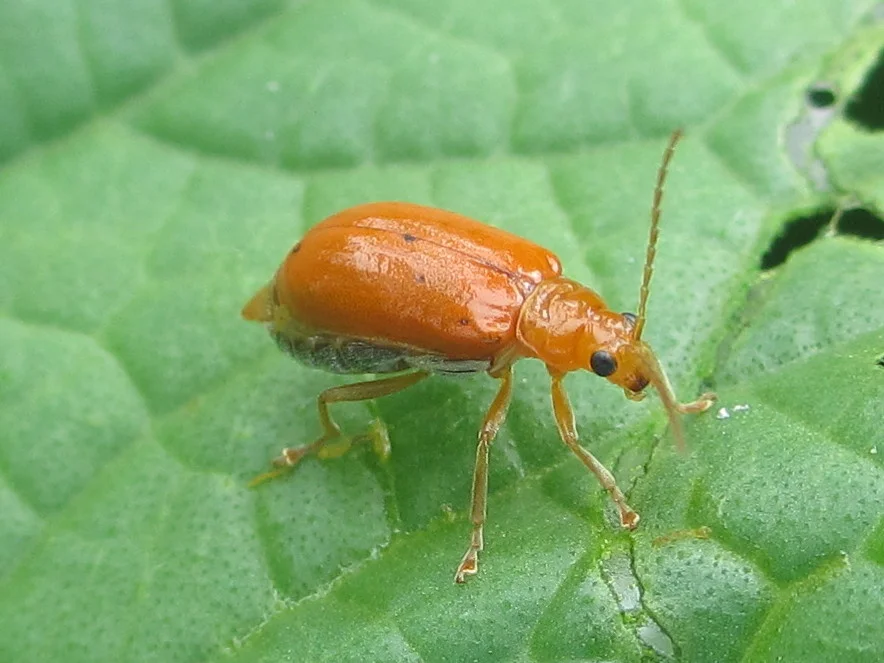
Photo: Ton Rulkens · CC BY-SA 2.0
Cucumber beetles are small, shiny leaf beetles — in Africa most often the red pumpkin beetle (Aulacophora), alongside striped and spotted kinds — that attack the cucurbit family: cucumber, pumpkin, watermelon, melon and squash. The adults chew holes in the leaves, flowers and young fruit, while their creamy-white grubs feed hidden on the roots and stems below the soil. They are most dangerous at the seedling stage, when just a few beetles can wipe out a newly emerged crop.
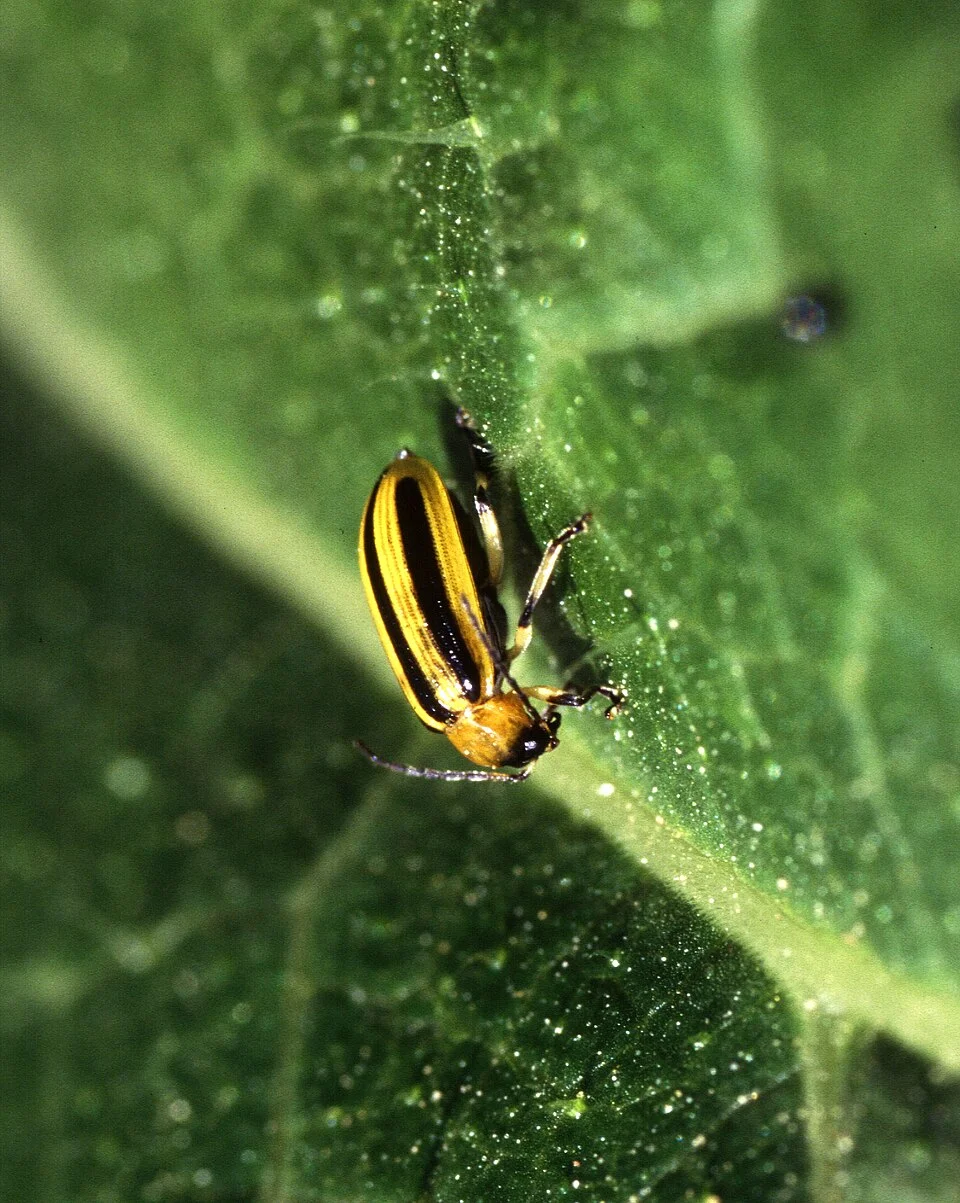
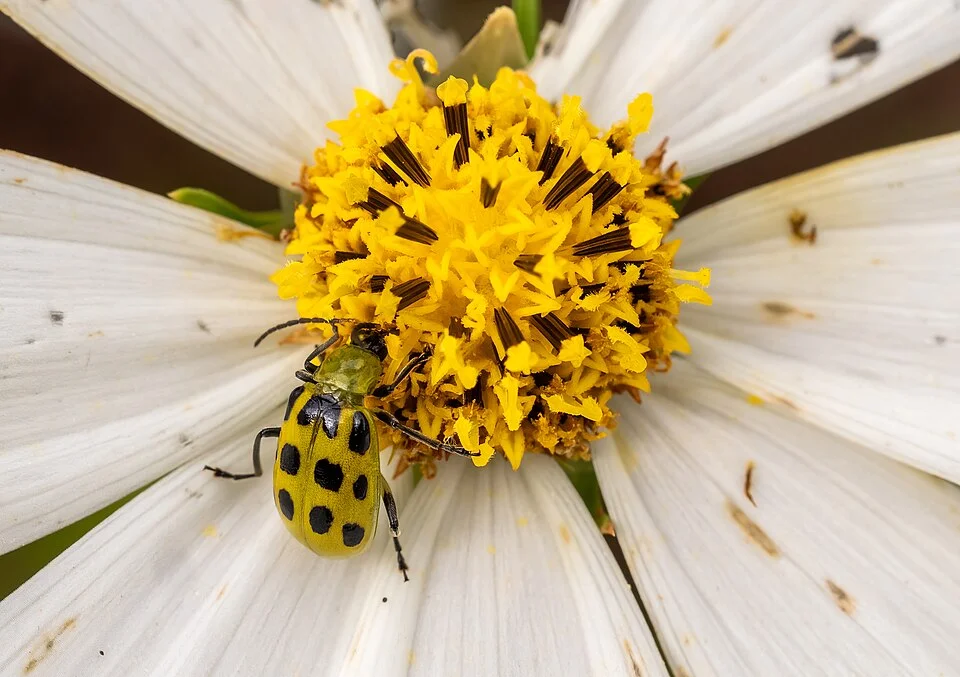
Rhododendrites · CC BY-SA 4.0
Why it matters
Cucumber beetles strike your cucurbits when they are weakest — as tiny seedlings just breaking through the ground. A heavy attack can take up to half your crop (50%), and because only a handful of beetles can strip and kill a seedling in a day or two, the damage happens fast. The grubs also chew the roots unseen, weakening or killing plants from below. Stopping them early, while the plants are small, is the whole game.
When to act
About 1 beetle per seedling, or clear feeding holes on the cotyledons and first true leaves of young plants.
This guidance is general, compiled from published agronomic references including FAO and CABI. Thresholds and timing shift with your crop, your variety and the season.
In much of the region a spray is simply called mushonga — medicine. But a chemical group you cannot name is one you cannot rotate, and a product you did not write down has no pre-harvest interval you can observe. Mushonga, and other farming words →
The full Cucumber beetles field guide
Identify it
The damage shows first
On young plants you will see round, ragged holes chewed through the cotyledons (the first two rounded seed-leaves) and the first true leaves — sometimes so many that a seedling is left a lacy skeleton. Look too for scarred flowers and pale bite-marks on young fruit, and for seedlings that wilt or stay stunted even in moist soil, a sign the grubs are chewing the roots below.
The beetle itself is small and shiny — about the size of a grain of rice (5–8 mm)
In our region it is usually the red pumpkin beetle: bright orange-red to yellow on the back with a black underside. You may also meet striped kinds (yellow with black stripes) or spotted kinds (yellow-green with black spots). They cluster on the youngest plants, feed in the warm part of the day, and fly or drop off the instant your shadow touches them — so count them in the cool early morning, when they sit still.
The grubs stay out of sight
Unless you dig you will not see them: they are small, creamy-white with a darker head, living in the soil and feeding on the roots and on any fruit resting on the ground.
Don't confuse them with helpful ladybirds
A ladybird is round and dome-shaped, like half a pea, and is busy eating aphids, not your leaves — leave it be, it is on your side. Cucumber beetles are longer and oval, like a grain of rice, and are the ones chewing your leaves, flowers and fruit.
Scout for it
Start watching the day the seedlings break the soil
The danger window is the seedling and early-vine stage (the plant's initial and development stages) — from emergence until the plants are established and flowering. Through this window, in warm weather (about 22–32 °C), check every single day; beetles find tender seedlings within hours.
Scout in the cool early morning
, while the beetles are slow and still sitting on the plants instead of flying. Walk a big "W" across the field so you cover all four corners and the middle — not just the row beside the path where your eye always lands.
Make about 10 stops, and at each stop check a few seedlings closely: the tops and undersides of the cotyledons and first true leaves for beetles and fresh holes, the open flowers once they appear, and the stem base and soil for wilting plants that hint at grubs below.
The threshold is low because the plants are so small — lead with the count
Act the moment you find about 1 beetle per seedling (roughly 10 beetles across 10 plants), or fresh holes chewed in the seed-leaves and first true leaves. On seedlings you do not wait for numbers to build — even a few beetles can kill a young plant, so this is your signal to act now.
Control it
Prevent first
-
cover the seedlings
Lay a fine net or row cover (a light mesh or cloth spread over the young plants and pinned down at the edges with soil) over the crop from sowing until it flowers. This is your strongest protection — it simply keeps the beetles off the plants during their most vulnerable weeks. Open or lift the cover once flowers appear so bees can get in to pollinate; cucurbits set no fruit without them.
-
deny them a foothold
Raise sturdy transplants in a protected nursery and set out only vigorous seedlings, which race through the tender stage faster. Stagger your sowing dates to dodge the peak of beetle numbers. Clear away old cucurbit crop residue and pull out volunteers (self-sown pumpkins and melons that come up on their own), which shelter beetles between crops. And rotate — do not plant cucurbits where cucurbits grew last season.
Act early — pick and trap
In the cool early morning, hand-pick the sluggish beetles off the seedlings and drop them into a tin of soapy water; on just a few seedlings this alone can hold them. Plant a trap crop — a border of a favourite such as pumpkin or squash — to pull beetles away from your main crop, then deal with them there.
For a light attack, reach for a gentle spray first
A neem spray (made from the neem tree) knocks back a light infestation and is soft on bees and other helpful insects. Apply it in the cool of the day, coating both the tops and the undersides of the seed-leaves where the beetles feed.
Only if beetles stay above threshold on the seedlings, use an approved insecticide as a last resort
— an insecticide is a chemical made to kill insects. Choose a product registered for cucurbits, and spray with the wind at your back so it blows away from you.
Spray safely
Cover your skin, eyes, nose and mouth. Keep the spray well away from food, drinking water, children, animals and bees. Wash yourself and your clothes as soon as you finish. Respect the pre-harvest interval — the number of days the label tells you to wait between spraying and eating or selling the fruit.
Protect the bees, and rotate
Spray at dusk, once bees have stopped visiting the flowers — or very early, before any flowers have opened. Never spray once blooms are open in the morning, while bees are working them. And rotate to a different chemical group each time, so the beetles do not build resistance (stop being killed by a chemical you lean on too often).
If it keeps spreading
where seedlings are dying faster than you can save them, replant the gaps and keep the new seedlings under cover from day one, and hit the trap-crop border hard. Once the crop is past the seedling stage and vining and flowering strongly, a few leaf-holes no longer matter — stop spraying, protect the bees, and let the vigorous plants carry the harvest.
Catch Cucumber beetles before it costs you the harvest
This guide is the general answer. Divisi works out yours — the week to scout your own field for Cucumber beetles, and what to do the day you find it.


Crops it affects
Plan the crops it attacks


All planting calendars, country by country
Get Insights by email
A short digest of new Divisi articles. No email on quiet weeks.
Frequently asked questions
How do I identify Cucumber beetles?
The damage shows first. On young plants you will see round, ragged holes chewed through the cotyledons (the first two rounded seed-leaves) and the first true leaves — sometimes so many that a seedling is left a lacy skeleton. Look too for scarred flowers and pale bite-marks on young fruit, and for seedlings that wilt or stay stunted even in moist soil, a sign the grubs are chewing the roots below.
When should I take action against Cucumber beetles?
About 1 beetle per seedling, or clear feeding holes on the cotyledons and first true leaves of young plants.
How do I control Cucumber beetles?
Prevent first — cover the seedlings. Lay a fine net or row cover (a light mesh or cloth spread over the young plants and pinned down at the edges with soil) over the crop from sowing until it flowers. This is your strongest protection — it simply keeps the beetles off the plants during their most vulnerable weeks. Open or lift the cover once flowers appear so bees can get in to pollinate; cucurbits set no fruit without them.
Which crops are attacked by Cucumber beetles?
Among the crops covered here: Cucumber, Watermelon.