 Divisi
Melon fly
Zeugodacus cucurbitae · Insect
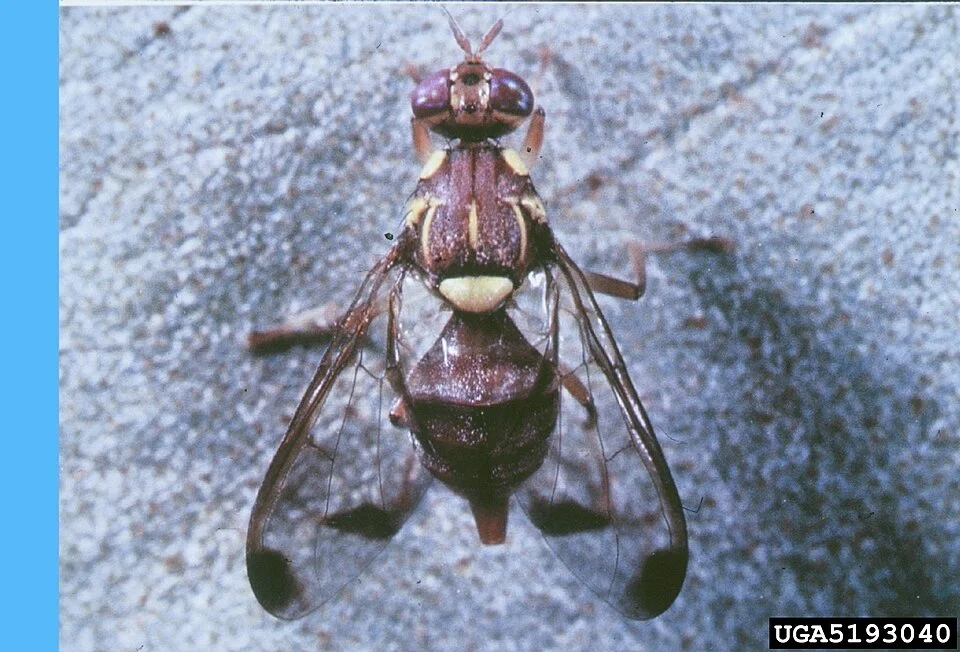
Photo: Florida Division of Plant Industry Archive, Florida Department of Agriculture and Consumer Services, Bugwood.org · CC BY 3.0 us
The melon fly (Zeugodacus cucurbitae) is a fruit fly — a strong-flying, housefly-sized, orange-brown insect with dark-banded wings — that attacks the whole cucumber family: cucumber, melon, pumpkin and watermelon. The female jabs her egg-laying spike into young, still-firm fruit and slips her eggs just under the skin. The hatching grubs (maggots) tunnel through the flesh and rot it, so the fruit drops early; the fallen fruit then breeds a fresh wave of flies in the soil. It builds up fast in warm (about 20–32 °C), humid weather wherever cucurbits keep flowering and fruiting.
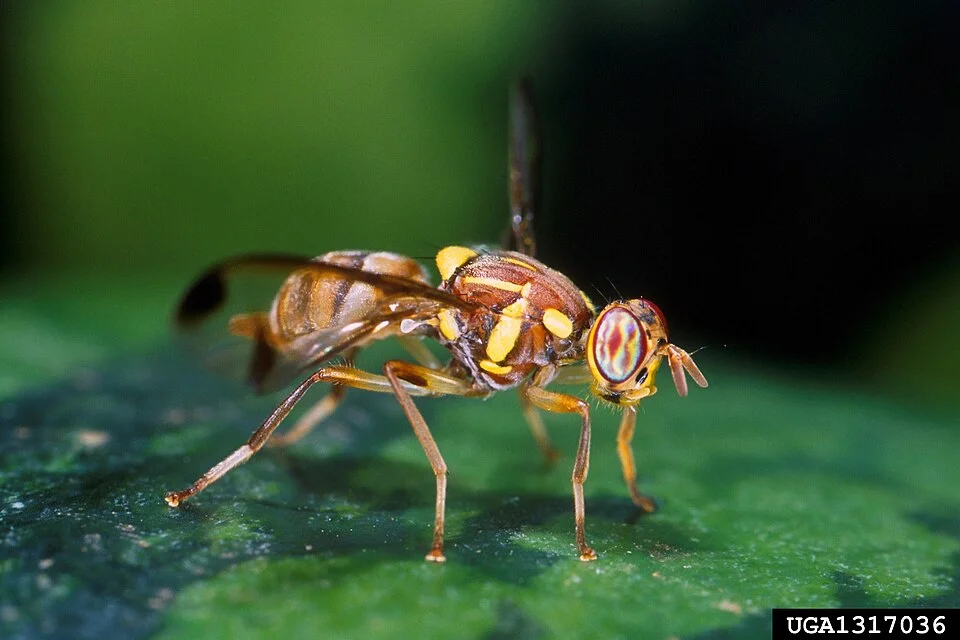
Scott Bauer, USDA Agricultural Research Service, Bugwood.org · CC BY 3.0 us 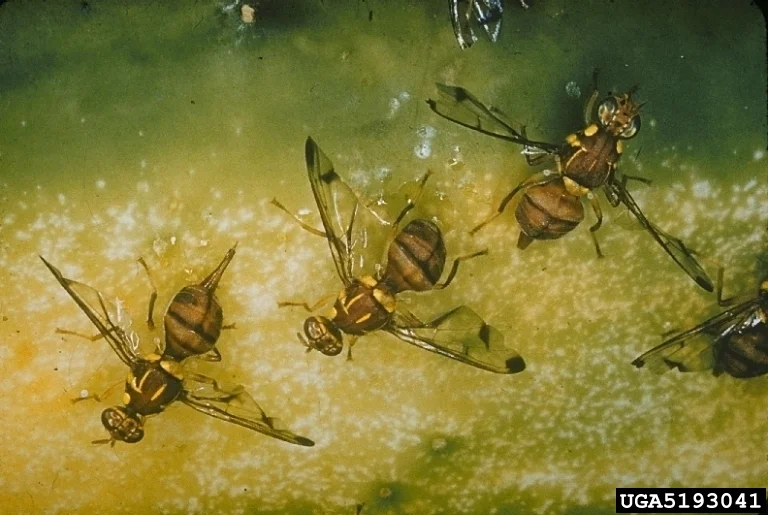
Florida Division of Plant Industry Archive, Florida Department of Agriculture and Consumer Services, Bugwood.org · CC BY 3.0 us
Why it matters
The melon fly can destroy up to 60% — more than half — of your cucumbers, melons, pumpkins and watermelons. The damage is hidden: the female lays her eggs inside young fruit, so by the time you see the rot and the fruit drops, the grubs are already deep in the flesh where no spray can reach them. Worse, every rotting fruit that falls to the ground breeds a fresh batch of flies, so once they settle in your garden they keep coming back season after season. The only way to win is to stop the flies before they sting the fruit — once you can see the damage, it is already too late for that fruit.
When to act
Rising catches in cue-lure traps or the first stung fruit with oviposition punctures; act at the young-fruit stage before egg laying peaks.
This guidance is general, compiled from published agronomic references including FAO and CABI. Thresholds and timing shift with your crop, your variety and the season.
In much of the region a spray is simply called mushonga — medicine. But a chemical group you cannot name is one you cannot rotate, and a product you did not write down has no pre-harvest interval you can observe. Mushonga, and other farming words →
The full melon fly field guide
Identify it
The first sign — a "stung" young fruit:
on a young cucumber, small melon or baby pumpkin, look for tiny puncture marks like pinpricks, often with a bead of clear or gummy sap weeping out and a small brown, sunken halo around each dot. This is where a female fly has jabbed in her egg-laying spike ("stung" the fruit) and slipped her eggs just under the skin.
What happens next
a stung fruit grows crooked or lumpy, goes soft, and rots from the inside. Many young fruit then turn yellow and drop early — you find small fruits lying on the ground long before they should be there.
The proof inside
cut a suspect or fallen fruit open and you will find white, legless grubs (maggots) up to about 1 cm long wriggling in wet, brown, foul-smelling pulp. When you disturb them they can flick and jump off the flesh.
The fly itself
about the size of a housefly but orange-brown, with clear wings marked by dark brown bands along the front edge and a spot at the wing-tip, and pale-yellow marks on its back. It rests on the underside of leaves in the heat of the day and is busiest in the cool of early morning and late afternoon.
Don't confuse it
the many small flies crawling over an already-rotten fruit are usually harmless scavengers (houseflies and vinegar flies) that arrived AFTER the rot began — they are not the culprit. The melon fly attacks healthy, young, still-firm fruit, so hunt for the fresh sting on a good fruit, not the crowd on a spoiled one. A plain grey housefly with clear, unmarked wings does not sting fruit at all.
Scout for it
When to look
start checking the moment tiny fruit begin to form behind the flowers (fruit-set) and keep going right up to harvest. This fruiting stretch — the mid to late part of the season — is exactly when the flies attack. Warm, sticky-humid weather makes it worse, so look harder then.
Hang a trap as your early warning
put up at least one cue-lure trap per plot — a smell-bait that pulls in the male flies so you catch them before you ever see fruit damage. Check the trap once a week and write the number down so you can watch it rise or fall.
The number that means ACT — it is very low:
melon fly builds up explosively, so do not wait for a crowd. Act the day your trap catch is higher than the week before, OR the moment you find even ONE young fruit with a fresh sting. By the time you can find several stung fruit, eggs are already laid inside where you cannot reach them.
Walk a big "W"
twice a week, walk a "W" shape across the plot so you cover all four corners and the middle, not just the row nearest the path. Make about 10 stops along the way.
At each stop, check three things
(1) the skin of young fruit for fresh punctures and sap beads, (2) any fruit already lying on the ground, and (3) the underside of shaded leaves for resting orange-brown flies. Cut open any suspect or dropped fruit to confirm the maggots inside.
Control it
Prevent
-
keep it clean (your single strongest tool):
the flies breed in fallen and rotting fruit, so collect every stung, dropped and over-ripe fruit and destroy it EVERY day. Feed it to animals, boil it, bury it at least knee-deep, or seal it in a black bag left in the sun. Never leave rotten fruit lying in the garden — this daily clean-up (sanitation: removing all infested fruit) starves the next generation of flies.
-
cover the fruit and break the cycle:
bag young fruit in paper, cloth or newspaper sleeves as soon as they set, so the fly cannot reach the skin to sting it. After harvest, dig over or deep-plough the soil to turn up the pupae — the resting stage in the soil where a maggot changes into a fly — so the sun and birds kill them. If you can, time your planting so the fruit forms in a low-fly window, and plant together with your neighbours.
Act early — trap the flies to pull the whole population down:
hang cue-lure traps across the plot to mass-trap the male flies; the smell-bait draws them in, and with the males caught, fewer females can breed. Spread several traps over the block, and get your neighbours trapping too — one garden alone cannot hold back flies that drift in from all around.
The smart spray — a protein BAIT, not a whole-field spray:
the one recommended spray is a protein bait spray — dabs of protein food mixed with a small amount of killer, placed as spots or short bands on the leaves, never on the fruit you will eat. The adult flies come to feed on the bait and die before they can sting the fruit. This beats blanket-spraying the whole field, which does not work here, because the maggots sit hidden inside the fruit where no spray can reach them.
Spray safely — every single time you spray anything:
cover your skin, eyes, nose and mouth; spray in the cool of early morning or evening with the wind behind you; keep the bait well off food, drinking water, children, animals and bees; and after finishing, wash yourself and your clothes. Always wait the full pre-harvest interval — the set number of days between spraying and picking or eating the fruit — before you harvest. If you ever mix a stronger insecticide into the bait, switch to a different type each time so the flies do not become resistant (stop being killed by it).
If it keeps spreading — and when it's too late:
if trap catches and stings keep climbing, do everything at once and rope in your neighbours — daily clean-up, bagging, traps and bait sprays across all the plots together, because one neglected garden re-seeds the whole area. If a fruit is already soft, crooked and maggoty it cannot be saved — strip ALL infested fruit off the vines, gather every fallen one, and bury or destroy the lot, then deep-plough to kill the pupae in the soil. You lose that fruit, but breaking the breeding cycle now protects your next crop — and your neighbours'.
Catch melon fly before it costs you the harvest
This guide is the general answer. Divisi works out yours — the week to scout your own field for melon fly, and what to do the day you find it.


Crops it affects
Plan the crops it attacks


All planting calendars, country by country
Get Insights by email
A short digest of new Divisi articles. No email on quiet weeks.
Frequently asked questions
How do I identify melon fly?
The first sign — a "stung" young fruit:. on a young cucumber, small melon or baby pumpkin, look for tiny puncture marks like pinpricks, often with a bead of clear or gummy sap weeping out and a small brown, sunken halo around each dot. This is where a female fly has jabbed in her egg-laying spike ("stung" the fruit) and slipped her eggs just under the skin.
When should I take action against melon fly?
Rising catches in cue-lure traps or the first stung fruit with oviposition punctures; act at the young-fruit stage before egg laying peaks.
How do I control melon fly?
Prevent — keep it clean (your single strongest tool):. the flies breed in fallen and rotting fruit, so collect every stung, dropped and over-ripe fruit and destroy it EVERY day. Feed it to animals, boil it, bury it at least knee-deep, or seal it in a black bag left in the sun. Never leave rotten fruit lying in the garden — this daily clean-up (sanitation: removing all infested fruit) starves the next generation of flies.
Which crops are attacked by melon fly?
Among the crops covered here: Cucumber, Watermelon.