 Divisi
Nettle caterpillars
· Insect
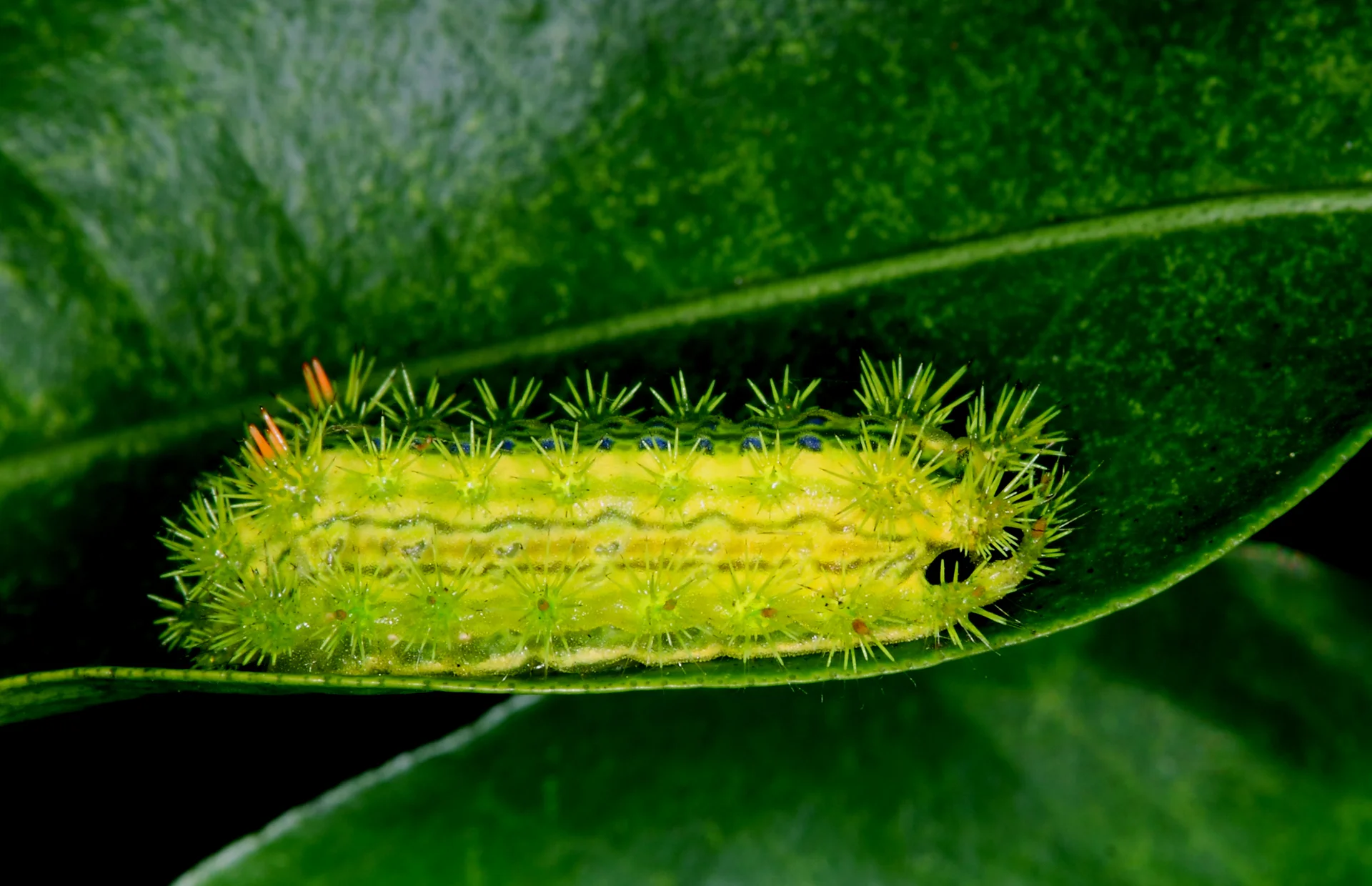
Photo: Masaki Ikeda · CC BY-SA 3.0
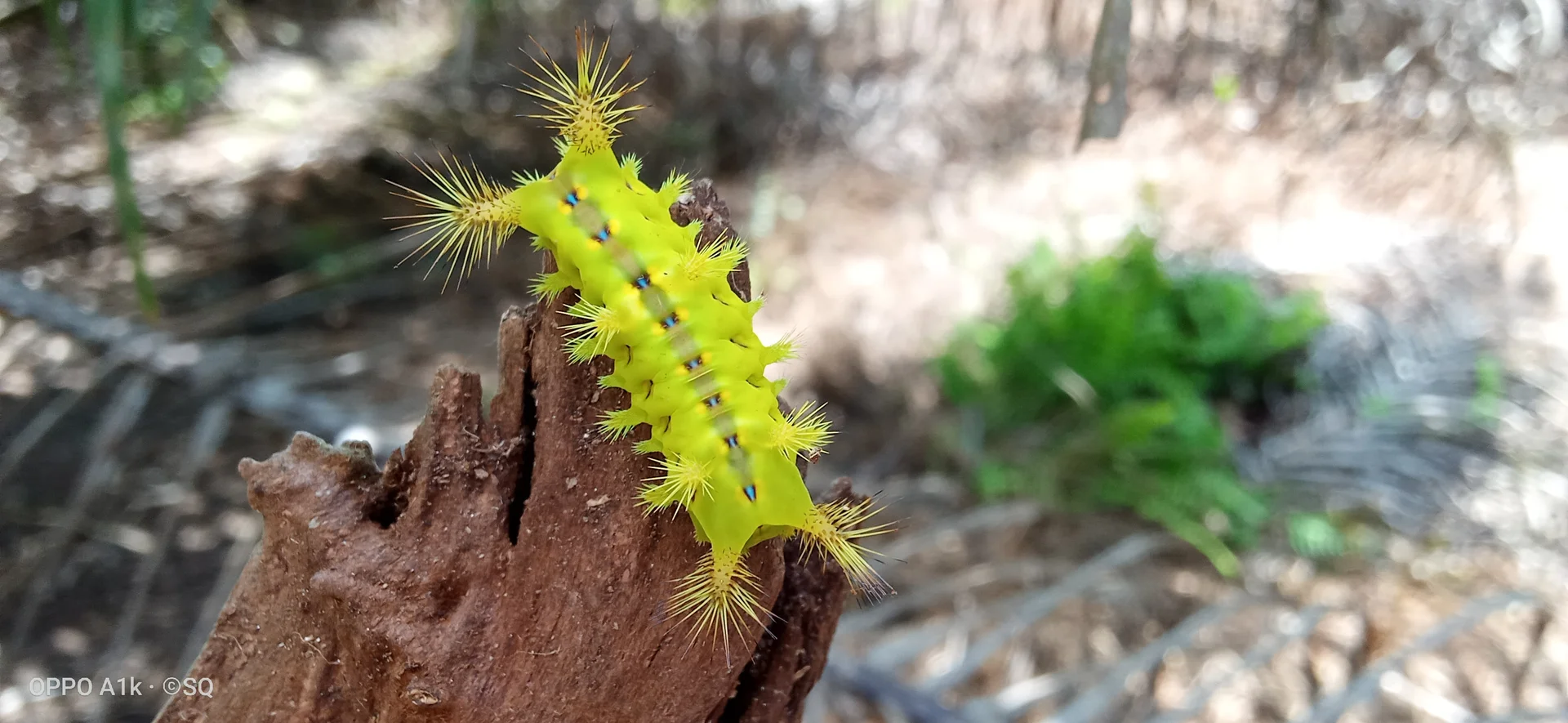
Nettle caterpillars are the larvae of slug moths (family Limacodidae) — flat, sluglike, brightly coloured caterpillars armed with rows of stinging spines, which is why brushing against one burns like a nettle. They feed in tight clusters on the undersides of oil-palm and coconut fronds and on banana leaves, first scraping the surface into pale windows and then stripping whole fronds down to the bare ribs. When they are full-fed they seal themselves inside hard, seed-like cocoons stuck to the fronds, leaf bases or trunk, and later hatch out as small brown moths.
Susenoqurnia · CC BY-SA 3.0 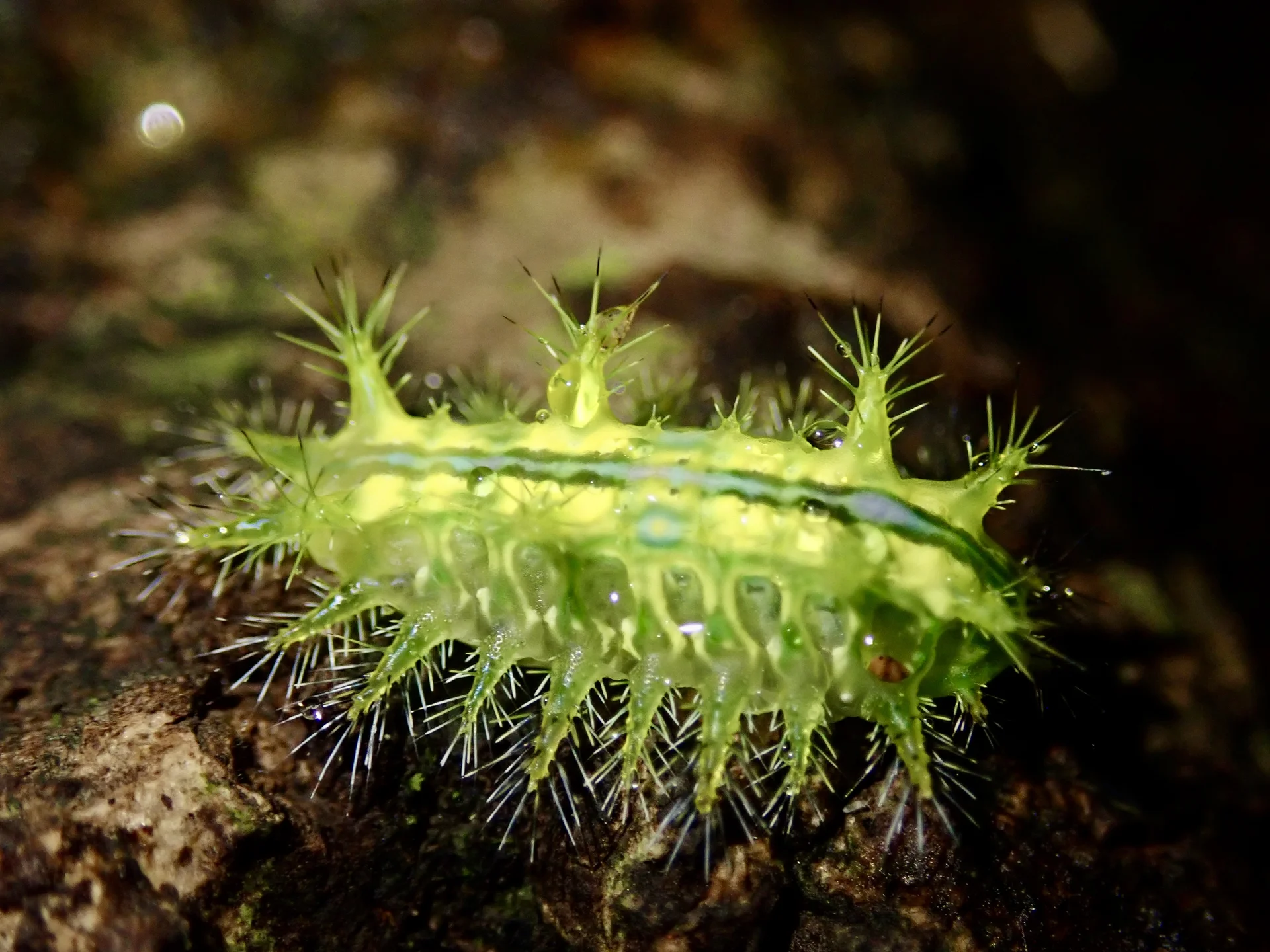
Amonrat Sanedee · CC BY-SA 4.0
Why it matters
Nettle caterpillars can strip your oil palm, coconut or banana fronds right down to the bare ribs, and a tree with no green leaves cannot fill its bunches or nuts. A heavy attack can cost you up to 40% — about four in every ten of your harvest. They breed fast in warm, damp weather, feed in stinging clusters that hurt to touch, and glue hard cocoons onto the tree that seed the next wave — so once an outbreak spreads across a block it is slow and painful to beat back. Catching them early, while the colonies are small and on just a few trees, is everything.
When to act
Rising numbers of larvae feeding on the fronds and visible defoliation building in a block; act before whole fronds are skeletonised.
This guidance is general, compiled from published agronomic references including FAO and CABI. Thresholds and timing shift with your crop, your variety and the season.
In much of the region a spray is simply called mushonga — medicine. But a chemical group you cannot name is one you cannot rotate, and a product you did not write down has no pre-harvest interval you can observe. Mushonga, and other farming words →
The full Nettle caterpillars field guide
Identify it
The damage shows first
on the fronds (the big palm leaves) and on banana leaves, look for pale, thin, see-through patches — like little windows — where the caterpillars have scraped one side of the leaf away. As they grow the windows join into ragged holes, and then whole leaflets are stripped down to the bare ribs and midrib, like a leaf skeleton, leaving the tree looking dry, scorched and brown. It usually starts on the older, lower fronds and spreads across a patch of neighbouring trees.
The caterpillar itself
turn a frond over and look on the underside. Each one is small — from shorter than your thumbnail up to about the length of your thumb (1–2.5 cm) — flat and sluglike, with no legs you can see, so it seems to glide rather than crawl. Most are bright green or yellow with stripes or spots, and they carry rows of stiff, bristly spines. They sit crowded side by side in clusters, not alone.
They sting — that is the sure giveaway
Brush bare skin against the spines and you get an instant burning, nettle-like rash (that is how the pest got its name). An ordinary crawling caterpillar never does this.
Don't mix it up
with bagworms (which drag a little bag of leaf-bits around and dangle from a thread) or with ordinary loopers and leaf-worms (which have clear legs, loop or crawl along, have smooth bodies and do not sting). Nettle caterpillars are the ones that look legless and sluglike, huddle together in clusters, and sting.
You may also find the cocoons
hard, oval, brown cases about the size of a small bean or seed, glued onto the fronds, leaf bases or trunk. This is where each caterpillar seals itself in to turn into a moth — and where the next generation comes from.
Scout for it
When to look
nettle caterpillars build up in the warm, humid months when the canopy is full and the bunches or nuts are filling — the mid- to late season. Warm, damp weather (about 22–32°C with high humidity) is when the colonies grow fastest, so step up your checks in that window.
Cover up before you scout
wear gloves and long sleeves — the spines sting the instant you touch them, even by accident.
Walk a big letter "W"
across the block so you cover all four corners and the middle, not just the row by the path. Make about 10 stops along the way.
At each stop, turn over the lower, older fronds
(and the banana leaves) and check the undersides, where the colonies start. Look for the pale window-pane scraping, the flat sluglike caterpillars packed in clusters, and any hard, seed-like cocoons on the fronds, leaf bases or trunk.
Count colonies, not single caterpillars
— because they feed in groups. Across your 10 palms, note how many fronds carry a cluster and roughly how many caterpillars are on each, so you can tell whether the numbers are rising from one week to the next.
Act as soon as you find a colony (about 5 or more caterpillars on a frond) on 2 or more of your 10 palms, or fresh window-pane scraping spreading from tree to tree — and always before a single whole frond is stripped to its bare ribs
A few colonies left alone this month become brown, skeletonised blocks next month.
Control it
Prevent it by protecting the helpers
tiny parasitic wasps and flies — whose young feed on the caterpillars — normally keep nettle caterpillars in check on their own. Blanket-spraying the whole plantation kills these helpers and is the main reason outbreaks flare up, so do not spray the whole block. Keep scouting instead, and deal with colonies while they are still small and on only a few trees.
Cut out and burn the early colonies
while the attack is still on a few fronds, prune off the fronds carrying the clusters and the hard cocoons, and burn them — with your gloves on, because the spines still sting. Taking out the colonies and cocoons early stops the next, bigger wave from hatching.
Act early with a natural spray, Bt
where colonies are spreading, spray Bt (Bacillus thuringiensis — a natural soil bacterium that sickens only caterpillars and is harmless to you, your bees, birds and the helpful wasps) onto the undersides of the infested fronds, where the caterpillars sit. Spray while they are still small and young — big caterpillars are far harder to kill — and spray in the cool of the day (early morning or late afternoon), wetting the leaf undersides well.
Only as a last resort, a chemical spray — a pyrethroid:
a pyrethroid is a fast-acting contact poison (it kills the caterpillar when the spray lands on it). Use it only to spot-treat the outbreak patch — never the whole plantation — because it also kills the natural enemies and makes the next outbreak worse. When you do spray: cover your skin, eyes, nose and mouth; spray in the cool of the day with the wind at your back; keep it off food, water, children and bees; and wash yourself and your clothes straight afterwards. Respect the pre-harvest interval (the number of days you must wait after spraying before the fruit or nuts are safe to harvest). And to stop the pest getting used to the poison (resistance), rotate to a different chemical group each time rather than reaching for the same one again and again.
If it keeps spreading
if colonies keep multiplying and whole fronds are being skeletonised across the block in spite of your spot-treating, stop any broad spraying (it is feeding the outbreak by wiping out the helpers), cut and burn the worst-hit fronds to pull out the caterpillars and cocoons, and seek advice on protecting or bringing back natural enemies. When a tree is already stripped to bare ribs, those fronds — and this season's bunches or nuts on it — are lost: protect the central growing point (the spear or heart of the palm), put your effort into saving the trees that are still green, and rebuild the helper population so the block can recover next season.
Catch Nettle caterpillars before it costs you the harvest
This guide is the general answer. Divisi works out yours — the week to scout your own field for Nettle caterpillars, and what to do the day you find it.


Crops it affects
Plan the crops it attacks


All planting calendars, country by country
Get Insights by email
A short digest of new Divisi articles. No email on quiet weeks.
Frequently asked questions
How do I identify Nettle caterpillars?
The damage shows first. on the fronds (the big palm leaves) and on banana leaves, look for pale, thin, see-through patches — like little windows — where the caterpillars have scraped one side of the leaf away. As they grow the windows join into ragged holes, and then whole leaflets are stripped down to the bare ribs and midrib, like a leaf skeleton, leaving the tree looking dry, scorched and brown. It usually starts on the older, lower fronds and spreads across a patch of neighbouring trees.
When should I take action against Nettle caterpillars?
Rising numbers of larvae feeding on the fronds and visible defoliation building in a block; act before whole fronds are skeletonised.
How do I control Nettle caterpillars?
Prevent it by protecting the helpers. tiny parasitic wasps and flies — whose young feed on the caterpillars — normally keep nettle caterpillars in check on their own. Blanket-spraying the whole plantation kills these helpers and is the main reason outbreaks flare up, so do not spray the whole block. Keep scouting instead, and deal with colonies while they are still small and on only a few trees.
Which crops are attacked by Nettle caterpillars?
Among the crops covered here: Coconut, Oil palm.