 Divisi
Rhinoceros beetle
Oryctes monoceros · Insect
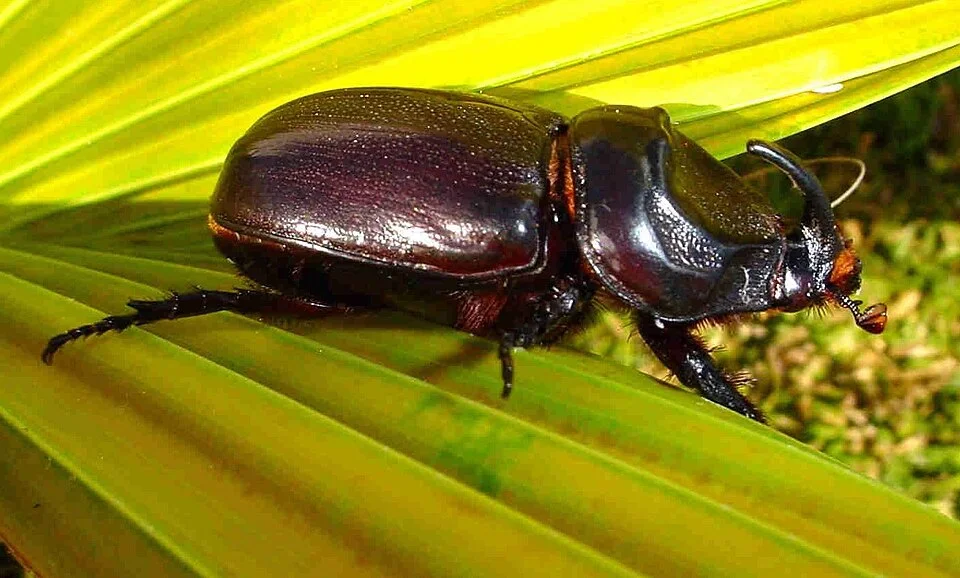
Photo: Jjargoud · CC BY-SA 3.0
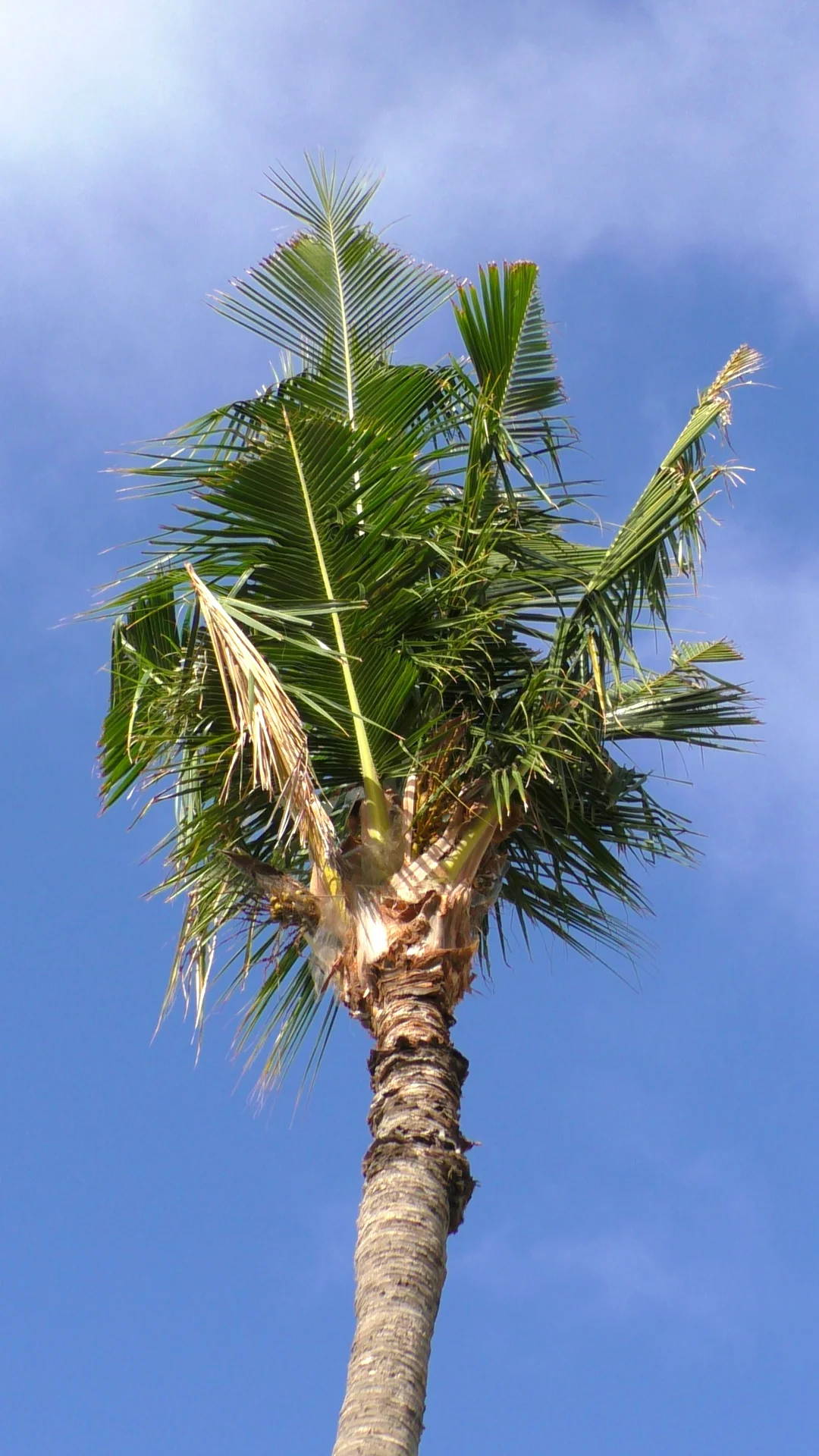
The rhinoceros beetle (Oryctes monoceros) is a large, heavy, shiny-black beetle — the male carries a single upward-curving horn on its head like a tiny rhino — that attacks coconut, oil palm and date palm across the humid tropics. Adults fly at night and bore into the crown (the tuft of leaves at the very top of the palm) to feed on the soft, unopened heart, leaving round holes and, once the damaged leaves unfold, the tell-tale V-shaped cuts across the fronds. The fat, C-shaped white grubs never touch the palm itself: they grow in rotting palm trunks, sawdust, manure and compost — which is exactly where this pest is beaten.
Scot Nelson · CC0 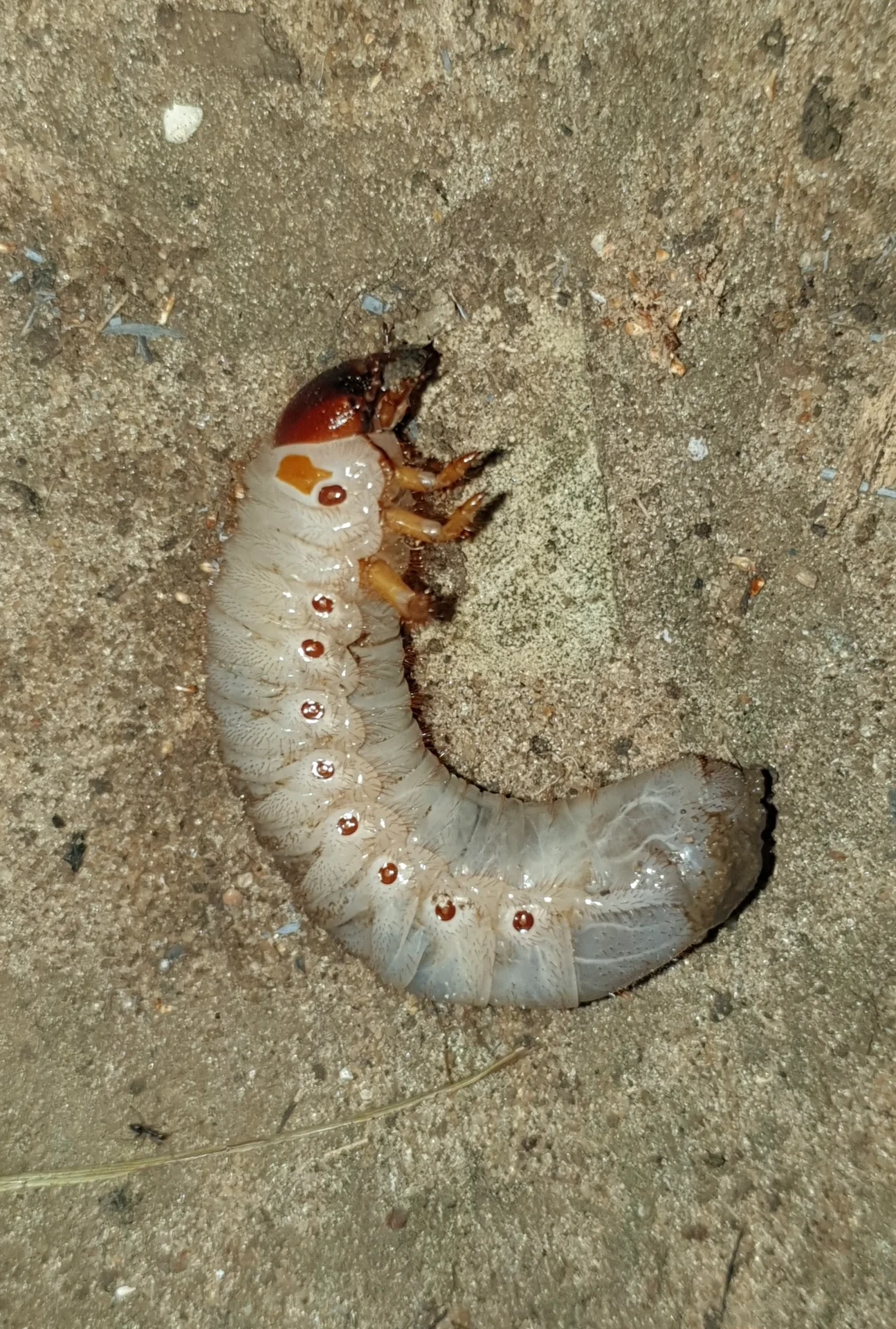
Aravinth · CC BY 4.0
Why it matters
The rhinoceros beetle is the big black borer of palms. Its adults tunnel into the soft heart of the palm to feed, and because that heart holds the single growing point the whole tree grows from, a heavy attack can cost you up to half your palms (50%) — and a young palm bored through its growing point simply dies and does not grow back. It is hard to beat because the beetle feeds hidden deep in the crown where no spray can reach it and breeds out of sight in rotting logs and manure, so by the time you see the V-cut fronds the damage is already done. Your real power is in prevention — destroying its breeding heaps and trapping the adults — not in any spray.
When to act
fresh bore holes or V-cut fronds on more than a few palms, or adults found in crowns during scouting
This guidance is general, compiled from published agronomic references including FAO and CABI. Thresholds and timing shift with your crop, your variety and the season.
In much of the region a spray is simply called mushonga — medicine. But a chemical group you cannot name is one you cannot rotate, and a product you did not write down has no pre-harvest interval you can observe. Mushonga, and other farming words →
The full rhinoceros beetle field guide
Identify it
The damage you notice first
when a bored leaf finally opens out, its leaflets carry clean, triangular V-shaped notches in neat rows — as if someone cut the frond with scissors, often in matching mirror-image pairs because the still-folded leaf was bitten through several layers at once. At the base of the central spear leaf (the youngest, still-folded, upright frond in the middle of the crown) look for round bore holes about a finger wide plugged with chewed brown fibre (frass — the beetle's sawdust-like droppings).
The dying young palm
on a badly bored young palm the central spear wilts, browns and pulls out easily by hand, and the little palm can topple and die — because its one growing point has been eaten out.
The beetle itself
a big, heavy, shiny black beetle about the length of your thumb (3.5–5 cm), the male carrying a single upward-curving horn on its head like a tiny rhino. It works at night, so by day it hides deep in the crown or inside its bore hole — you will seldom catch it in the open in daylight.
The grub (in the rot, never on the palm)
dig into nearby rotting palm trunks, sawdust, manure or compost and you find fat, creamy-white grubs curled like the letter "C" with a red-brown head, some as long as your hand. These are the young beetles — they live in the rot, not on the tree.
Don't confuse it
clean V-cuts mean the beetle — wind damage is ragged and frayed and tears along the length of the leaflet, not in neat triangles. And don't mix up this black horned beetle with the red palm weevil, a reddish-brown, long-snouted weevil whose grubs tunnel inside the trunk; it often follows the beetle into the same wounds and kills even faster, so if you see it, treat it as a bigger emergency.
Scout for it
When to look
palms can be bored all year, young and old — so keep a steady routine — but check young and newly-planted palms (their first 3–4 years) the hardest, because a single beetle can kill them. Step up your checks in warm, humid weather (about 22–33°C) after rain, when adults fly and bore most, and straight after any clearing or replanting that leaves dead trunks and heaps behind for them to breed in.
How to walk it
walk a large "W" across the block so you cover the four corners and the middle — not just the edge row by the path. Stop at about 10 palms along the way (more if the block is big).
What to check on each palm
look down into the crown and at the base of the central spear leaf for fresh round bore holes and moist chewed fibre, and scan the newest opened fronds for fresh V-cuts. Fresh damage is pale, moist and clean-edged; old damage is dry and browned — don't raise the alarm on old damage alone.
Check the breeding heaps too
walk the manure, compost and sawdust piles and any dead or rotting palm trunks in and around the plantation and dig a little. Finding fat white C-grubs there warns you a new wave of beetles is coming even before any crown damage shows — that is your earliest warning.
Act on this count
the trigger is low, because one beetle can kill a young palm. Act now the moment you find fresh bore holes or new V-cut fronds on more than 1 in 10 palms, OR you catch even a single adult beetle in a crown, OR you turn up grubs in the breeding heaps.
Control it
Prevent it — kill the breeding, not just the beetle (your strongest tool):
the grubs grow only in rot, so find and destroy every breeding heap. Chop up, burn or deep-bury dead palm trunks and stumps; spread out and dry, or hot-compost, the manure and sawdust piles so grubs cannot survive; and never leave rotting logs lying about the plantation. A clean plantation starves the next generation — and since no spray can reach a beetle hidden deep in the crown, this is the single most powerful thing you can do.
Act on the adults — hook them out and trap them:
for any palm with a fresh bore hole, push a stiff hooked wire into the hole, pull the beetle out and kill it. Across the block, set pheromone traps — a simple bucket or box trap baited with the beetle's own scent-lure (a pheromone is a smell the beetle gives off to draw others in) — to catch adults in numbers and to show you how heavy the pressure is. Set the traps around the edges and near old breeding areas.
Seed the heaps with a natural germ (biological control)
stir the beetle's own virus (Oryctes nudivirus) — a natural germ that only makes this beetle sick and harms nothing else — into the manure, compost and rotting logs where the grubs live, so infected grubs pass it on and the whole heap slowly dies off. Safety: handle it in the cool of the day, keep it out of direct sun (sunlight kills the germ), do not mix it into food or animal feed, and wash your hands afterwards. It is harmless to you, to bees and to birds.
If it keeps spreading — go harder at the source, and cut your losses on dead palms:
there is no reliable chemical spray for this beetle in a smallholder's kit — it feeds hidden in the crown and breeds beyond a spray's reach — so if numbers keep climbing, hunt down and destroy every last breeding heap in and around the plantation, add more traps, and seed every heap with the virus. Any young palm whose central spear is already dead (it pulls out easily and smells rotten) will not recover — cut it out and destroy the trunk at once so it can't become fresh breeding material, then replant. And keep watching every fresh bore wound for the red palm weevil moving in; if it does, treat that as a bigger emergency.
Catch rhinoceros beetle before it costs you the harvest
This guide is the general answer. Divisi works out yours — the week to scout your own field for rhinoceros beetle, and what to do the day you find it.


Crops it affects
Plan the crops it attacks


All planting calendars, country by country
Get Insights by email
A short digest of new Divisi articles. No email on quiet weeks.
Frequently asked questions
How do I identify rhinoceros beetle?
The damage you notice first. when a bored leaf finally opens out, its leaflets carry clean, triangular V-shaped notches in neat rows — as if someone cut the frond with scissors, often in matching mirror-image pairs because the still-folded leaf was bitten through several layers at once. At the base of the central spear leaf (the youngest, still-folded, upright frond in the middle of the crown) look for round bore holes about a finger wide plugged with chewed brown fibre (frass — the beetle's sawdust-like droppings).
When should I take action against rhinoceros beetle?
fresh bore holes or V-cut fronds on more than a few palms, or adults found in crowns during scouting
How do I control rhinoceros beetle?
Prevent it — kill the breeding, not just the beetle (your strongest tool):. the grubs grow only in rot, so find and destroy every breeding heap. Chop up, burn or deep-bury dead palm trunks and stumps; spread out and dry, or hot-compost, the manure and sawdust piles so grubs cannot survive; and never leave rotting logs lying about the plantation. A clean plantation starves the next generation — and since no spray can reach a beetle hidden deep in the crown, this is the single most powerful thing you can do.
Which crops are attacked by rhinoceros beetle?
Among the crops covered here: Coconut, Oil palm.