 Divisi
How to grow fonio
Digitaria exilis · Poaceae

Photo: KAG1LP2MDIAKITE · CC BY-SA 4.0
Fonio (Digitaria exilis) — also called acha, hungry rice, findi or fundi — is West Africa's ancient small grain and the fastest cereal in the world: early types give grain in about 70 to 85 days, some in as little as 6 to 8 weeks. It is a short, tufted grass whose seed is dust-fine — about 2,000 seeds in a single gram. Fonio asks almost nothing of the land: it grows on poor, sandy ground where maize or sorghum would starve, needs little or no fertiliser, and ripens fast enough to feed a family in the hungry season — the weeks before the main crops come in. Its one real burden comes after harvest: the tiny grain is slow and tiring to thresh and de-hull. (This guide is for white fonio; black fonio, Digitaria iburua, is a different crop.)
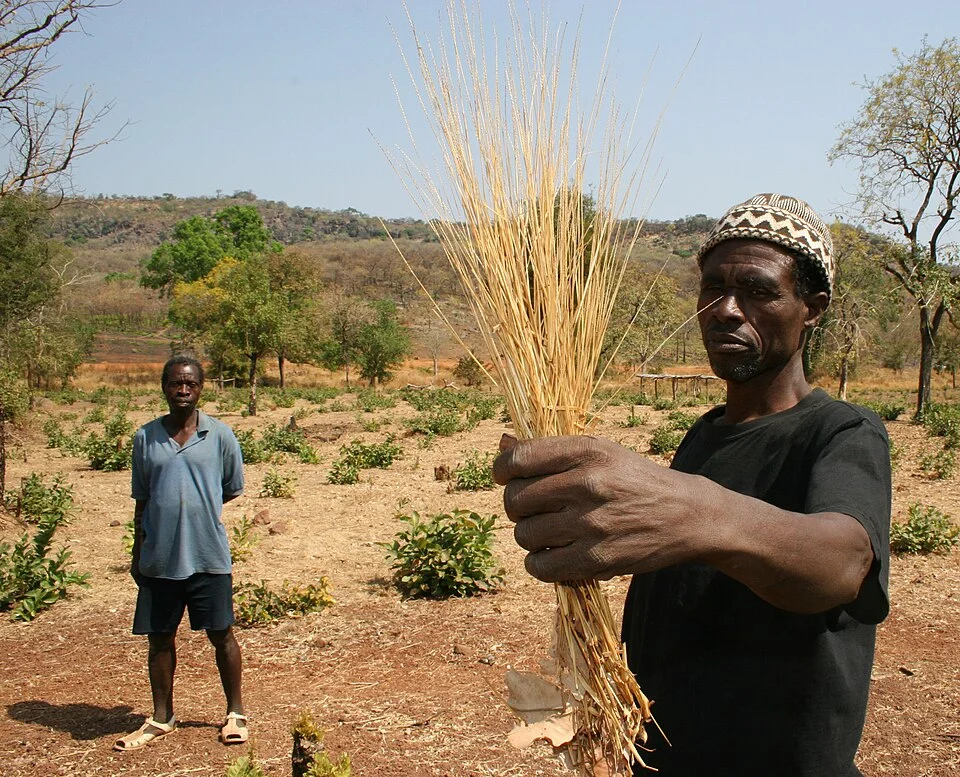
Richard Nyberg, USAID · Public domain 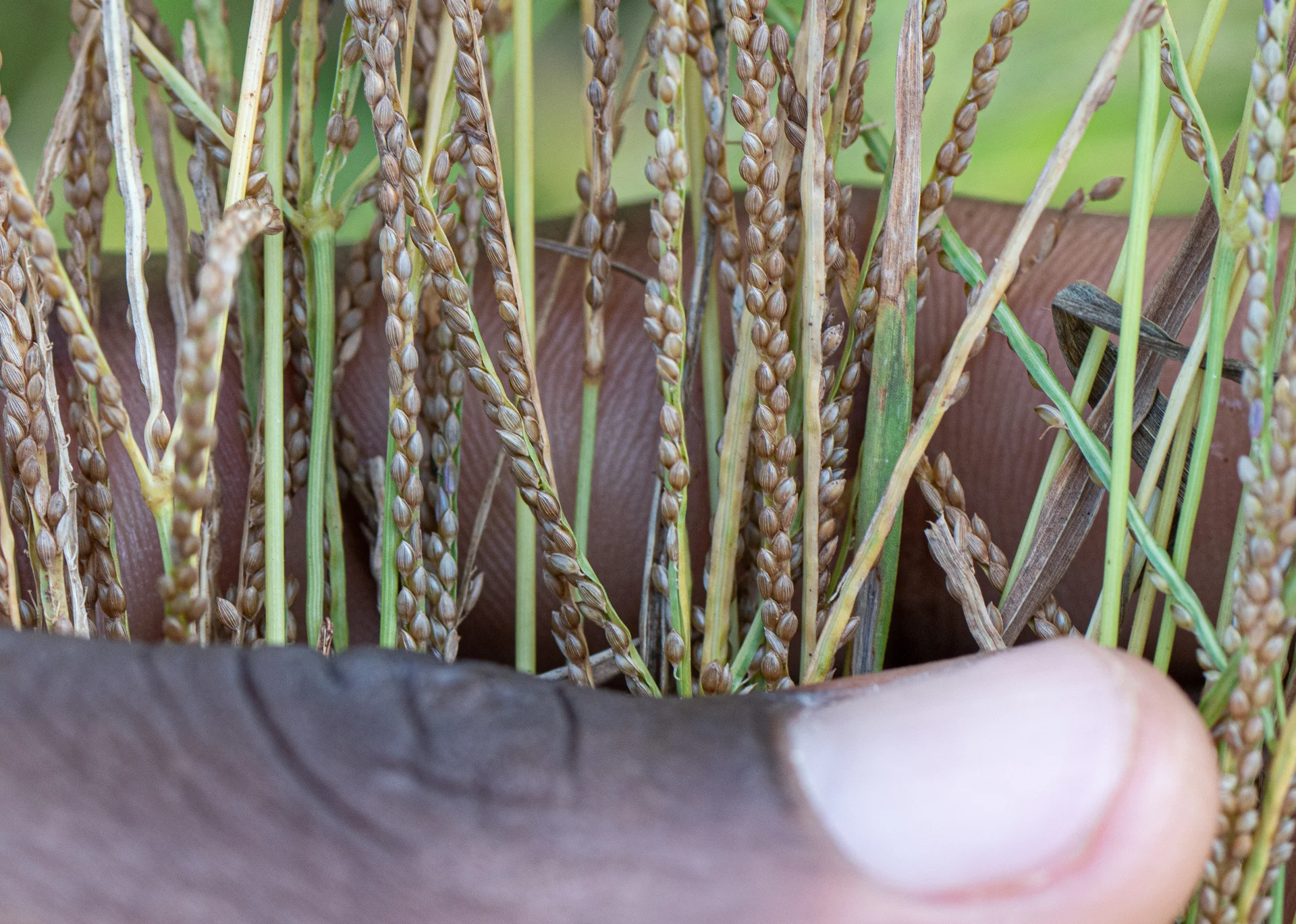
Crop Trust · CC BY-SA 4.0
- Days to maturity
- 60–120 days
These are general figures for the crop, compiled from published agronomic references including FAO and CABI. The right choice for your field depends on your soil, rainfall and the yield you are aiming for.
Will fonio actually do well on your field? Check your own field against every crop in the catalogue — no signup. Run the crop check →
Also known as
Fonio is also called acha, hungry rice, findi and fundi.
- English
- acha, hungry rice, findi, fundi
- Bambara
- fini, fonio
- French
- fonio
- Hausa
- acha
Working in buckets, bags or paces? The farming glossary turns the measures growers actually use into kilograms and hectares — what a 20 litre bucket of each crop really weighs, and how to size a field by walking it — alongside the Shona, Swahili, Ndebele and Yoruba words used in the field. Open the glossary →
Growing fonio, stage by stage
Your fonio season, step by step: make a fine, level bed on poor land, scatter the dust-fine seed evenly and barely cover it, weed early (the single biggest job), guard water at flowering, then race the birds and the shattering to a fast harvest — and thresh, de-hull and dry the grain so none is lost.
A fine seedbed on poor land
Fonio is happy on poor, sandy ground, so you are not chasing rich soil here — you are making the surface fine, level and firm. The seed is dust-fine (about 2,000 seeds in one gram), and dust-fine seed needs a fine, crumbly, level bed to catch it, or it rolls into hollows and comes up in patches. Do this in the last two weeks before you sow, line up clean seed early, and don't waste money on heavy fertiliser: fonio needs little or none.
Prepare a fine, level seedbed Recommended
Fonio seed is tiny and carries almost no food to push through lumps or a hard crust. A fine, level, firm surface lets every seed sit against moist soil and sprout together. A rough, cloddy or sloping bed gives a thin, patchy stand you can never fix once the crop is up — and with fonio an even stand is the whole game.
Clear the weeds and old stalks off the plot. Fonio doesn't need rich soil — poor, sandy land is fine — so you are working the surface, not digging deep.
Break the topsoil down to a fine, crumbly tilth — tilth just means how fine and soft the loose topsoil is. Hoe and rake until the lumps are gone and the top looks like coarse flour; dust-fine seed needs fine soil to settle into.
Level the surface with the back of the hoe or a light drag, then firm it gently by patting or lightly treading it down. A level, firm bed spreads the rain evenly and holds each seed where it falls.
Rake out any hollows and low spots — the tiny seed rolls into them and comes up as thick clumps beside bare patches.
On a slope, work and rake across the slope, not up and down, so the first heavy rain doesn't wash your fine seed and soil downhill.
- Do:
Get the bed fine, level and firm even on poor, sandy land — an even surface is what gives an even stand.
- Tip:
Leaving clods and hollows — the dust-fine seed rolls into the low spots and comes up thick in some places, bare in others.
- Watch out:
A cloddy bed also cakes into a hard crust after rain that the fine seedlings can't push through — fine tilth now prevents that later.
Buy the recommended seed Recommended
Good seed of an early type is what makes fonio the hungry-season saver — grain in as little as 6 to 8 weeks. Clean seed also carries less smut disease and fewer weed-grass seeds, saving you work all season. Line it up in the last two weeks before sowing so you can plant the moment the rains settle.
Get seed of an early (short-season) fonio for the hungry-season crop — it ripens in about 70 to 85 days after sowing, so it feeds you before the main crops are ready. (Later types take up to 120 days and are for a fuller season.)
Pick clean seed — from a good head, well winnowed, free of chaff, weed seeds and any dark, dusty grain (that dust is smut, a disease you'll meet in the growing stage). Clean seed means fewer weeds and less disease in your field.
Work out roughly how much you need for your plot and get it early; a little extra is worth having so you can re-scatter any bare patches in the first days after sowing.
Fonio needs little or no fertiliser — it is one of the few grains that yields on poor, sandy land — so don't spend on heavy fertiliser. If you have a little well-rotted manure or compost, a thin scatter worked into the bed will lift a very poor plot, but it is not needed.
Keep the seed dry and cool until sowing — off the ground, away from damp, rats and grain stores where it can pick up moisture or pests.
- Do:
Choose an early type for the hungry season — its speed is the whole point of the crop.
- Tip:
Sowing dusty grain saved from a smutted crop — you plant the disease with the seed. Keep only clean, bright seed for sowing.
- Watch out:
If you use manure, use only well-rotted manure, keep it off drinking water, food and children, and wash your hands after — fresh manure brings weed seeds and can burn the tiny seedlings.
Sow and get an even stand
This is the make-or-break moment for your stand. Fonio is broadcast — scattered by hand — and only barely covered, then kept moist until it sprouts in a few days. An even scatter onto a moist surface gives an even crop; a heavy hand or a dry surface gives clumps and bare patches you can't undo. The stand you set now is the most you will ever have, so sow it well and watch the young crop closely for its first two weeks.
Broadcast (seed mixed with sand) + barely cover Critical
The stand you set now is the most you will ever have — you cannot add plants later. Because the seed is dust-fine with little food to spare, scattering it evenly and barely covering it onto moist soil is what turns seed into a full crop. Bury it deep, or let the surface dry out, and much of it never comes up.
Sow onto a moist surface — ideally just after a rain, or wet the bed first. The tiny seed must not dry out while it sprouts; it comes up in just a few days.
Mix the seed with dry sand before you scatter — about one tin of seed to two or three tins of sand. The sand carries the dust-fine seed evenly through your hand instead of letting it fall in clumps.
Broadcast the mix — broadcast means scatter it by hand — walking steadily across the bed and swinging your arm in a wide arc so the seed falls in an even sheet.
Go over the plot twice, the second pass across the first (if the first walked up-and-down, walk the second side-to-side), to even out any thin and thick spots.
Barely cover the seed: a very light raking, or drag a leafy branch or a light bundle of thorns across the top. Cover it no deeper than a fingernail — a few millimetres — fonio must sit almost on the surface (it sows just 0 to 1 cm deep). Seed buried deeper simply never reaches the light.
Keep the surface moist until the crop is up, and re-scatter any bare patches you spot in the first few days while the soil is still damp.
- Tip:
Burying the seed — the commonest mistake. It should be barely covered; deep seed rots or never emerges.
- Do:
Mix with sand and sow in two crossing passes — the simplest way to get an even scatter by hand.
- Watch out:
A dry spell right after sowing is the big risk. Keep the surface damp (water lightly if you can) until the seedlings show.
Scout (crusting, gaps, grasshoppers) Recommended
The first two weeks after sowing decide your stand, and this is the only time you can still fix it. A crust after rain can trap the seedlings underground, bare patches can be re-scattered while the soil is still moist, and grasshoppers can chew out a thin young crop before it gets going.
Walk the whole plot twice a week (every 3 to 4 days) for the first two weeks after sowing — corner to corner, not just the edge by the path.
Look for bare patches where the seed didn't take. While the soil is still moist and the crop is only days old, re-scatter a little seed there to fill them — later re-sowing just falls behind.
Look for a hard crust after heavy rain — a sealed skin of soil the fine seedlings can't push through. If one is forming over seed that hasn't come up yet, break it very gently with a light raking so you don't uproot what has already sprouted.
Look for grasshoppers — you'll see them hop up as you walk, and find ragged, chewed edges on the young leaves. A few are normal.
If grasshoppers come in numbers and start stripping a thin crop, act: hand-pick them in the cool of early morning when they are slow, and clear the grassy field edges where they breed.
- Watch out:
Grasshoppers do most harm to a thin young stand — a full, even crop shrugs them off. One more reason a good, even sowing pays.
- Do:
Re-scatter bare patches early, while the soil is still moist — later re-sowing just falls behind the rest of the crop.
Grow clean — win the weeding
Young fonio grows slowly, and — this is the hard part — the seedlings look almost exactly like the weedy grasses around them. For these few weeks, weeds are your single biggest enemy: they steal the light, water and soil that should feed your crop, and getting them out early and on time is the biggest yield gain you can make — worth 20 to 50% of your harvest. Once fonio closes over the ground it holds its own. Watch too for smut disease in the forming heads, and pull out any affected plants.
Scout (weeds vs crop, smut, birds) Recommended
This is when you must tell the crop from the weeds in time to pull them, and when smut disease first shows in the heads. Both are only fixable if you catch them now — a weed left to seed, or a smutted head left standing, costs you next season too.
Walk the crop twice a week (every 3 to 4 days) from about two weeks after sowing onward. Learn to tell fonio from the grassy weeds: look closely and compare — the weed grasses are often coarser, a different green, or taller and faster than the fine, even fonio. When unsure, follow a plant you know is fonio and match it.
Mark where the worst weed patches are, so your weeding (the next task) hits them first.
Check the forming heads for smut — a head that turns into a mass of black or dark-brown powder instead of normal pale grain, and smears your fingers when you touch it.
Pull out and carry away any smutted plant — this is called roguing (removing sick plants so they can't infect the rest). Carry it right out of the field in a bag or cloth so its dust doesn't blow onto healthy heads or into next year's seed.
Glance at the leaves for leaf spot — small brown or reddish spots or streaks that can join into dead patches. On fonio it is usually mild: keep the crop growing well and rely on clean seed and rotation next season rather than spraying.
- Do:
If you can't yet tell crop from weed, wait a day or two and look again — the difference grows clearer as both grow. But don't leave it so long the weeds take over.
- Watch out:
Smut spreads by dust. Carry rogued heads out of the field in a bag or cloth — don't shake them over the crop.
Weeding (critical) Critical
This is the job of the fonio season. The tiny seedlings are slow and weak and lose badly to weeds, so weeding early and well is worth 20 to 50% of your whole harvest — more than anything else you do. Miss the window and the weeds win; get it right and the crop closes over and looks after itself.
Weed early — about 2 to 4 weeks after sowing (roughly 14 to 30 days) — while the seedlings are still tiny and the weeds are still small. Waiting even a week too long lets the weeds get ahead.
The hard part is telling crop from weed — they look alike. Go slowly and pull the weed grasses by hand, close to the ground, so you don't uproot the fonio beside them.
Be gentle — fonio is shallow-rooted and sits loosely in the light, sandy soil. Steady the soil around a fonio plant with one hand as you pull the weed next to it, so you don't lift the crop with the weed.
Pull weeds roots and all where you can, and lay them out of the crop; snapping off just the tops lets many grow straight back.
Get the whole plot done inside this window. On a big plot, weed the worst patches first — the ones you marked while scouting.
- Do:
Weed on time even if you do nothing else perfectly — early weeding is the single biggest thing you control on fonio.
- Tip:
Deep hoeing among the seedlings — it tears the shallow fonio roots and buries small plants. Pull by hand while everything is small.
- Watch out:
Once the crop closes over the ground (its leaves shade the soil), new weeds struggle and your hardest work is behind you.
Flowering — guard water and grain
Fonio flowers and sets its grain in a short window. It pollinates itself, so it needs no insects or bees — but this is its thirstiest, most important stage for water: dry soil now means empty, unfilled grain. And as the grain starts to soften, birds begin to find the field. Keep the crop moist if you can, and start watching for the first flocks.
Scout (birds arriving) Recommended
Flowering is short, and it is when the grain first forms and softens — exactly what seed-eating birds are looking for. Spot the first flocks now and you can be ready to scare from the moment the grain turns milky, instead of losing a chunk of the crop before you react.
From the time the crop flowers, walk it often — every 2 to 3 days. Flowering passes quickly, so check closely.
Watch for birds — small seed-eating birds and flocks (such as weavers or queleas) settling on the field and lifting off in a cloud when you walk up. Early on a few come to test the softening grain; soon they arrive in numbers.
Note where they first land — usually the field edges near trees and bushes. That's where you'll concentrate your scaring.
Feel a few heads: as the grain turns from watery to soft and milky (squeeze one and a milky liquid shows), bird damage is about to start — that's your signal to begin daily scaring (the next stage's task).
Check the crop isn't stressed for water — fonio needs moisture most now, at flowering. Leaves rolling shut or turning grey in the heat mean it is too dry.
- Watch out:
The flowering window is short. Don't wait for heavy damage — start scaring as soon as the grain goes milky.
- Do:
Note where birds first land (usually field edges near trees) — that's where to concentrate your scaring.
Irrigate through flowering Recommended
Fonio is usually grown on rain alone, but if you can water, flowering is the one stage where it pays most. This is the crop's thirstiest, make-or-break stage — dry soil now means empty, unfilled grain. A little water through the short flowering window protects the whole harvest.
This applies only if you have a way to water. Most fonio is rain-fed and never watered — that is normal for this hardy crop.
If you can water, keep the soil just moist through flowering — water lightly every 5 to 7 days, more often in fierce heat or on quick-drying sand.
Check by pushing a finger in: water when the top few centimetres have gone dry, and stop while the soil below is still damp.
The flowering window is short, so a few well-timed waterings here do more than water at any other stage.
Don't overdo it — fonio likes light, well-drained soil and hates standing water. Aim for moist, not soaked.
- Do:
If you can water at only one time all season, water now, at flowering — it is the crop's critical stage.
- Tip:
Flooding the plot — fonio rots in waterlogged ground. Keep it lightly moist, not wet.
Fill the grain, beat the birds
The grain now fills and the plants yellow fast — fonio ripens quicker than almost any grain. Two things can rob you at the finish: birds eating the soft grain, and shattering — ripe fonio drops its seed off the plant on its own if you leave it standing too long. This is a race: guard the grain daily and be ready to cut the moment it turns golden and hard.
Bird-scaring Critical
From the time the grain softens until you cut it, flocks of seed-eating birds can strip a fonio field fast — this is a critical, everyday job. Fonio ripens quickly, so the guarding window is short but intense: leave the field for a few days and the birds take a real share of your harvest.
Start scaring as the grain turns soft and milky (around 55 days after sowing for early types) and keep it up every day until harvest.
Be in the field at dawn and dusk — that's when birds feed hardest. Share the daily watch with children and neighbours so the field is never left open at those times.
Guard actively: walk the field, shout, clap, crack a whip, bang a tin, or string cords across the plot tied to rattles and flapping cloth or old bags.
Keep moving and changing things — birds quickly learn that a scarecrow which never moves is harmless, so shift it about and vary the noise.
Concentrate on the edges near trees and bushes, where flocks gather and launch their raids.
As you guard, watch the crop ripen: it turns golden and the seeds go hard. Early types are ready fast (about 70 to 85 days after sowing) — the moment it is ripe, be ready to cut, because ripe fonio shatters (drops its grain onto the ground by itself) if left standing.
- Do:
Share the daily watch with children and neighbours — the busy bird times are dawn and dusk, every day.
- Watch out:
Bird-scaring runs straight into harvest. Have your sickles or knives and drying space ready so you can cut the day it's ripe and not lose grain to shattering.
- Tip:
Leaving the field unguarded once the grain is soft — even a day or two lets a flock do a lot of damage.
Harvest fast, before it shatters
Fonio is ready fast — early types about 70 to 85 days after sowing (60 to 120 by type) — and it will not wait. The plant turns golden and the seeds go hard; that is your signal. Cut the whole plant promptly, because ripe fonio shatters — it sheds its grain onto the ground on its own if it stands too long, and that grain is gone. Cut it with a sickle or knife, tie it into small bundles, and carry it in under cover to dry and thresh.
Thresh, de-hull and store
The grain is grown — now don't lose it to the crop's one real burden. Threshing (beating the grain loose from the heads) and de-hulling (rubbing off the husk) the dust-fine fonio is slow, tiring work — the labour bottleneck of the whole crop. Do it while the plants are fully dry, get the grain clean and dry, and store it well: clean, dry fonio keeps for months and is a vital hungry-season reserve.
Thresh & de-hull Critical
This is fonio's hardest job — the grain is so tiny that beating it loose and rubbing off the husk takes real work (the crop's labour bottleneck). But it is what turns your standing crop into food you can cook and store. Get the grain clean and properly dry and it keeps for months as your hungry-season reserve; leave it damp and it moulds and is lost.
First dry the cut plants fully — spread the bundles in the sun on a clean mat, tarpaulin or swept hard floor (never on bare soil, which pushes damp and dirt back in). Dry plants thresh far more easily.
Thresh the dry plants — beat, flail or gently tread them to knock the grain loose from the heads.
Winnow to clean it — pour the grain from a basket in a light breeze, or toss it in a winnowing tray, so the wind carries off the light chaff and dust while the clean, heavier grain falls back.
De-hull the grain to rub off the husk. Traditionally this is pounding in a mortar in several short rounds, winnowing between each round, until the grain runs clean. It is slow — where a mechanical de-huller is within reach, it cuts this work sharply.
Dry the clean grain again in the sun until it is dry to the touch — it should run freely through your fingers and not feel cool or clump together.
Store the clean, dry grain in a clean, dry, sealed pot, tin, gourd or bag, in a cool, dry place off the floor, safe from damp and rats.
If the grain still feels cool or damp, or clumps together → it is too wet: spread it back in the sun and dry it more before you store it. Stored damp, it moulds in the store and the whole reserve can be wasted.
- Watch out:
Threshing and de-hulling is the crop's labour bottleneck — plan for the time and the hands it needs, and use a mechanical de-huller if you can reach one.
- Do:
Store fonio really dry — it is your hungry-season reserve, so it must keep for months without moulding.
- Tip:
Threshing or drying on bare ground — the fine grain picks up soil, stones and damp. Always use a mat, tray, tarpaulin or swept hard floor.
Pests and diseases that attack fonio


Where to sell fonio
Markets that trade this crop — what each one sells it by, when supply peaks there, and the currency used.


Grow fonio with a plan, not a guess
This guide is the general answer. Divisi works out yours — the week to plant fonio on your soil and your rainfall, and each job dated for your field.


When to plant fonio, country by country
- When to plant fonio in Algeria
- When to plant fonio in Angola
- When to plant fonio in Benin
- When to plant fonio in Botswana
- When to plant fonio in Burkina Faso
- When to plant fonio in Burundi
- When to plant fonio in Cabo Verde
- When to plant fonio in Cameroon
- When to plant fonio in Comores
- When to plant fonio in Congo
- When to plant fonio in Côte d'Ivoire
- When to plant fonio in Egypt
- When to plant fonio in Eritrea
- When to plant fonio in Eswatini
- When to plant fonio in Ethiopia
- When to plant fonio in Gabon
- When to plant fonio in Gambia
- When to plant fonio in Ghana
- When to plant fonio in Guinea Ecuatorial
- When to plant fonio in Guinea-Bissau
- When to plant fonio in Guinée
- When to plant fonio in Kenya
- When to plant fonio in Lesotho
- When to plant fonio in Liberia
- When to plant fonio in Libya
- When to plant fonio in Madagascar
- When to plant fonio in Malawi
- When to plant fonio in Mali
- When to plant fonio in Mauritanie
- When to plant fonio in Mauritius
- When to plant fonio in Morocco
- When to plant fonio in Moçambique
- When to plant fonio in Namibia
- When to plant fonio in Niger
- When to plant fonio in Nigeria
- When to plant fonio in Rwanda
- When to plant fonio in République centrafricaine
- When to plant fonio in République démocratique du Congo
- When to plant fonio in Sao Tome and Principe
- When to plant fonio in Seychelles
- When to plant fonio in Sierra Leone
- When to plant fonio in Somalia
- When to plant fonio in South Africa
- When to plant fonio in South Sudan
- When to plant fonio in Sudan
- When to plant fonio in Sénégal
- When to plant fonio in Tchad
- When to plant fonio in Togo
- When to plant fonio in Tunisie
- When to plant fonio in Uganda
- When to plant fonio in United Republic of Tanzania
- When to plant fonio in Zambia
- When to plant fonio in Zimbabwe
Where fonio scores best
Districts where Divisi's engine currently rates this crop highest, ranked by fit.


Get Insights by email
A short digest of new Divisi articles. No email on quiet weeks.
Frequently asked questions
How do I grow fonio?
How to grow fonio: 60–120 days to maturity. Also called acha, fini. Plus the pests and diseases that attack it.
What is fini in English?
Fini (also fonio) is the Bambara name for fonio.
What is fonio in English?
Fonio is the French name for fonio.
What is acha in English?
Acha is the Hausa name for fonio.
How long does fonio take to grow?
Fonio takes about 60–120 days from sowing to maturity, though the exact length varies with variety, temperature and how the season runs.
What pests and diseases attack fonio?
The ones covered in this guide are Grasshoppers, Leaf spot, Smut. Each has its own page explaining how to identify, check for and control it.