 Divisi
Asian soybean rust
Phakopsora pachyrhizi · Fungal
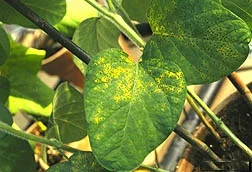
Photo: USDA · Public domain
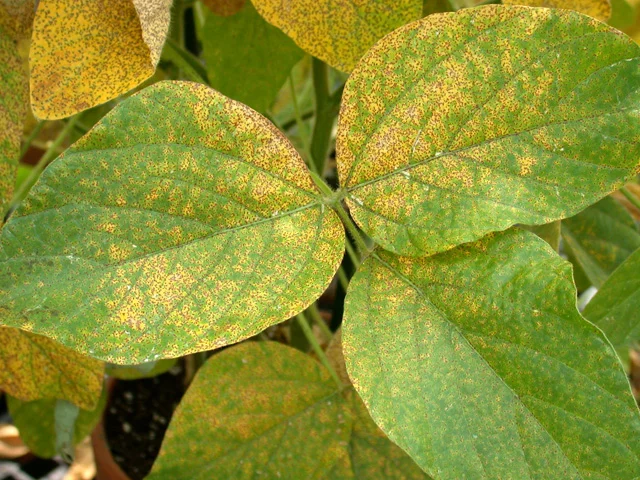
Asian soybean rust is an aggressive, wind-borne fungal disease of soybean and other legumes such as common bean and cowpea. Its spores drift long distances on the wind and settle on the underside of the leaves, where warm, humid, dewy weather lets them infect and erupt into tan pustules. It builds up fastest once the crop is flowering and filling pods, stripping the leaves early and starving the seeds.
USDA · Public domain 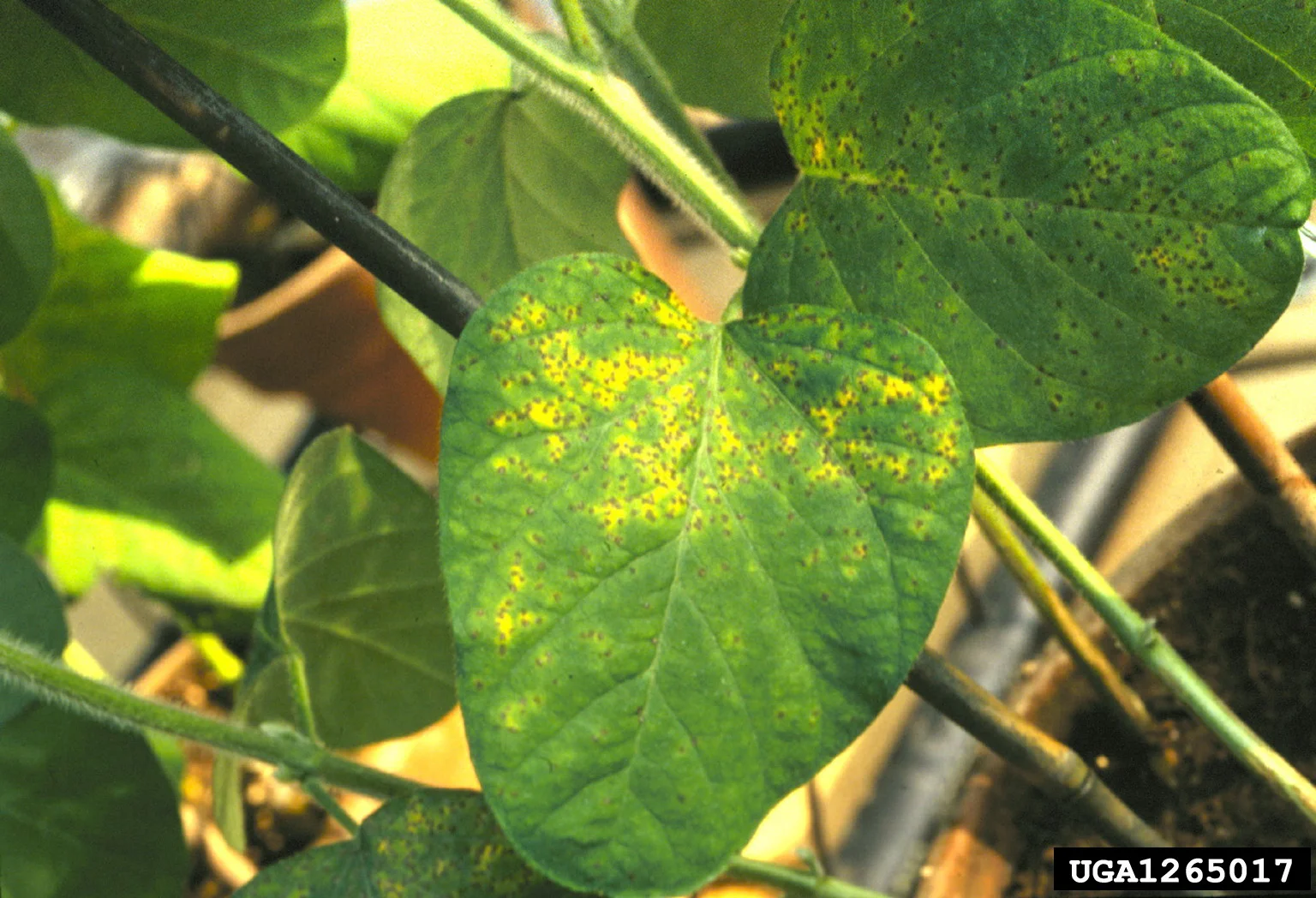
Reid Frederick, USDA Agricultural Research Service, Bugwood.org · Public domain
Why it matters
Asian soybean rust can strip the leaves off your crop just when the plant is filling its pods — and once the leaves are gone, the pods stay small and light. In a bad, wet year it can take up to 80% (four-fifths) of your harvest. It blows in on the wind and explodes fast in warm, humid weather, so by the time you see whole leaves yellowing and dropping, it is already very hard to stop. That is why the trick is to catch it early and spray protectively, before it climbs into the upper leaves that feed your beans.
When to act
Spray protectively from early flowering to pod fill when rust is reported in the area or the first pustules are found on lower leaves.
This guidance is general, compiled from published agronomic references including FAO and CABI. Thresholds and timing shift with your crop, your variety and the season.
In much of the region a spray is simply called mushonga — medicine. But a chemical group you cannot name is one you cannot rotate, and a product you did not write down has no pre-harvest interval you can observe. Mushonga, and other farming words →
The full Asian soybean rust field guide
Identify it
The damage you notice first
the lower leaves start going yellow and dropping early — while the plant is still flowering or filling pods, long before the crop should be drying down. It looks like the plant is 'ripening' from the bottom up at the wrong time.
Turn a yellowing leaf over
On the underside you'll find many tiny tan to reddish-brown raised bumps (pustules — little blisters that burst open). Each is smaller than a pinhead and angular (many-sided, boxed in by the leaf veins) rather than round. On the top side you'll see matching small yellow-brown flecks.
The give-away test
rub a ripe patch with your finger or a dark cloth and a fine tan, cinnamon-coloured dust comes off — those are the spores (the fungus's dust-like 'seeds' that blow to new plants). That powder on the leaf underside is the sure sign of rust; no other soybean leaf problem sheds it.
It starts low and shaded
— on the older leaves deep inside the canopy where the dew sits longest — then climbs upward, plant by plant, worst after warm, humid, dewy nights.
Don't confuse it with look-alikes
ordinary end-of-season yellowing comes evenly and late (at true maturity) with no bumps and no dust underneath; brown spot or bacterial spot make flat brown or angular blotches but no raised, dusty pustules; spider-mite damage is fine pale speckling with faint webbing, not powder. If you see the raised bumps that shed tan dust, it is rust.
Scout for it
When
start looking from early flowering and keep going right through pod fill (the mid-to-late season) — that is when your crop is most at risk and when rust does its worst damage. Check at least twice a week.
Look harder after the weather it loves
warm days around 18–28°C with long dew or leaf-wetness (6 hours or more) and damp, still, crowded canopies. A wet, humid spell — or word that rust is already in your district — means step up your scouting straight away.
Where to walk
go in a big 'W' across the whole field so you cover the four corners and the middle, not just the edge by the path. Rust often starts in the thickest, dampest, most sheltered patches — check those especially.
What to check
at about 10 stops, bend down to the lower, older, inner leaves (not the fresh top ones), pull a few, and turn them over. Study the underside with a cheap hand lens (a pocket magnifier) for the tiny tan pustules, and rub for the cinnamon dust.
Your trigger to act (this is the number that matters)
with rust you can't wait for a safe percentage — it moves too fast. The moment you find pustules on even ONE plant's lower leaves during flowering-to-pod-fill — or you hear that rust is in your area — that is your signal to spray protectively. Do not wait for many plants, or for whole leaves to drop; by then it is too late.
Control it
Prevent it
-
start with the variety:
where an adapted one is sold, plant a rust-tolerant / rust-resistant variety. It carries a good part of the load for you; on its own it won't fully stop rust in a wet year, but it slows the disease and buys you time.
-
deny the fungus the damp it needs:
plant early and choose early-maturing varieties so your pods fill before the humid rust season peaks. Don't crowd the crop — use wider rows and sensible spacing so air moves through and the leaves dry faster (rust needs 6+ hours of leaf wetness to take hold). And keep an ear out for regional rust alerts, since it arrives on the wind from far away.
Act early — there is nothing to pick off:
rust is a wind-blown dust, so you can't handpick it, trap it, or wash it away like an insect. Here, 'acting early' means spraying protectively at your trigger — the first pustules on the lower leaves, or a report that rust is nearby. A protective spray guards the healthy upper leaves that fill your pods before the disease climbs into them; it cannot bring back leaves that are already killed.
The spray — a triazole fungicide (use responsibly, it costs money):
the recommended chemical control is a triazole fungicide, often sold mixed with a strobilurin. These are systemic — they move inside the leaf and give both protection and some early cure — unlike a contact/protectant that only coats the surface and washes off. Start at early flowering or first find and repeat as the label says (roughly every 2–3 weeks) through pod fill while the risk lasts. To stop resistance (the fungus getting used to a chemical until it stops working), never spray the same chemical group over and over — rotate or mix the triazole with a different group such as a strobilurin. Spray safely: cover your skin, eyes, nose and mouth (long sleeves, gloves, eye cover, a cloth over the face); spray in the cool of the day with the wind behind you; keep it off other people, food, drinking water, children and bees; wash yourself and your clothes afterwards; and respect the pre-harvest interval — the set number of days you must wait between your last spray and harvest so no chemical is left on the beans you eat or sell.
If it keeps spreading → protect the new growth; when it's too late → cut your losses
if rust keeps climbing, stay on the spray interval to keep guarding each new flush of upper leaves, and rotate the chemical group every round. But once most leaves have already yellowed and dropped late in pod fill, spraying no longer pays — stop spending. If the pods are already well filled, harvest as soon as they are mature and dry to save what you have. Then set up next season to win: a tolerant variety, earlier planting, wider spacing, and be ready to spray protectively at the very first alert.
Catch Asian soybean rust before it costs you the harvest
This guide is the general answer. Divisi works out yours — the week to scout your own field for Asian soybean rust, and what to do the day you find it.


Crops it affects
Plan the crops it attacks
-
 When to plant Common bean in Dilolo
 -
 When to plant Cowpea in Bangui-Rapides
 -
 When to plant Soybean in Dola
All planting calendars, country by country
Get Insights by email
A short digest of new Divisi articles. No email on quiet weeks.
Frequently asked questions
How do I identify Asian soybean rust?
The damage you notice first. the lower leaves start going yellow and dropping early — while the plant is still flowering or filling pods, long before the crop should be drying down. It looks like the plant is 'ripening' from the bottom up at the wrong time.
When should I take action against Asian soybean rust?
Spray protectively from early flowering to pod fill when rust is reported in the area or the first pustules are found on lower leaves.
How do I control Asian soybean rust?
Prevent it — start with the variety:. where an adapted one is sold, plant a rust-tolerant / rust-resistant variety. It carries a good part of the load for you; on its own it won't fully stop rust in a wet year, but it slows the disease and buys you time.
Which crops are attacked by Asian soybean rust?
Among the crops covered here: Common bean, Cowpea, Soybean.