 Divisi
Powdery mildew
· Fungal
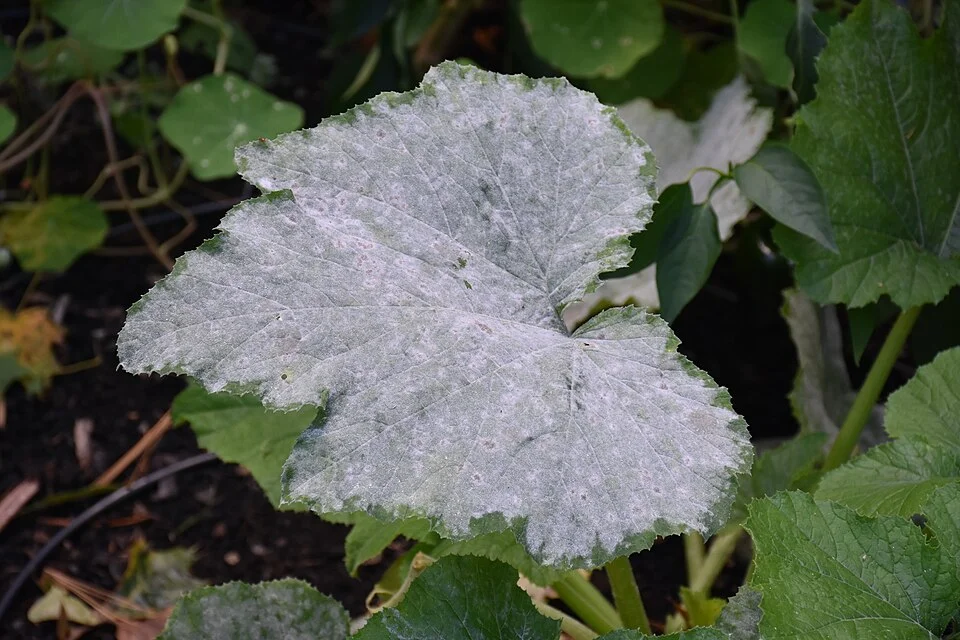
Photo: Dmitry Brant · CC BY-SA 4.0
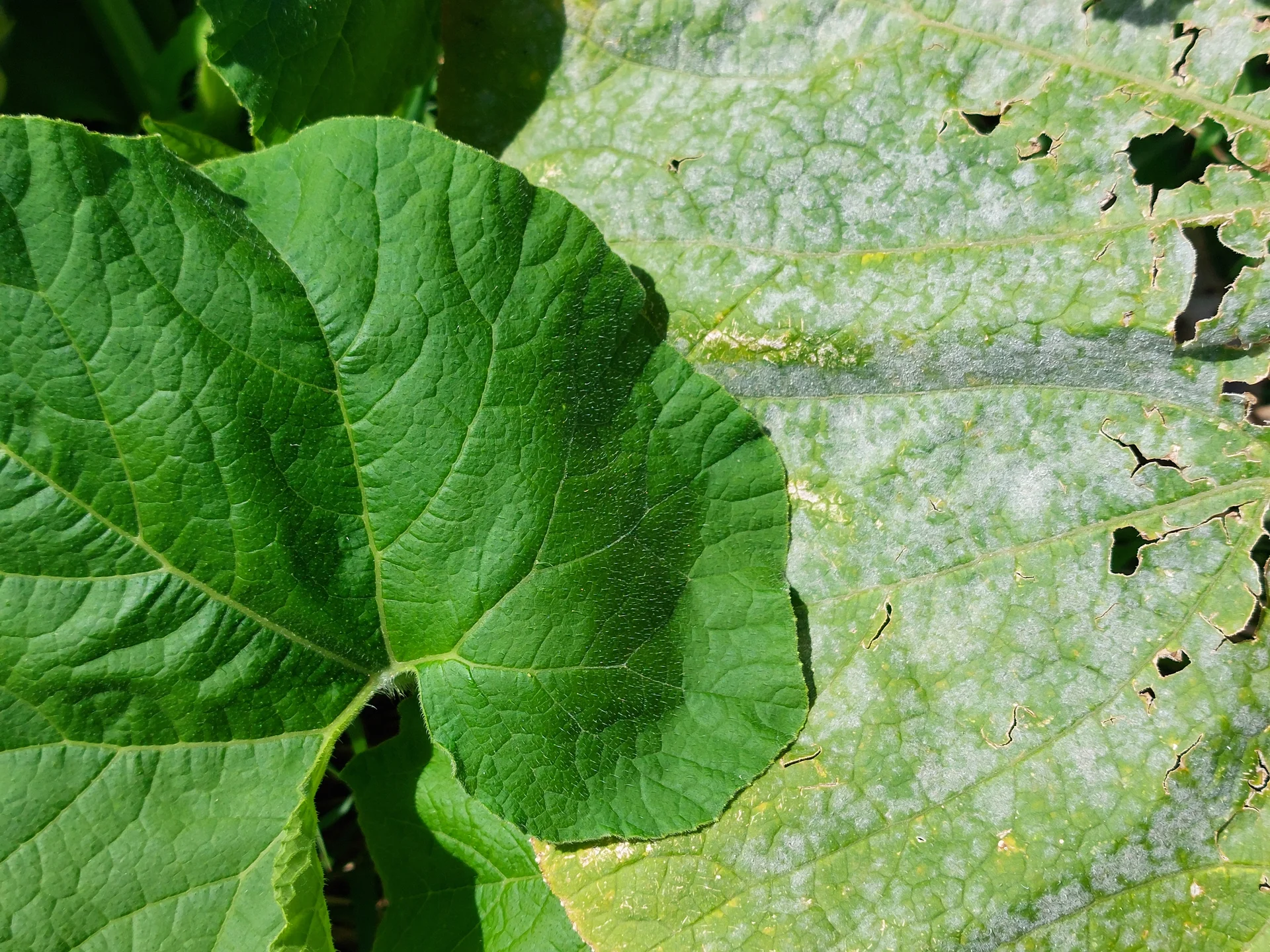
Powdery mildew is a group of fungi that live on the surface of the leaf, pushing tiny feeding roots into the skin of the leaf while their dry, flour-like spores blow to the next plant on the wind. Unlike most leaf diseases it does NOT need rain or wet leaves — it only needs humid air, so it strikes in warm, dry weather. On smallholder plots it commonly hits cucurbits (pumpkin, cucumber, melon, squash), tomato, pepper, common bean, mango and grape.
Schlaghecken Josef · CC BY-SA 4.0 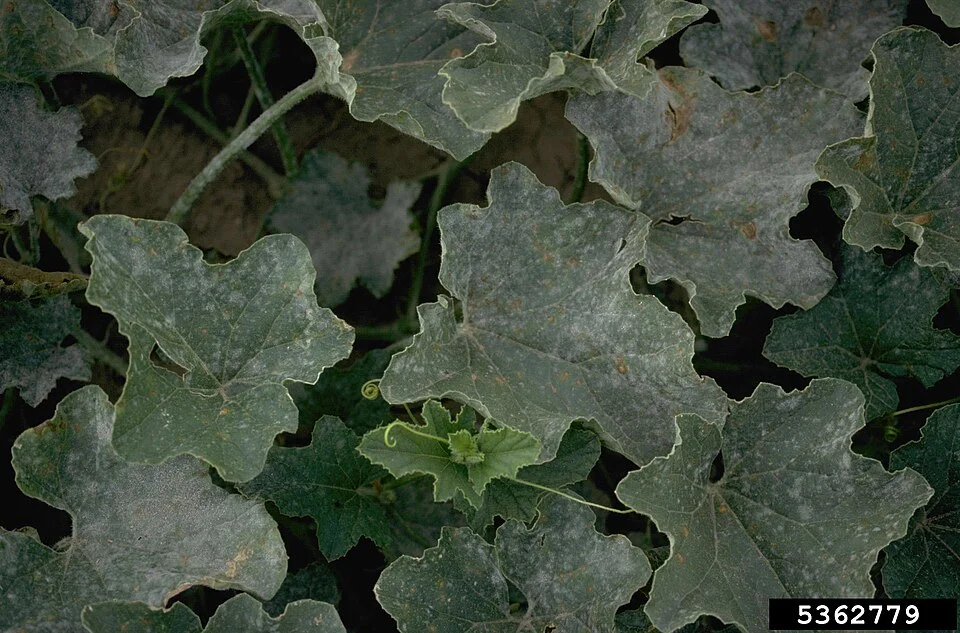
M.E. Bartolo, Bugwood.org · CC BY 3.0
Why it matters
Powdery mildew coats the leaves so the plant can no longer feed itself from the sun — in a bad attack it can cost you as much as 40% of your harvest, and it robs fruit of sweetness and size while leaving them open to sunscald once the leaves die back. It matters most because it moves fast: the dry spores blow from leaf to leaf on the wind and can blanket a whole plant in a week or two. Once the white powder has spread across the canopy the fungus is buried in the leaf and hard to knock back — sprays can stop it climbing further but they cannot un-white the leaves it has already killed. That is why you win or lose this fight in the first few days, at the very first patches.
When to act
First white powdery colonies on lower or shaded leaves; begin protectant sprays before it spreads over the canopy
This guidance is general, compiled from published agronomic references including FAO and CABI. Thresholds and timing shift with your crop, your variety and the season.
In much of the region a spray is simply called mushonga — medicine. But a chemical group you cannot name is one you cannot rotate, and a product you did not write down has no pre-harvest interval you can observe. Mushonga, and other farming words →
The full Powdery mildew field guide
Identify it
The first thing you see
small, round white-to-grey powdery patches, like someone dusted the leaf with flour or wood ash. Rub one with your finger and the powder smudges off — that is the giveaway. They show up first on older, lower and shaded leaves, usually on the top side, but on some crops (pepper, tomato) look on the underside too.
As it spreads
the small spots join into a dry, felt-like white coating over the whole leaf, and can climb onto stems, leaf stalks and even the skin of fruit. The disease looks dry and dusty, never slimy or wet.
As it gets bad
the covered leaves turn yellow, then curl, brown and dry up and die early. With the shade gone, fruit gets scorched by the sun (sunscald), and mango or grape bunches stay small and crack.
Don't confuse it
with downy mildew, which sits on the underside of the leaf as a grey-purple fuzzy mould with yellow angular patches on top and loves wet, rainy weather — powdery mildew is white, on the top, dry and dusty, and loves dry weather. It is also not dust or spray residue: real dust brushes off and does not come back, powdery mildew grows back and spreads.
Scout for it
When to look
start once the crop is well into leaf and stem growth (the development, mid-season and late-season stages) — this is when powdery mildew attacks. Look harder during spells of warm dry days with cool humid nights, and in shaded, crowded parts of the plot, which is exactly the weather and place it loves.
How to walk the field
twice a week, walk a large "W" shape across the plot so you cover all four corners and the middle — not just the row nearest the path, where you always look.
Where to check
make about 10 stops, and at each stop turn over and look at the leaves of a few plants — start with the oldest, lowest and most shaded leaves and the crowded inside of the plant, where the air is stillest and most humid. Check both sides of the leaf.
The number that means ACT
you do not wait for a big count. As soon as you find the very first white powdery patch on even 1 leaf, treatment starts — begin your protectant sprays straight away, before the powder spreads over the rest of the canopy. Waiting until many plants are white is waiting too long.
Control it
Prevent it first (best value)
give every plant room to breathe — space plants wider and prune out crowded inner growth so air moves through and dries the humid pockets the fungus needs. Go easy on nitrogen fertiliser: too much makes soft, leafy growth that mildew loves. Keep the plot in more sun, less shade.
Grow a variety that fights back
where you can get them, plant powdery-mildew-tolerant varieties — for many farmers this is the single easiest win, because the plant resists the fungus on its own with no spraying.
Act early — remove and treat at the first patch:
pick off and carry away the first few heavily-coated leaves (bury or burn them, don't drop them in the plot) to slow the spread, then start a low-risk protectant spray. A protectant spray coats the leaf surface to stop new spores landing and taking hold — it protects clean leaf, so start it early while most of the plant is still green.
Low-risk spray — sulphur (or a substitute):
at the first signs, spray sulphur as a protectant; potassium bicarbonate or a light mineral/plant oil work the same gentle way. Cover both sides of the leaf. Safety: cover your skin, eyes, nose and mouth, spray in the cool of the morning or evening with the wind at your back, keep it off food you'll eat that day, off drinking water, and away from children and bees, and wash yourself and your clothes after. Important sulphur warning: do not spray sulphur in very hot weather (roughly above 30°C) or it will burn the leaves, and never within about two weeks of an oil spray.
Chemical spray — last resort (dmi-fungicide):
only if it keeps climbing despite the steps above, use a DMI fungicide (DMI stands for de-methylation-inhibitor — a systemic type, meaning it soaks into the plant and works from the inside, unlike a protectant that only coats the surface). Use it at the first symptoms or preventively, follow the label dose, and observe the pre-harvest interval — the set number of days you must wait between the last spray and picking, so no unsafe residue is on the food. Take the same full safety care as above (skin/eyes/nose covered, spray in the cool with the wind behind you, keep off food, water, children and bees, wash after).
Guard against resistance
never lean on the DMI fungicide alone — the fungus breeds fast and will stop responding if you use the same product again and again. Rotate between different chemical groups (and back to sulphur) each spray so no one product is overused.
If it keeps spreading
tighten the loop — remove more infected leaves, open up the canopy further, and switch to a different chemical group on the next round. If nearly every plant is white and the leaves are already yellowing and dying, spraying will no longer save this crop: focus on harvesting what you can early, then pull out and burn or bury all the crop residue after harvest so the fungus cannot carry over, and next season plant a resistant variety with wider spacing in a sunnier spot.
Catch Powdery mildew before it costs you the harvest
This guide is the general answer. Divisi works out yours — the week to scout your own field for Powdery mildew, and what to do the day you find it.


Crops it affects
Plan the crops it attacks
-
 When to plant Common bean in Dilolo
 -
 When to plant Mango in South Imenti
 -
 When to plant Tomato in Goma
All planting calendars, country by country
Get Insights by email
A short digest of new Divisi articles. No email on quiet weeks.
Frequently asked questions
How do I identify Powdery mildew?
The first thing you see. small, round white-to-grey powdery patches, like someone dusted the leaf with flour or wood ash. Rub one with your finger and the powder smudges off — that is the giveaway. They show up first on older, lower and shaded leaves, usually on the top side, but on some crops (pepper, tomato) look on the underside too.
When should I take action against Powdery mildew?
First white powdery colonies on lower or shaded leaves; begin protectant sprays before it spreads over the canopy
How do I control Powdery mildew?
Prevent it first (best value). give every plant room to breathe — space plants wider and prune out crowded inner growth so air moves through and dries the humid pockets the fungus needs. Go easy on nitrogen fertiliser: too much makes soft, leafy growth that mildew loves. Keep the plot in more sun, less shade.
Which crops are attacked by Powdery mildew?
Among the crops covered here: Common bean, Mango, Tomato.