 Divisi

Organic matter is your farm's water bank — and compost, manure and mulch are how you fill it. Add these three and your soil soaks up more rain, holds it longer, and gives that water back to your crop during a dry spell, protecting both your yield and your income.
This is smart money in an El Nino season, when rain can arrive late or in hard bursts (see what El Nino means for your farm). Soil rich in organic matter can hold up to 20 times its weight in water, and every 1% rise in soil organic matter adds about 3.7% more water your plants can actually use, according to the FAO.
Why does organic matter act like a water bank in my soil?
It works like a sponge glued between soil grains: it opens pores that catch rain and slow evaporation. The FAO found that simply keeping soil covered stored around 4% more water — roughly 8 mm of rain, often the gap between a crop that wilts and one that holds on.
| What you add | What it does for your water bank |
|---|---|
| Compost | Adds humus that holds many times its weight in water and feeds soil life |
| Manure | Builds organic matter and slow-release nutrients over several seasons |
| Mulch | Shades the soil, cuts evaporation and keeps the surface cool |
| Biochar | Adds long-lasting pore space that traps water, especially in sandy soils |
Biochar is the slow-burn option on that list. Char crop waste in a simple oil-drum kiln, then work it into sandy soil at up to 10 t/ha: in one review it lifted pore space from 49% to 56%, giving water more room to sit, per this Agronomy review. Charge it with manure or compost first so it does not lock up nutrients, trial it on one bed, and scale up only if your crop responds.
How do I make good compost, and when should I apply it?
Aim for a carbon-to-nitrogen ratio of about 25:1 — inside the 25:1 to 30:1 band where microbes work fastest, per FAO's on-farm composting guide. In practice, mix about 3 parts "browns" (dry grass, maize stover, leaves) to 1 part "greens" (fresh weeds, kitchen scraps, manure) by volume.

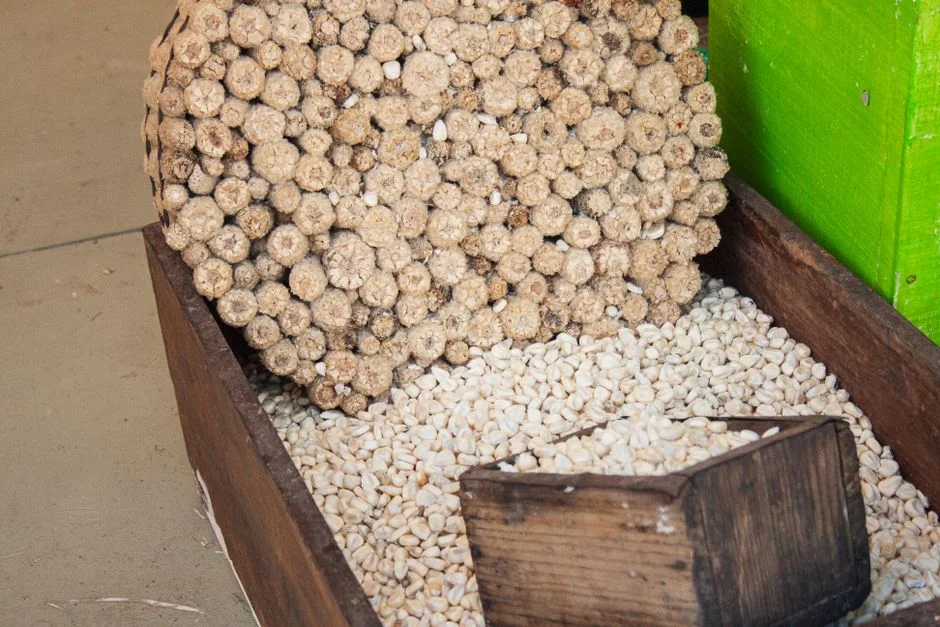
Photo: Alexey Demidov / Pexels
- Layer browns and greens like a cake, wetting each layer as you build.
- Keep it as damp as a wrung-out cloth — 50 to 60% moisture.
- Build the heap at least 1 m wide and 1 m high so it heats up inside.
- Turn it every 2 to 3 weeks to let in air.
- It is ready in about 2 to 3 months when dark, crumbly and earthy-smelling — finished compost settles to a stable 10:1 to 15:1 ratio.
Dig mature compost into the topsoil before planting, where the roots will find it.
How much manure should I use, and how do I apply it?
Spread 12 to 15 tonnes of well-decomposed farmyard manure per hectare and work it in 3 to 4 weeks before planting, as the FAO recommends. Use it well-rotted, never fresh — fresh manure burns roots and steals nitrogen from your crop.
| Where | Well-rotted rate | In everyday measures |
|---|---|---|
| Whole field | 12–15 t/ha, dug in 3–4 weeks early | ~1.2–1.5 kg per m². Weigh it, don't count bags: about 90 kg covers ~60 m², a 50 kg bag ~35 m². Manure is far lighter than grain, so a bag "full" of manure weighs well under 90 kg — weigh it or top up. |
| Per planting station | 1–2 handfuls per basin | mixed into the basin before the seed goes in |
Concentrating manure in the planting station stretches a small pile a long way — the same logic behind Pfumvudza basins.
How thick should my mulch be to keep water in?
Cover at least 30% of the soil surface — the conservation-agriculture minimum set by the FAO — and aim higher where you can. A mulch layer inhibits evaporation while still letting rain soak in, the FAO notes.

Photo: Sudarson Alwin / Pexels
- Lay straw or dry grass 5 to 10 cm deep (a loose layer up to your ankle); this raised soil moisture about 10% over bare ground in one review.
- In dryland trials, straw mulch lifted soil moisture around 21% and organic mulch cooled the surface by more than 10°C, per this study.
- Leave a hand's gap of bare soil around each stem so it does not rot.
- On Pfumvudza basins, mulch is the finishing step; it also shades roots for maize in a dry year.
Pair mulch with rainwater harvesting to bank even more of every storm.
How can I check my soil moisture without a meter?
Use the squeeze test, a field method from the FAO's Global Soil Doctors programme:
- Dig 10 to 15 cm down and grab a handful.
- Squeeze it firmly into a ball.
- Crumbles and won't hold? Your bank is low — mulch and water.
- Forms a ball and ribbons between your fingers with a slick feel? You have good moisture in reserve.
Do this weekly. Well-built soil holds its ball far longer between rains — living proof your water bank is filling.
Your next step this week
Start one job: build a 1 m compost heap, spread well-rotted manure on next season's plot, or lay 5 cm of mulch on your basins. Then run the squeeze test, note what you feel, and check again after the next rain.