Divisi

Conservation agriculture can lift maize yields 24–39% in a dry year — not by giving you more rain, but by keeping more of the rain that falls inside your soil (Zambia on-farm trials). You get there with three habits working together: disturb the soil as little as possible, keep it covered, and rotate your crops.
In an El Niño dry season, that stored moisture is often the gap between a harvest and a failed plot. Here is how the system works and where it fits.
What is conservation agriculture in simple terms?
Conservation agriculture (CA) is a system, not one trick. The FAO defines it by three rules you hold at the same time (FAO):

Photo: Nicholas Githiri / Pexels
- Minimum soil disturbance — open only a narrow planting slot, less than 15 cm wide or under a quarter of the field, instead of ploughing the whole plot.
- Permanent soil cover — keep at least 30% of the ground covered with crop residue (dead stalks and leaves left as mulch) or a living cover crop, all year. Below 30% cover, it does not count as CA.
- Crop rotation — grow at least 3 different crops in sequence, for example maize, then a legume such as cowpea or beans, then another cereal.
Miss one and the system leaks. Ploughing dries and bakes the soil; bare soil loses water to the sun; maize after maize after maize feeds pests and drains nutrients. Together, the three habits build soil that drinks rain and holds it — the same goal as building soil that holds water.
Should I use planting basins or rip lines?
Both open the soil in narrow strips only — the rest of the field stays untouched. Choose by your zone, plot size and power source.
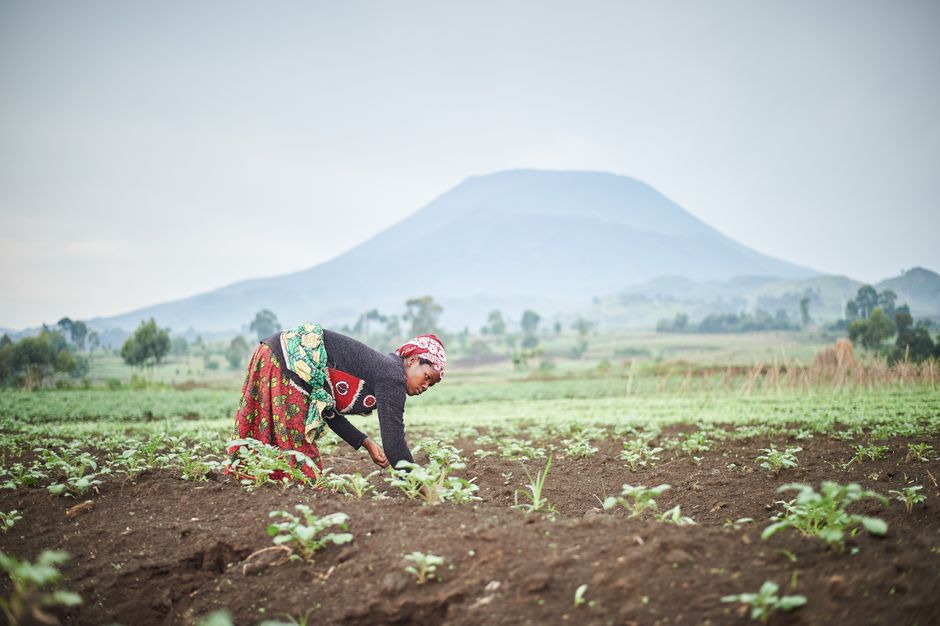
Photo: Stephanie Bujiriri / Pexels
| Method | Best for | How it works |
|---|---|---|
| Planting basins | small plots, hand labour, drier semi-arid zones | Dig fixed holes about 15 cm wide × 20 cm deep × 40 cm long, rows 90 cm apart — roughly 13,875 basins per hectare, 4 seeds per basin (Zambia trials) |
| Rip lines | larger plots, draught animals or a tractor, or a hardpan to break | Pull a ripper tine along the planting row, about 15–25 cm deep, leaving the soil between rows undisturbed |
A hardpan is a hard, compacted layer below the topsoil that blocks roots and water from going down; ripping cracks it open.
Basins concentrate scarce rain and manure right at the plant's roots. This is the same idea as Zimbabwe's Pfumvudza — if you already dig Pfumvudza basins, you are already doing CA. In the drier semi-arid zone (under about 800 mm of rain a year), basins win because they trap every drop. In wetter sub-humid zones, rip lines cover ground faster and drain better in a wet spell.
How much mulch do I need to cover my soil?
Keep at least 30% of the ground covered. A full protective mulch is about 4 tonnes of dry crop stalks per hectare (0.4 ha = 1 acre), which is roughly 80% cover (FAO). At that level, runoff can drop to about 5% of the rain that falls (FAO) — so roughly 19 of every 20 buckets (debe, ~20 L) soak into your soil instead of running off the surface. Mulching alone can cut surface runoff by up to 25% (CIMMYT).
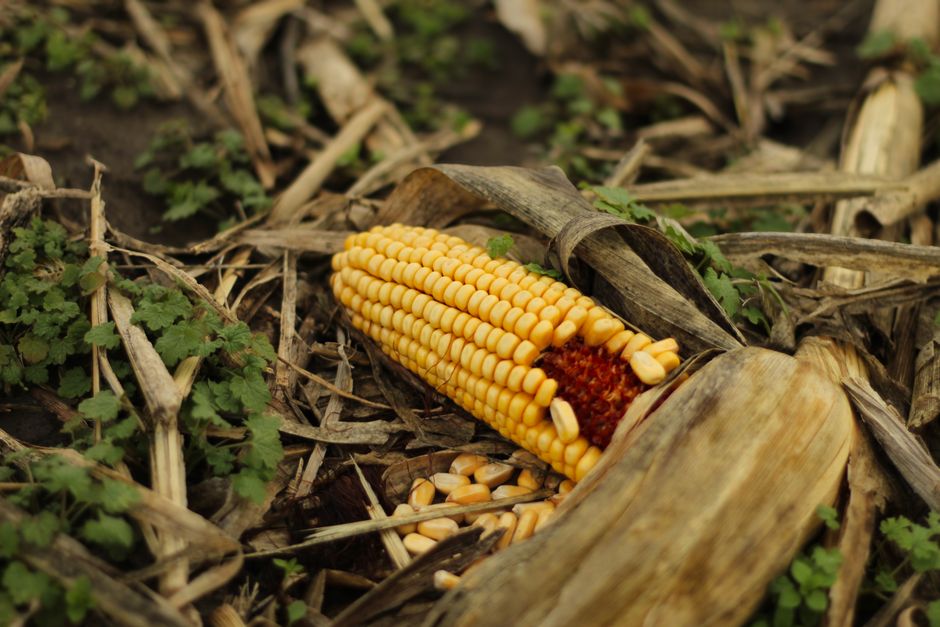
Photo: Sight See-RR / Pexels
Cover also keeps soil 3–7% moister and cooler — and that matters, because every 1°C that root-zone soil rises above 30°C can cost maize about 10% of yield (icipe / Infonet).
No-tool cover test: walk 20 steps across your field. At each step, look straight down at your toe. If crop residue — not bare soil — sits under your toe on at least 7 of the 20 steps, you have about 30% cover.
Residue is scarce in dry, semi-arid areas, and livestock need it too. Rather than grazing the plot bare, hold the 30% floor and grow more biomass with a legume intercrop, or cut-and-carry grass onto the plot. Pair this with rainwater harvesting for more effect.
Will conservation agriculture mean more weeding?
Yes — in the first years, and this is the honest trade-off. Without herbicide, hand-weeding labour can rise from about 27 person-days per hectare under ploughing to as much as 81 under hand-dug basins (weed-control review). (A person-day is one person working one full day.)
A knockdown herbicide — one that kills weeds already growing, such as glyphosate — sprayed before planting can cut weeding to 10–20 person-days per hectare (review). If you spray: wear gloves, boots and long sleeves; never spray into the wind; follow the label's pre-harvest interval and re-entry time; and keep children and livestock off the plot until the spray has dried.
The good news: with steady weeding and a thick mulch smothering weed seeds, weed pressure falls over the first 2–5 seasons, while yields climb (review).
Does conservation agriculture work in a dry year?
Yes — that is exactly when it pays. In Zambia's on-farm trials, CA grew 24–39% more maize than conventional ploughing across five seasons, and the gap was widest in the driest years (Zambia trials). On a 1.8 t/ha crop, that is roughly 9–14 extra 50 kg bags per hectare.
But CA is not instant. Expect the full benefit to build over 2–5 seasons as soil structure and cover improve (review). Start on part of your land, not all of it.
Your next step this week
This season, pick one plot of 0.4 ha (1 acre). Stop ploughing it, dig basins or rip lines, and leave at least 30% of last season's stalks on top as mulch. At harvest, weigh it against your ploughed plot — then decide how far to spread it. For variety choice and spacing on that plot, see growing maize in a dry year.