 Divisi
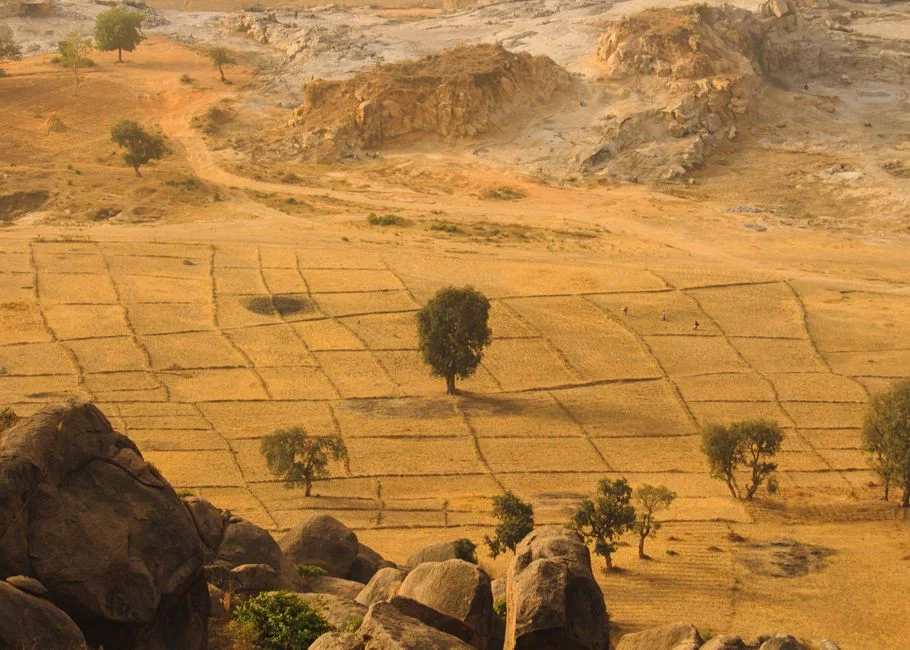
You do not need to buy a single seedling to add trees to your farm. The trees are already there — as living stumps and self-sown seedlings hiding in your soil — and protecting them can lift cereal yields by about 100 kg a hectare, roughly two 50 kg bags of extra grain on land you already work.
That practice is farmer-managed natural regeneration (FMNR): instead of raising and planting seedlings, you find the roots and stumps still alive underground and let a few of their shoots grow back into trees. It is one of the cheapest resilience tools you have. In Niger, farmers used it to bring back 5 million hectares and some 200 million trees over 20 years — mostly with a machete and patience.
Scattered trees are quiet money. They slow the wind, shade the soil, drop leaf litter that becomes free fertiliser, and give you fodder and firewood. In an El Niño year — when heat and dry spells bite harder — that shelter is worth even more.
Do I have to buy and plant seedlings?
No. FMNR is free tree cover, and that is the whole point. You manage what nature already planted, at about US$14 a hectare — almost all of it your own labour.

Photo: Vaidas Vaiciulis / Pexels
The prune-and-protect method:
- Find them. After the first rains, walk your field and mark every living stump and strong self-sown seedling — even the ones you would normally slash.
- Select the stems. On each stump, keep the 3–5 tallest, straightest stems. Cut the rest off at the base. Fewer stems grow faster and stronger.
- Prune. Strip the side branches off the lower two-thirds of each kept stem so it grows tall and straight — and up out of your crop's light.
- Protect. Keep goats and cattle off the young shoots, and clear a bare strip a few paces wide around them before the dry season so grass fire cannot reach them. Re-prune every few months.
Use a sharp tool, cut away from your body, and work in the cool of the morning — see working safely in extreme heat.
Won't trees in my field shade my crops?
Not if you pick the right tree and the right spacing. The star of dryland farming is Faidherbia albida, a nitrogen-fixing acacia (it pulls nitrogen from the air and feeds it to the soil). Its trick is reverse phenology — the tree drops its leaves at the start of the rains and stands bare while your crop grows, then leafs out again in the dry season. It sheds its leaves with the rains and is green during the dry season, so it feeds and shelters your soil without stealing your crop's sunlight. The field test: it is the tree that looks dead and grey when everything else is green.

Photo: Joseph Ruwa / Pexels
Under its canopy, maize yields double or triple and millet can rise by up to 150%. In Senegal's sandy soils, soil nitrogen and available phosphorus almost doubled under the tree. Across sub-Saharan Africa, crop yields are almost twice as high in agroforestry systems, and rain soaks in three times faster — priceless in a dry year.
Keep the density right. Aim for a scattered "parkland", not a forest:
| Goal | Faidherbia per hectare | On the ground (no tape) |
|---|---|---|
| Wind + soil, healthy crop | about 40 trees | one big tree every ~20 paces (16 m) |
| Denser Sahel parkland | up to 100–150 trees | one every ~13 paces (10 m) |
In Ethiopia's highlands, cropping under 65 trees a hectare raised farm income by 82% versus bare fields.
Which tree is best for my maize or millet?
For cereals in dry zones, Faidherbia is hard to beat. But your agro-ecological zone (the climate-and-soil band you farm in) decides the best mix. Here are four proven options and their honest trade-offs:
| Tree | What it gives you | Best zone | The honest trade-off |
|---|---|---|---|
| Faidherbia albida | Nitrogen, leaf litter, dry-season fodder; won't shade the crop | Sahel and semi-arid parkland; Zambia–Malawi maize belt | Slow to establish; can lower groundnut yields (too much nitrogen) |
| Gliricidia sepium | Fast, nitrogen-rich prunings you dig into the soil | Wetter Sudanian zone and Southern Africa | Needs regular pruning — that is labour |
| Pigeonpea | Grain, firewood and nitrogen in one season | Semi-arid to sub-humid | A shrub, not a shade tree; re-plant each year |
| Grevillea robusta | Poles and timber to sell; a boundary windbreak (a line of trees that breaks the wind) | East African highlands | Competes for water — keep it off your driest fields |
Nitrogen-fixing trees give the biggest, cheapest yield boost, but even non-fixing trees like Grevillea raise crop yields when spaced well. One warning: do not crowd Faidherbia onto a groundnut field — the extra nitrogen can depress groundnut yields.
How do I stop goats and fire from killing the young trees?
Protection is the make-or-break step. Young shoots are food for goats and fuel for fire, so plan for both from day one.
- Grazing: agree a closed season with your neighbours and herders to keep animals off regenerating fields until the shoots are above browsing height (roughly head height). Rotate stock through later.
- Fire: clear a bare firebreak strip around the trees before the dry season starts.
- Patience pays: shelter helps from year one, but the big nitrogen and yield gains build over three to five seasons. Pair trees with mulch and minimum tillage — see conservation agriculture and building soil that holds water.
Your next step this week
Walk one field and count your living stumps. Mark them, choose the strongest three to five stems on each, and cut the rest — that single afternoon starts your free tree cover. For the cereals that grow best beneath these trees, read sorghum and millet agronomy for a dry year.