Divisi

Dry your maize to about 13% moisture, sort out every damaged grain, then seal it in an airtight container. Do that and you starve out both the mould that makes aflatoxin and the weevils that eat your profit — keeping your grain worth full market price.
A wet, humid El Niño season makes this urgent. When grain dries slowly and sits damp, the fungus and the insects win — WHO links aflatoxin build-up directly to warm, humid conditions and to grain damaged during drying and storage. Across sub-Saharan Africa, roughly 15–18% of the maize harvest is already lost after cutting, much of it in storage and much of it avoidable.
What is aflatoxin, and why do buyers reject mouldy maize?
Aflatoxin is a poison made by a mould called Aspergillus flavus — the greenish growth you see on damp cobs and grain. You cannot wash it off or boil it out, and WHO warns that high doses damage the liver and can cause cancer, so it is a food-safety problem, not just a quality one.
For your business the maths is simple. A serious buyer, miller or aggregator tests for it. Most East African markets follow the EAC limit of 10 micrograms per kilogram of total aflatoxin (5 µg/kg for aflatoxin B1); the EU allows just 4 µg/kg. Grain over the limit gets rejected or docked, and you carry the loss. Clean, dry grain passes and earns full price.
Risk is highest in hot, humid lowlands and anywhere late El Niño rain keeps grain wet in the field or the store. Cooler highlands dry slowly too when the rain lingers — so this season the rules below apply everywhere.
How dry should my maize be before I store it?
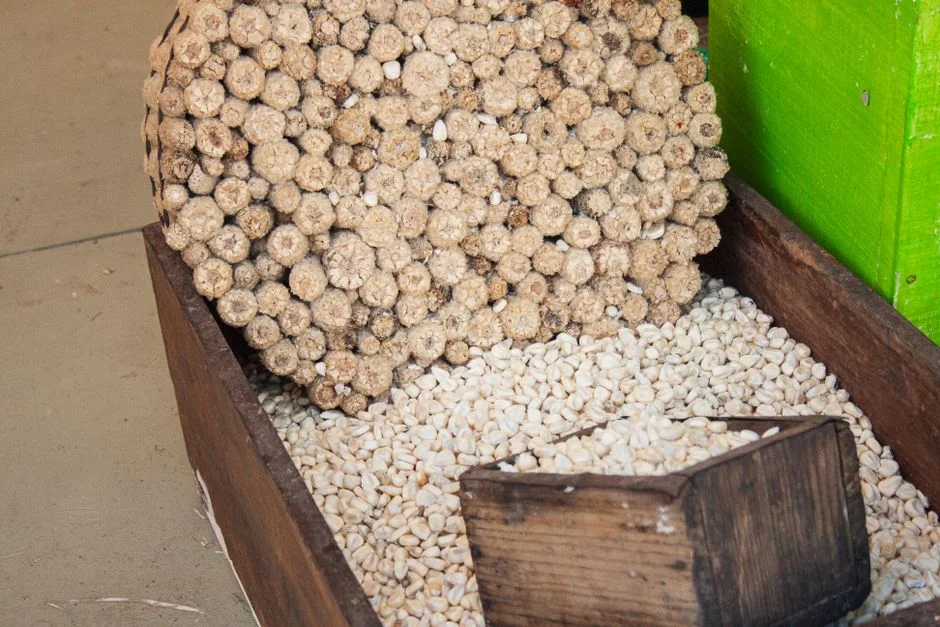
Dry it to about 13% moisture, no wetter. FAO sets 13% as the safe line for storage and warns that for every 1.5% of moisture above it, grain spoils twice as fast — so grain at 16% rots about four times faster than grain at 13%.

Photo: micka randrianjafisolo / Pexels
No moisture meter? Use two no-tool field tests:
- Salt-in-a-bottle test. Put two handfuls of grain and a spoon of dry table salt in a clean, dry glass bottle, cap it, and shake hard for 2–3 minutes. If salt sticks to the glass or clumps on the grain, the maize is still too wet — keep drying. FAO's grain-storage guide describes the same test: dry salt will not lump or stick to the glass once the grain is dry enough to store.
- Bite or hammer test. Bite one kernel: dry grain cracks with a sharp snap and cannot be dented with a fingernail, while wet grain feels soft or rubbery and squashes. Or lay a few kernels on a stone and tap with a hammer — dry grain shatters, wet grain flattens.
Dry on a raised rack, a tarp or a clean cracked floor — never on bare soil, which pushes moisture and mould back into the grain. Turn it so it dries evenly.
How do I clean and store maize so mould and weevils stay out?
Airtight (hermetic) storage is the single biggest win, because a well-sealed container starves both the insects and the mould of the oxygen they need to live.
Before you bag it:
- Shell and winnow to remove chaff and dust.
- Sort out every grain that is holed, cracked, discoloured or mouldy — these carry insect eggs and fungus. One handful of bad grain can spoil a whole bag.
- Bag only grain that passed your dryness test.
Then seal it in one of these:
| Airtight option | Typical size | Good to know |
|---|---|---|
| PICS triple-layer bag | 25, 50 or 100 kg | Two plastic liners inside a woven sack; tie each liner separately |
| Metal silo | 100 kg and up | Reusable for years; needs a tight lid seal |
| Well-sealed plastic drum | 20–200 litres | Lid must close airtight; check the rubber ring |
The numbers make the case. In one trial, maize in ordinary woven bags lost about 40% of its weight and was almost entirely insect-damaged after six months, while grain in a sealed PICS bag lost under 3% and stayed almost undamaged. That is the gap between selling a full 90 kg bag and selling half of one.
Fill airtight containers to the top so little air is trapped, seal them tight, and resist opening them for a weekly scoop — every opening lets oxygen and insects back in.
How do I stop maize weevils and the larger grain borer?
Two insects do most of the damage. The maize weevil (Sitophilus zeamais) is a shiny dark-brown-to-black beetle 3–3.5 mm long, with a long snout and four pale spots on its back; it hollows out grains from the inside. The larger grain borer (Prostephanus truncatus) is a dark-brown beetle 3–4.5 mm long, shaped like a tube cut off square, that bores neat round holes and leaves piles of maize dust — it can cost around 30% of grain weight in 3–6 months.

Photo: SweeMing YOUNG / Pexels
Work the steps in order, cheapest and safest first:
- Sanitation. Before harvest, empty the store, sweep out old grain, and burn last season's infested residue — old grain is where the next infestation hides.
- Cultural. Harvest promptly at maturity, dry fast to 13%, store only clean sorted grain, and choose varieties with tight husk cover.
- Physical/biological. Mix wood ash or food-grade diatomaceous earth (a fine mineral dust) through the grain; it kills insects by drying them out. For the larger grain borer, its natural predator beetle Teretrius nigrescens helps in many areas.
- Botanical. Neem and other plant powders repel store pests — see our guide to homemade botanical pesticides.
- Chemical — last resort. Use only a registered grain-protectant dust at the label rate. Wear gloves and a dust mask, and respect the label's withholding period — the number of days you must wait before eating or selling treated grain. Airtight storage lets you skip this step entirely.
Where it is sold, Aflasafe — a biocontrol you spread in the field before flowering that crowds out the toxic mould with harmless strains — cuts aflatoxin by 52–96% at harvest.
Can I store maize that already has mould?
No. Once grain is visibly mouldy the aflatoxin is already made, and sealing it in will not remove it. Sort heavily mouldy grain out, wear a dust mask while you do it (the spores are harmful to breathe), and keep it away from food, clean grain and animal feed. Never mix a mouldy batch into a good bag to hide it — one bad handful can push the whole bag over the buyer's limit.
Your next step this week
Pick your driest, cleanest maize, run the salt-in-a-bottle test, and move one batch into a sealed PICS bag or drum today. If damp or floods caught your harvest, act faster — see recovering your farm after a flood. Storing beans too? They face their own store pest — see controlling bean bruchids. And for sorghum, see cutting sorghum post-harvest losses.