 Divisi

Dry-season vegetables can be your steadiest cash: a small, well-watered plot that pays you every couple of weeks while the main crop is still a gamble. On beds no bigger than a small garden plot, leafy greens give a first cut in about six weeks and then every 2-3 weeks, and an irrigated tomato crop can yield 45-65 tonnes per hectare — about 4.5-6.5 kg per square metre, so one 10 m2 bed can fill a full 45-60 kg market basket (two to three of the 20-25 kg plastic crates) across the season, selling when supply is thin and prices are high.
Why bother when El Niño makes rain unreliable? Because thin supply is exactly when town prices climb. If you control the water, you control the harvest, and you sell when others have nothing to bring.
First rule: site your plot near a reliable water source, a shallow well, borehole, river bend, or a tank you fill in the rains. Keep beds within easy carrying distance of the water, because every extra metre is a bucket you have to lift. Harvest and store rainwater now so your dry-season plot never runs dry.
Which vegetables give the best income in the dry season?
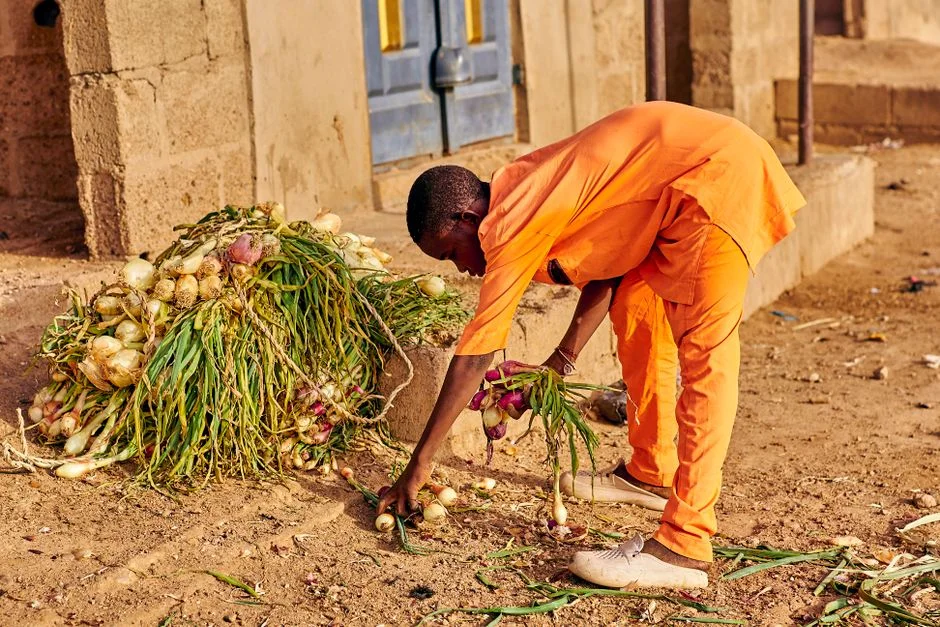
Match the crop to your cash flow. Fast leafy greens pay the weekly bills; tomato, onion and pepper are higher-value but need more water and care.

Photo: Eva Bronzini / Pexels
| Crop | First harvest | Season water need |
|---|---|---|
| Amaranth, sukuma wiki (kale) | ~6 weeks, then every 2-3 weeks | Low-medium |
| Cabbage | ~4 months | 350-500 mm |
| Tomato | 3-4 months | 400-600 mm |
| Onion (dry bulb) | 5-7 months | 350-550 mm |
| Sweet pepper | 4+ months | 600-900 mm |
All are rated medium-high sensitivity to water stress by FAO, so a few dry days at flowering or bulbing costs you yield. Steady water matters more than heavy water.
How much water do vegetables need, and how do I water with a can or drip?
Water little and often, and mulch to keep it in the ground. FAO puts a field tomato crop at 400-600 mm over 90-120 days. Spread out, that is roughly 5 litres per square metre a day on average, more at the hot peak. A 10 m2 bed (about 3 x 3 m) then drinks around 50 litres, two to three 20-litre cans, on a hot, windy day.
Do not guess, test. Push a finger into the bed to the first knuckle (about 5 cm). Dry at the fingertip means water now; still damp means wait. Water in the early morning or late afternoon, never in the midday heat.
Two ways to stretch every litre:
- Mulch. A finger-thick layer of dry grass or leaves over the soil cuts evaporation and keeps roots cool. Build soil that holds water.
- Drip beats a can. Simple drip lines or a treadle pump put water at the root, not on the path, and save your back — that guide sizes a can, treadle pump or drip kit to your plot and water source and sets your watering schedule.
Feed through the water (fertigation). Work a bucket of well-rotted manure or compost into each square metre before planting, then feed little and often: half-fill a can with manure, top up with water, let it steep, and pour the strained "tea" around the roots every 1-2 weeks.
How do I raise strong seedlings and space my beds?
Start tomato, pepper, onion and cabbage in a nursery, then transplant the strongest. A seedling is ready at about 25-26 days old with 4-5 true leaves. Harden it off first: from 16 days, slowly cut back water and shade so it does not wilt in the field.

Photo: Judith Knight / Pexels
Give each plant room to breathe; crowding invites disease and shrinks fruit.
| Crop | Between plants | Between rows |
|---|---|---|
| Tomato | 40-60 cm | 60-100 cm |
| Onion | 5-10 cm | 30-50 cm |
| Amaranth (leaf bed) | 5 cm in the row | 10 cm |
No tape measure? A grown hand-span is about 20 cm. For cabbage and kale, space so the leaves of full-grown neighbours just touch, about two hand-spans apart.
How do I beat aphids, whitefly and Tuta absoluta without wasting money?
Work in order, cheapest first. Sprays are the last step, not the first.
Know the three:
- Tomato leafminer (Tuta absoluta). Larvae tunnel inside leaves, leaving pale, irregular blotches, then bore into the fruit. Worst in warm lowlands and the hot dry season; cooler highlands see less pressure but slower growth.
- Whitefly (Bemisia tabaci). Tiny white insects under the leaves that fly up in a cloud when you shake the plant; they spread viruses.
- Aphids (Aphis gossypii, Brevicoryne brassicae). Soft 1-4 mm insects clustered on shoots, leaving sticky honeydew and curled leaves.
IPM, step by step:
1. Sanitation. Pull and bury infested leaves and fruit, clear all crop debris after harvest, and never plant tomato straight after tomato.
2. Cultural. Rotate crops, stake for airflow, and ring beds with onion, garlic or marigold to repel aphids. Cover the nursery and beds with fine insect net, which cut sprays by about 70% and raised marketable yield 35-70%.
3. Botanical / biological. Hang pheromone traps for Tuta, 45-50 per hectare, and yellow sticky traps for whitefly. Spray neem (86-100% Tuta larval kill) or a soap wash (1 tablespoon soap in 4 litres of water); protect the ladybirds and wasps that eat aphids for free.
4. Chemical, last resort. Rotate active ingredients and avoid WHO Class 1b products. Wear gloves, long sleeves, boots and a face cover, and wash after. Obey the pre-harvest interval printed on the label and never harvest before it. With greens you pick weekly, stick to neem or soap so there is no waiting.
How do I sell when prices are good?
Do not plant everything at once, stagger. Sow greens every 2-3 weeks and set out tomato in two or three lots a month apart, so your harvest lands across the price peak instead of flooding one week. Keep a simple record of what you spend and earn per bed; that number tells you which crop to grow more of. Handle tomato well after picking and time your sale to protect your margin.

Photo: Barnabas Sani / Pexels
Your next step this week
Pick one bed near your water, work in a bucket of manure per square metre, and sow a nursery tray of greens and tomato. Mulch it, and mark your calendar to sow the next batch in two weeks — stagger a few beds like this and you move from one harvest every 2-3 weeks to greens you can cut, and cash you can bank, almost every week.