 Divisi
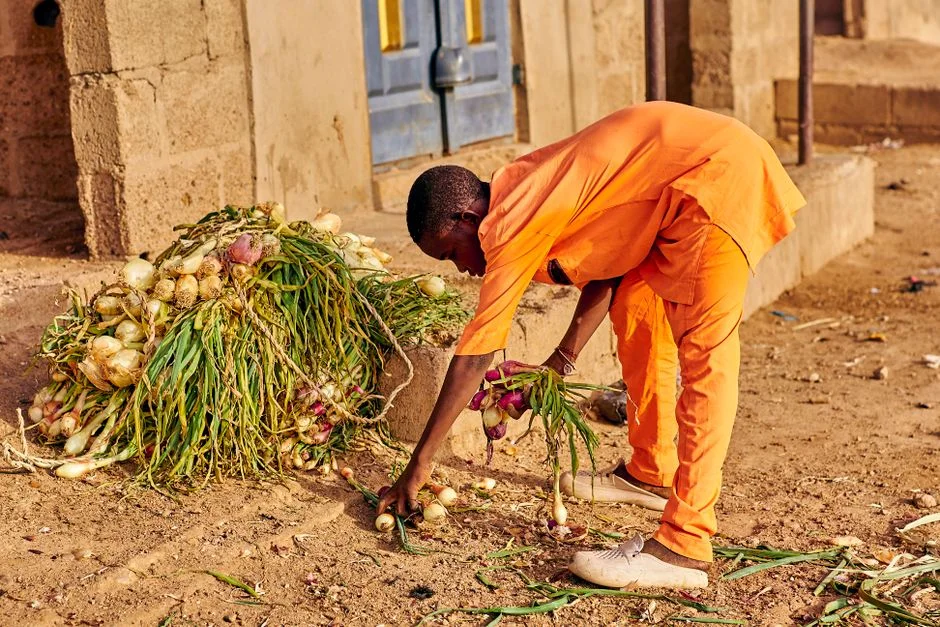
Onions are one of the few crops you can harvest, store for months, and sell when everyone else has sold out — and that gap is where the profit sits. A crate of well-cured bulbs held for 3–5 months can earn far more than the same crate sold on harvest day, when every farmer floods the market at once.
This guide takes you from seed to sale for irrigated onions in Niger's Galmi belt, Tanzania's Mang'ola valley, and Ethiopia's Central Rift Valley — variety, spacing, feeding, pests, curing, and the off-season play.
Why this crop fits an El Niño year. Onions are a dry-season, irrigated crop. In a wet El Niño season, time your planting so the bulbs form and cure in dry weather — rain on a curing onion invites rot and destroys your store. Pair it with reliable water and treat it as your dry-season cash crop.
Which onion variety should I plant in my area?
Plant a short-day type. Near the equator the day never gets long, so long-day European onions just grow leaves and never form a bulb — a costly, common mistake.
| Onion type | Day-length it needs | Bulbs in the tropics? |
|---|---|---|
| Short-day (Red Creole, Bombay Red, Mang'ola Red) | Short tropical day | Yes — best for storage |
| Long-day (imported European) | Long summer day | No — leaves only near the equator |
FAO and Ethiopian trials both name Red Creole and Bombay Red as proven tropical performers. Field test: if your neighbours already sell good hard bulbs, buy that same named seed — never just "any onion seed".
How do I raise the nursery and space onions for big bulbs?
Start in a nursery bed. Sow 3.5–4 kg of seed per hectare (about 80–100 g per 1 m × 5 m bed), and transplant at 45–55 days when seedlings carry 3–4 true leaves — never past 60 days, or they bulb early and yield collapses.

Photo: Los Muertos Crew / Pexels
Spacing decides bulb size, and bulb size decides your price:
| Spacing (rows × plants) | What you get |
|---|---|
| 20 cm × 10 cm | Best all-round; up to ~26 t/ha of marketable bulbs |
| 20 cm × 5 cm (Bombay Red) | More bulbs, but smaller |
Wider plants give fewer, bigger premium bulbs; tighter spacing gives more, smaller ones. Ethiopia's average is only 8.8 t/ha against a world average near 19.7 t/ha — good spacing, water and feeding close that gap.
Feed in splits, then stop:
| Stage | Action |
|---|---|
| Transplanting | Work in compost plus about a quarter of your nitrogen |
| From 3 weeks, every 2–3 weeks | Top-dress nitrogen |
| Bulbing starts | Add potassium for bigger, firmer, longer-storing bulbs |
| 4–6 weeks before harvest | Stop nitrogen; cut water 1–2 weeks before lifting |
Late nitrogen and late water make thick, soft necks that rot in storage — the number-one reason a store fails.
How do I stop thrips and purple blotch on my onions?
Scout weekly from the 4–5 leaf stage. Two problems arrive together: onion thrips (Thrips tabaci) and purple blotch (Alternaria porri). Thrips wounds open the door for the fungus — thrips-injured plants showed 100% purple-blotch infection versus 30–40% on clean plants.
How to ID and when to act
- Thrips: tiny insects leaving silvery streaks, worst deep in the leaf neck. Open the neck to count — act at 1–3 larvae per leaf; severe thrips cut bulb yield 30–50%.
- Purple blotch: purple-brown sunken patches with target-board concentric rings on the leaves; losses reach 85% left unchecked.
IPM, in order:
- Sanitation — remove and bury old onion debris and volunteer plants.
- Cultural — rotate off onion and garlic land for 2–3 years; grow on raised beds with airflow (purple blotch explodes in humid, warm El Niño-wet spells); avoid late-day overhead watering.
- Biological/botanical — protect natural predators, and use neem or Beauveria bassiana for early outbreaks.
- Chemical, last — rotate insecticide groups, because thrips build resistance fast. Wear gloves, goggles and a mask, and respect the label's pre-harvest interval so residues clear before you sell.
How do I cure and store onions so they don't rot?
Harvest when about 80% of the tops have flopped and the necks have gone soft. Lift on a dry day, and don't bruise the bulbs.

Photo: Alistair Mockett / Pexels
Curing means drying the neck until it seals shut. Spread bulbs one layer deep in shade with moving air — not full midday sun, which scalds them — for 14–20 days, until the neck is dry and shrunken and the skins rustle.
Then store like this:
- Ventilated crib — raised off the ground, slatted sides, thin layers or hung nets so air keeps moving.
- Sort hard — throw out any soft, thick-necked or bruised bulb; one rotten onion spoils the crate.
- Right container — crates (~13–20 kg) or 50 kg net bags. Never sealed plastic; it sweats and rots the crop.
When should I sell to get the best price?
Sell into the lean window, not on harvest day. Prices are lowest when everyone harvests at once and highest months later when supply runs dry — in Tanzania's Mang'ola the glut and the premium window sit months apart. Cured, well-stored bulbs are exactly what let you wait for that higher price. Sharpen the timing with when-to-sell tactics and solid post-harvest handling.
Your next step this week
- Buy named short-day seed (Red Creole or Bombay Red) and sow a nursery bed now.
- Mark your calendar: transplant in about 7 weeks, and stop nitrogen 4–6 weeks before harvest.
- Build or clear a shaded, airy curing space and a raised storage crib before the bulbs come in.