 Divisi
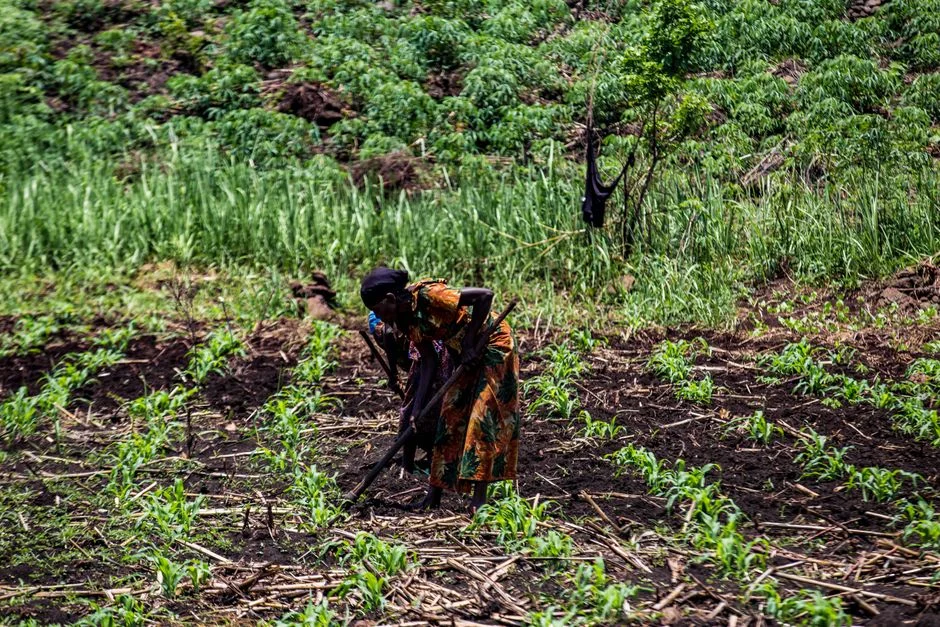
Fertiliser microdosing means placing one bottle cap — about 6 grams — of fertiliser straight into each planting hole, next to the seed, instead of scattering it across the field. In dry-year trials across the semi-arid Sahel, that small, well-aimed dose lifted grain yields by 43–120% while using roughly a third of the fertiliser that broadcasting needs.
Here is why it pays. In a dry year, scattered fertiliser feeds bare soil and weeds between your plants, and much of it never reaches a root. A bottle-cap dose sits where the young roots grow, so nearly every grain does paid work — one Sahel project measured a jump from 234 kg/ha to 577 kg/ha — roughly 5 to 11 fifty-kg bags of grain per hectare, more than double — off the same cheap 50 kg bag of NPK. In Niger, farmers who paired microdosing with a savings-and-credit scheme raised household income by 34%.
One honest warning up front: microdosing lifts your return per kilogram of fertiliser — it cannot make rain. Give the dose some moisture and it shines. Starve it and even perfect placement fails.
How much fertiliser goes in each planting hole?
One level bottle cap — a soda or beer cap holds about 6 g — in each planting station feeds two to three plants. No cap? A three-finger pinch is about the same. Keep your caps in an empty matchbox so you carry a tidy day's supply.
| Your measure | Fertiliser | Feeds |
|---|---|---|
| One level bottle cap | ~6 g | 2–3 plants |
| One three-finger pinch | ~6 g | 2–3 plants |
Placement, not quantity, is the trick:
| Broadcasting (scatter) | Microdosing (place) | |
|---|---|---|
| Where it lands | across the whole field | one cap per hole, beside the seed |
| Fertiliser used | full rate | about one third |
| In a dry year | much is lost between plants | 43–120% more grain in Sahel trials |
Keep the dose a few centimetres to the side of the seed and cover it — fertiliser touching the seed can scorch it.
What are the 4Rs, and how do I get them right?
The 4Rs are a simple checklist for every gramme you apply — the right source, right rate, right time, right place.
| The 4 Rs | In plain words | Do this |
|---|---|---|
| Right source | the right fertiliser | DAP or NPK in the hole at planting (phosphorus builds roots); urea or CAN later for nitrogen |
| Right rate | a small, measured dose | one bottle cap (~6 g) per station |
| Right time | when the plant can use it | split the nitrogen: some at planting, the rest at knee-high |
| Right place | next to the plant | a few cm from the seed, in the hole or basin, then cover |
Splitting the nitrogen matters most in a dry year. Put a little in at planting, then top-dress (add fertiliser beside the growing plant) with the rest when the crop is knee-high, about 45 cm tall — roughly 6–8 weeks after emergence, at the 8–10 leaf stage. See growing maize in a dry year for the full schedule.
When should I not top-dress with urea?
Never top-dress dry soil. Urea can lose much of its nitrogen to the air within 24–48 hours if no rain follows — you would be paying to feed the sky. If rain is uncertain, CAN holds on better than urea.
No moisture meter? Use the squeeze test: dig to 10 cm, take a handful, and press it. If it forms a ball that holds, top-dress now. If it crumbles to dust, wait for rain.
Does microdosing still work when the rains are poor?
Yes — that is exactly when placement pays most, because every kilogram counts. But the plant still needs water, so catch what falls. In the semi-arid Sahel, plant into zai pits (planting holes 20–40 cm wide and 10–20 cm deep) or half-moons; in Southern Africa's dry maize belt, use planting basins. Each catches runoff right at the plant.

Photo: Atlantic Ambience / Pexels
Drop two handfuls of manure or compost plus a bottle cap of NPK into each pit and yields of millet and sorghum climb 60–90% over flat planting. Learn the water side in rainwater harvesting and match it to sorghum and millet in a dry year.
Can I use manure instead of buying fertiliser?
Use both — they are a team. Manure and compost hold water and feed the soil slowly; the bottle-cap dose gives a quick, targeted boost. In trials, microdosing alone lifted yields 56%, but microdosing plus manure and rock phosphate pushed the gain to 140%. If cash is short, a 50 kg bag placed by the cap goes about three times further than the same bag scattered. Build the base first with compost, manure and mulch.
Your next step this week
Pick your smallest, driest plot and mark 20 planting stations. Save 20 bottle caps, fill each with NPK or DAP, and place one cap a few centimetres beside each seed as you plant. Set aside a matching strip where you plant as usual, and compare the two at harvest — let your own field prove the numbers before you scale up next season.