 Divisi
Catch the rain where it falls, and a dry season can still feed a harvest. The most drought-proof upgrade you can make this season is not a borehole — it is shaping your soil so rain soaks in instead of running off, using pits, ridges and low earth bunds you dig by hand. In ICRISAT trials in the Sahel, simple manured planting pits lifted millet from about 705 to 1,157 kg per hectare — a 64% jump, or roughly seven to twelve 100 kg sacks off the same land.
Which water-harvesting method fits my land?
Match the method to your slope and soil — that one choice decides whether the water stays or leaves. On flat, gentle ground you trap rain in pits and ridges; on a slope you stop it with low barriers built along the level line (the contour).
| Your land | Best method | Why it works |
|---|---|---|
| Flat to gently sloping | Planting pits (zai/tassa) or tied ridges | Traps rain in the pocket where you plant |
| Gentle slope, sandy or crusted | Half-moons (demi-lunes) | Semi-circle scoops runoff to the roots |
| Slope where you see erosion | Contour stone or earth bunds | Slows runoff along the level, holds topsoil |
| Small plot by the house | Bucket-kit drip garden | One bucket waters a full bed, slowly |
No-tool tests. For slope, tip a bucket of water onto bare ground: if it spreads and sinks, your land is gentle, so use pits and ridges; if it races off and cuts a little channel, build bunds and half-moons across the slope first. For soil, squeeze a wet handful — if it ribbons like modelling clay it holds water (dig fewer, wider pits); if it crumbles like sand it drains fast, so feed every pit with manure and mulch. See build soil that holds water.
How do I dig planting pits that actually hold water?
Dig small pits, feed each one, and plant into it: the pit catches runoff and the manure holds it long enough for roots to drink. This is the zai (or tassa) method, and it is the same idea as Zimbabwe's Pfumvudza basins.
- Dig pits about 25 cm across (up to 50 cm on crusted ground) and 15-20 cm deep, spaced to give around 10,000 pits per hectare (ICRISAT).
- Drop one or two handfuls of manure or compost into each pit — this is what pulls water and roots downward.
- Pile the dug soil on the downhill lip so each pit scoops more runoff.
- After the first real rain, sow a few seeds per pit; pair with the right dry-year maize spacing and variety.
- Mulch between pits so the surface does not seal and shed water.
The payoff is real: those manured pits carried millet to about 1,157 kg/ha, against 705 kg/ha on flat ground (ICRISAT) — roughly 225 extra 2-kg gorogoro tins per hectare in Kenya or Tanzania. To pick drought-tolerant millet and sorghum varieties and their spacing, see sorghum and millet agronomy in a dry year.
Do half-moons and bunds work on a slope?
Yes — on a slope you catch water before it leaves by building low barriers along the level line. Water backs up behind them, slows, and soaks in instead of stripping your topsoil.
- Half-moons (demi-lunes): earth semi-circles with the open side facing uphill. A common FAO design uses a radius of about 6 m and a bund about 25 cm high, set in staggered rows roughly 3 m apart — about 70-75 per hectare on slopes up to 1%.
- Contour stone bunds: lines of stone laid along the contour and at least 25 cm high, spaced about 20 m apart on slopes under 1% and 15 m on 1-2% slopes; earth bunds sit closer, about 5-10 m apart (FAO).
- Tied ridges: on gentle cropland, block the furrows between ridges with short cross-ties so each pocket ponds water. A meta-analysis across semi-arid Africa and Asia found tied ridges raised sorghum yields about 17% over flat planting, and most in the driest seasons (280-330 mm of rain). For step-by-step spacing and timing, see the Ethiopia highland guide.
Find the level with no tools: part-fill a clear hose or bottle with water; when both ends read the same height, those two points are level. Walk that line to peg your bund.
How do I water a kitchen garden on a bucket a day?
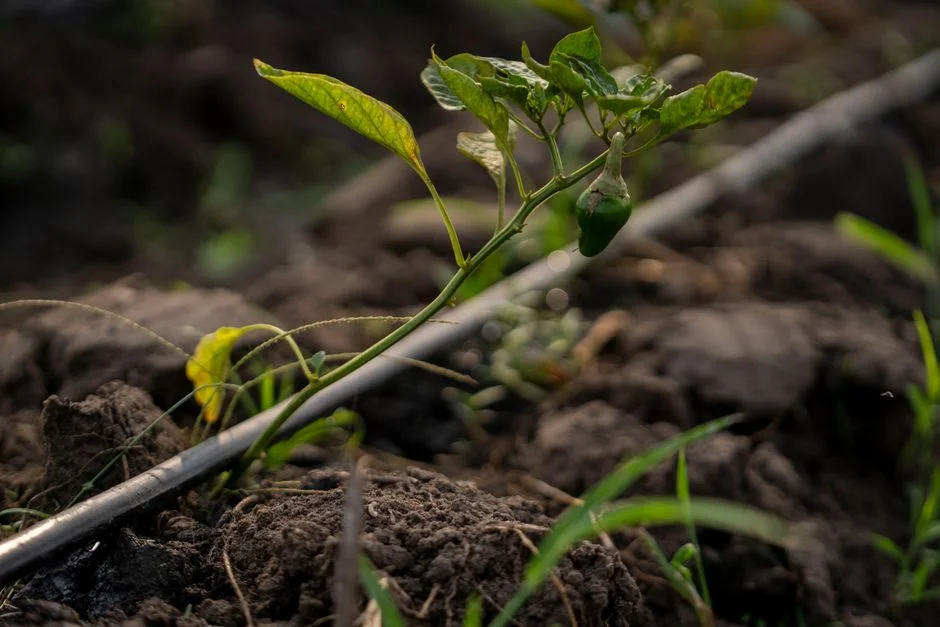
Use a low-cost bucket-drip kit so one 20-litre bucket feeds a whole bed slowly, straight to the roots. Near the house, high-value greens then keep earning right through the dry season.
- Raise the bucket about 1-1.5 m above the beds so gravity gives steady pressure; a basic kit waters roughly 20 m² (FAO).
- Drip wastes far less than a watering can, because it cuts the deep percolation, runoff and soil evaporation that lose a can's water (FAO).
- Simple low-cost drip can cost under US$250 per hectare (FAO) — a single bucket kit costs far less.
Checklist for a dry-season garden:
- [ ] Raise the bucket 1-1.5 m for steady drip
- [ ] Mulch beds thickly to hold the moisture in
- [ ] Water early morning or evening, never midday
- [ ] Grow greens, tomatoes or onions you can sell fresh
Your next step this week
Pick your flattest plot and your steepest. On the flat one, dig 20 test planting pits and drop a handful of manure in each before the rains come. On the slope, peg one contour line with a water-filled hose and lay a short stone bund along it. Small, by hand, this week — that is water in the bank.