Divisi
You can carry a vegetable crop through a two- or three-week dry spell with nothing more than a watering can and a plan. The trick is to know how much water your crop truly needs — usually less than you fear — and to match a cheap watering method to your water source and plot.
This is not about flooding the field. It is about putting the right litres in the right place at the right time, so scarce water and your own sweat both go further. A dry-season bed is worth the effort, because that is exactly when vegetables fetch their best prices.
How much water does my vegetable bed actually need?
Crop water use is measured in millimetres (mm) — the depth of water a crop drinks in a day — and 1 mm spread over one square metre is just 1 litre (FAO). A tomato bed at full fruiting uses about 6–8 mm a day in hot, dry weather. So a bed of 10 m² (1 m wide, 10 m long) needs roughly 60–80 litres a day at its thirstiest — three to four 20-litre buckets, or one full drum.
Match what you carry to the crop's stage, using FAO crop water-use figures (FAO):
| Stage (10 m² bed) | Crop water use | What to carry |
|---|---|---|
| Just-planted seedlings | ~2–3 mm/day | ~20–30 L/day (1–1.5 buckets) |
| Growing, leafy | ~4–5 mm/day | ~40–50 L/day (2–2.5 buckets) |
| Flowering & fruiting | ~6–8 mm/day | ~60–80 L/day (3–4 buckets) |
Over a whole season a tomato crop needs about 400–800 mm; peppers want more (600–900 mm), while onions (350–550 mm) and cabbage (350–500 mm) want less (FAO). Subtract any rain that falls — you only irrigate the gap, so pair this with good rainwater harvesting to keep the tank full when the sky is not.
Which irrigation method is cheapest for a small plot?
Match the tool to your water source and plot size, not to what your neighbour bought.

Photo: Anil Sharma / Pexels
| Method | Rough cost | Best for | Trade-off |
|---|---|---|---|
| Watering can / 20 L bucket | you likely own one | seedbeds, a few beds up to ~150 m² | you carry every litre — hard work |
| Rope-and-bucket or rope pump | low | lifting from a shallow well by hand | slow, steady effort |
| Treadle (foot) pump | US$50–120 | a river or shallow well feeding up to ~0.5 ha (1¼ acres) | you pedal, but hands are free and it is fast |
| Low-cost drip kit | US$5–25 | roots-only watering (bucket kit 15–50 m², drum kit ~125 m²) | saves water and labour once set up |
| Small petrol or solar pump | higher, plus fuel/panels | bigger plots, or water far or deep | low effort, higher cash cost |
Costs from FAO. The payoff can be real: in Zambia, farmers who moved from a bucket to a treadle pump lifted the income off a 0.25 ha (0.6 acre) plot from about US$125 to US$850–1,700 (FAO).
A low-cost drip kit drips water straight onto the roots, so almost nothing is wasted between plants. On sandy soil especially, small frequent watering beats flooding, which simply drains away (FAO).
How do I know when to water without a meter?
Use your hand. Dig about 15 cm into the root zone, take a handful and squeeze (FAO feel test):

Photo: Roy Photos / Pexels
- Forms a ball, leaves a light stain, makes a weak ribbon between finger and thumb → still moist, don't water.
- Barely holds, crumbles, no stain → dry, water now.
- Free water squeezes out → too wet, wait.
Water in the early morning or late afternoon, not the midday heat: watering in the hot hours loses 20–30% of every litre to evaporation before roots reach it (Clemson Extension). Know your soil, too. Sandy soil holds little — water small amounts, more often. Clay holds more but drinks slowly; if water pools and does not soak in within about 30 minutes, you are pouring faster than the soil can take it (FAO) — so water less at a time, more often.
Can I skip a watering to save water?
Yes — carefully. This is called deficit irrigation, or planned under-watering. Cutting water by about 25% during the less-sensitive, leafy stages stretches a scarce supply for little loss: sustained across the whole season, a 25% cut keeps a maize crop at about 82% of its yield, with each litre working about 1.1 times harder — roughly 10% more crop per litre (FAO). That 82% is a whole-season-deficit floor, so trimming water only at the leafy stages loses even less.
But never starve a crop at its make-or-break moment — flowering, fruit set and grain filling. Skip a watering while plants are just building leaves; keep them fully watered when flowers and fruit are forming. The same rule guards a thirsty staple like maize in a dry year.
Does mulch really cut how much water I carry?
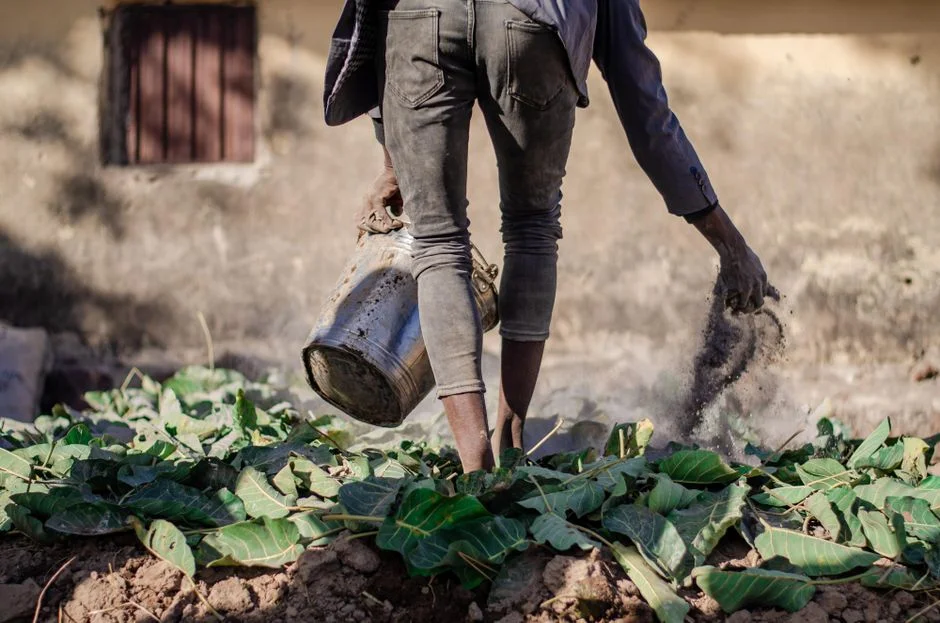
Yes — a lot. Mulch is a 5–10 cm blanket of dry grass, straw or crop residue laid over the soil. It shades the ground so less water evaporates, keeping your bed moist longer between waterings; trials show mulch lifting yield and water-use efficiency by around 20% (Scientific Reports). It works even harder on soil rich in compost and organic matter, which holds water like a sponge, and it is one of the pillars of conservation agriculture.

Photo: Jonathan Borba / Pexels
Two things to watch when you irrigate
Watering well is not only about quantity. The quality of your water and the drainage of your bed matter just as much.
- Salt (salinity). If you irrigate with salty or borehole water on tight soil, salt can build into a white crust on the surface. Every few weeks, give one heavier watering to wash the salt down below the roots (FAO).
- Waterlogging. Standing water drowns roots. If a bed stays soggy or free water squeezes from a handful of soil, stop and let it drain.
Your next step this week
Pick your thirstiest bed. Measure it (length × width in metres), work out its peak need — about 7 litres per square metre per day for fruiting vegetables — and count how many buckets that is. Then lay 5 cm of mulch and water at dawn tomorrow. You will carry fewer buckets by the weekend, and a well-watered fruiting crop gives you more to sell — handle it well after harvest to hold the price.