 Divisi
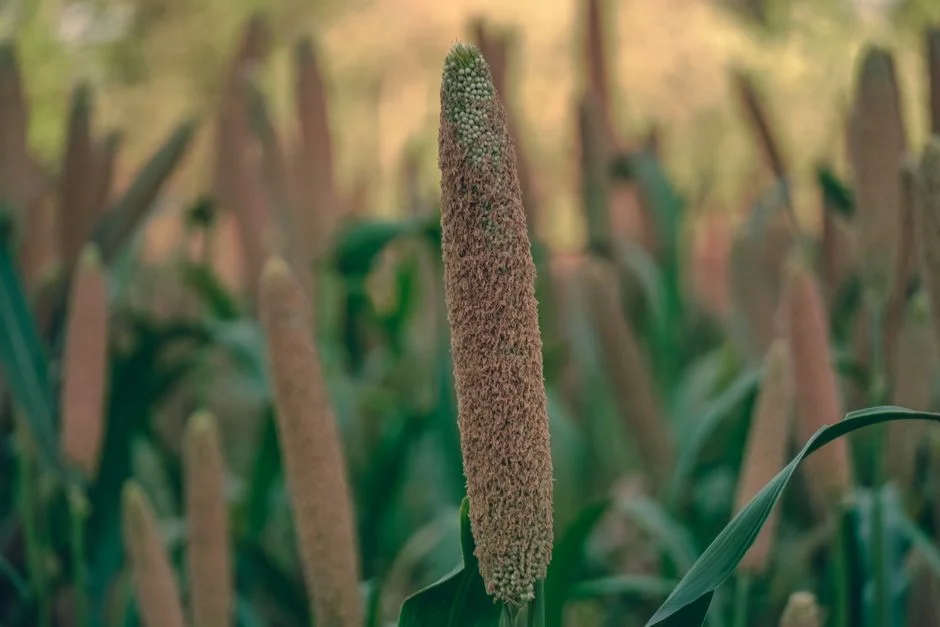
In a dry El Niño year, sorghum and millet are your safest bet: they need far less rain than maize and ripen faster, so they still fill grain when the rains cut out early. This clinic gives you the seed rates, spacing, striga control and bird-scaring to turn that toughness into a full 90 kg bag.
Why should I plant small grains instead of maize this year?
Because they finish the race on less water. Sorghum grows on 400–800 mm of rain a year and pearl millet on just 200–600 mm, where maize usually wants more and sulks in a dry spell. Pearl millet was bred in the Sahel on 200–600 mm and is one of the most drought-tolerant cereals we grow, partly because its main root drives down 9.1 cm a day, more than three times faster than maize, chasing deep moisture. Short-season types also beat the clock, maturing before a late dry-out.
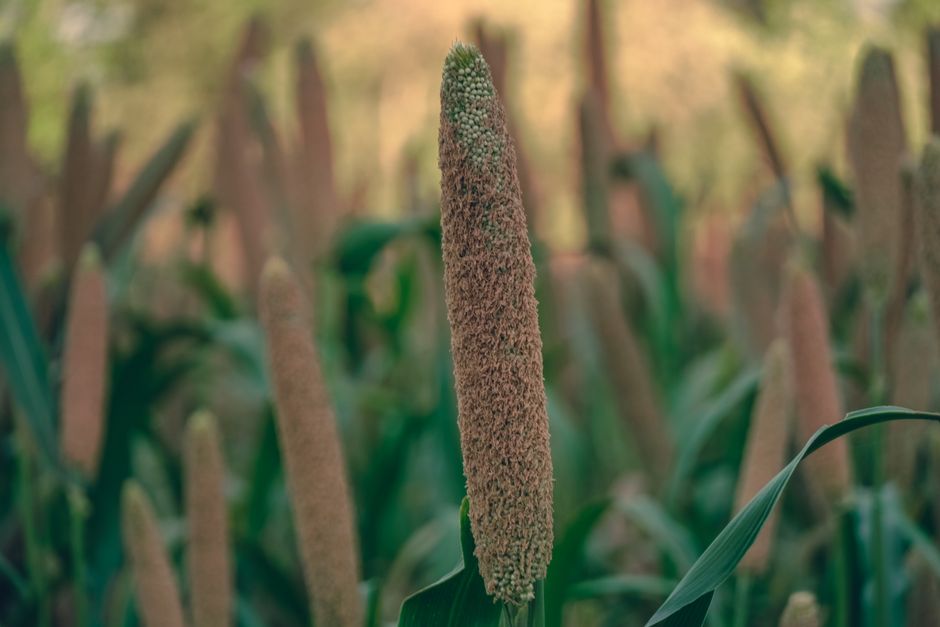
Photo: Ranjeet Chauhan / Pexels
| Crop | Rain it needs | Days to maturity | Grain yield* |
|---|---|---|---|
| Pearl millet | 200–600 mm | 75–120 | 0.5–3.0 t/ha |
| Sorghum | 400–800 mm | 90–120 | 3.0–6.0 t/ha |
| Finger millet | 500–1000 mm | 130–145 | 2.3–3.0 t/ha |
*Yields are good-management, improved-variety potentials from Zimbabwe's small grains guide; typical smallholder rain-fed sorghum in the region averages nearer 0.9 t/ha, so treat 3–6 t/ha as a target to grow toward, not a given.
Match the grain to the field, too. Pearl millet is your champion on the driest ground, sorghum handles the middle, and finger millet actually wants the most rain of the three at 500–1000 mm — keep it for steadier-rainfall or highland zones, where ICRISAT's sub-humid and high-altitude types still store and sell well. Match the maturity length to your season using how to read your seasonal rainfall forecast, and read what El Niño means for your farm first. For the head-to-head with maize, see growing maize in a dry year.
How do I plant and thin sorghum and millet the right way?
Plant shallow, sow thin, then thin again. Here is the playbook:
- Seed rate. Sow 7–12 kg/ha for sorghum, 5–10 kg/ha for pearl millet, 3–5 kg/ha for finger millet — roughly three to six 2 kg tins of clean seed per hectare for sorghum, and a little less for the millets.
- Depth. 2–3 cm, about the first knuckle of your finger. Too deep and the small seed never surfaces.
- Spacing. Rows 75 cm apart for sorghum and pearl millet, 45 cm for finger millet. No tape? A long adult stride is close to 75 cm.
- Thin early. At 2–3 weeks or the 3–4 leaf stage, leave one plant every 20 cm for sorghum, 15 cm for pearl millet, 10 cm for finger millet. One adult hand-span is about 20 cm; a fist is about 10 cm.
Thinning feels like waste, but crowded plants fight for water and give you thin heads. Set the field up to catch every drop before you sow: tied ridges, half-moons and zai basins hold rain right where the roots need it, and in the south a Pfumvudza land-prep basin does the same job. In a dry year, in-field water harvesting is one of the biggest levers you have on a small-grain yield.
How do I stop striga (witchweed) from stealing my yield?
Starve it and rotate it out. Striga can take up to 80% of a pearl millet crop under heavy infestation and costs the region about 8.6 million tonnes of grain a year. Learn to spot it first — thin stalks of bright pink-purple flowers at the base of your cereal — then work this checklist.
How to spot striga at the base of your crop
| What to check | Sign it's striga |
|---|---|
| Where | Small stalks pushing straight up from the soil, right against the base of your sorghum or millet |
| Flowers | Bright pink-purple, small and tubular |
| Size | Thin stems, only about 15–30 cm tall |
| When to pull | Before those flowers open, so it can never set seed |
- [ ] Rotate with a legume like cowpea or groundnut: these non-cereal crops make striga seed germinate and then die with no cereal host to latch onto.
- [ ] Pull striga by hand before it flowers, so it never sets seed again.
- [ ] Feed the soil with manure and good fertility; strong, well-fed plants shrug off striga, and the organic matter itself pushes striga seed to sprout and fail. See build soil that holds water.
- [ ] Plant a resistant variety where your extension officer offers one.
How do I protect the grain from birds and harvest at the right time?
Beat the birds and read the grain. At grain-fill, plant early, scare actively, and hang shiny tape ribbon strung across the field so it flickers and hums in the wind. Harvest when the crop is truly ripe: the leaves yellow and dry and a black spot forms at the base of each grain, the "black layer."
The grain-ready field test — no tool needed
| Check | What "ready" looks like |
|---|---|
| Leaves | Yellowed and dried right down |
| Grain base | A dark black layer where the grain joins the head — the "black layer" that means it is fully mature |
| Thumbnail press | Press a grain with your thumbnail: no milky liquid oozes out and it won't dent |
When all three line up, it's ready to cut and dry.
Cut the heads, dry them hard, then thresh by beating them with sticks. Store only when the grains rattle and shatter rather than squash.
Will small grains really pay, for my family and my business?
Yes, on the plate and in the market. Finger millet carries about 398 mg of calcium per 100 g, one of the richest calcium levels of any cereal, and pearl millet packs 8.0 mg of iron per 100 g, so they feed growing children and sell as premium health grains. A well-managed dry-year sorghum crop of about 2.5 t/ha — a realistic figure that sits between the region's 0.9 t/ha average and the improved-variety potential in the table — is about 28 bags of 90 kg from one hectare, grain that stores well, brews well, and moves fast when maize is short. Treat small grains as a cash crop, not a fallback.
Your next step this week
Pick one field, choose a short-season variety that matches your forecast, and buy your clean seed now — about three to six 2 kg tins per hectare — before the planting rush. Rotate that field out of last year's cereal to break the striga cycle, and set aside shiny tape for bird season.