 Divisi
Get your land ready now, in the dry winter, and a hard El Niño season becomes a plan you control instead of a surprise you survive. The smart setup for 2026-27 is to dig your Pfumvudza/Intwasa planting basins early and go easy on blanket ploughing that dries your soil out — FEWS NET expects below-average rainfall and extreme heat across Zimbabwe from October 2026 to March 2027. Here is how to prepare your fields like a business, not a gamble. (For the science of why Southern Africa dries out while East Africa floods, see what El Niño means for your farm.)
Why should I prepare my land now, in the dry season?
Because labour is free now, and time is your scarcest input once the rains start. Land that is already marked and dug lets you plant with the very first planting rains, instead of losing a week clearing and digging while the moisture drains away. In a short El Niño season, planting early can be the difference between a crop that tassels before the dry spell and one that does not.
There is a money reason too. Land that is dug and mulched before the rains is what lets you plant on time and hold on to the harvest you sell — and in a short season that early start is money in the bank. The 2023-24 El Niño was hard enough that Zimbabwe declared a national state of disaster in April 2024; the farmers who had their land ready and planted early protected far more of their harvest and income than those who waited. Preparing now is how you stay on the selling side of that story.
Winter ploughing or conservation-agriculture basins — which is safer before a dry El Niño year?
Both can work, but on Zimbabwe's light granite-sand soils, blanket ploughing carries real risk. Open, ploughed sandy land loses about 30% of rainfall as runoff and up to 50 tonnes of soil per hectare a year, against roughly 5% runoff and 2 t/ha under minimum tillage with soil cover. Bare tilled soil also bakes and loses moisture — the opposite of what you want in a below-average year.
| Winter ploughing | Pfumvudza / CA basins | |
|---|---|---|
| Weeds | Buries and kills a weed flush early | Handled with mulch plus light hoeing |
| Moisture | Dries sandy soil; better on heavy clay | Basin and mulch hold water in place |
| Erosion on sand | High runoff and soil loss | Low; crop-failure risk falls under residue cover |
| Best for | Heavier soils, done early, then covered | Sandy soils and dry-year insurance |
Rule of thumb: if you plough, do it early and only on heavier land, and never leave sandy fields bare into the rains. On sand, basins plus mulch are the safer bet.
How do I lay out a Pfumvudza/Intwasa plot, step by step?
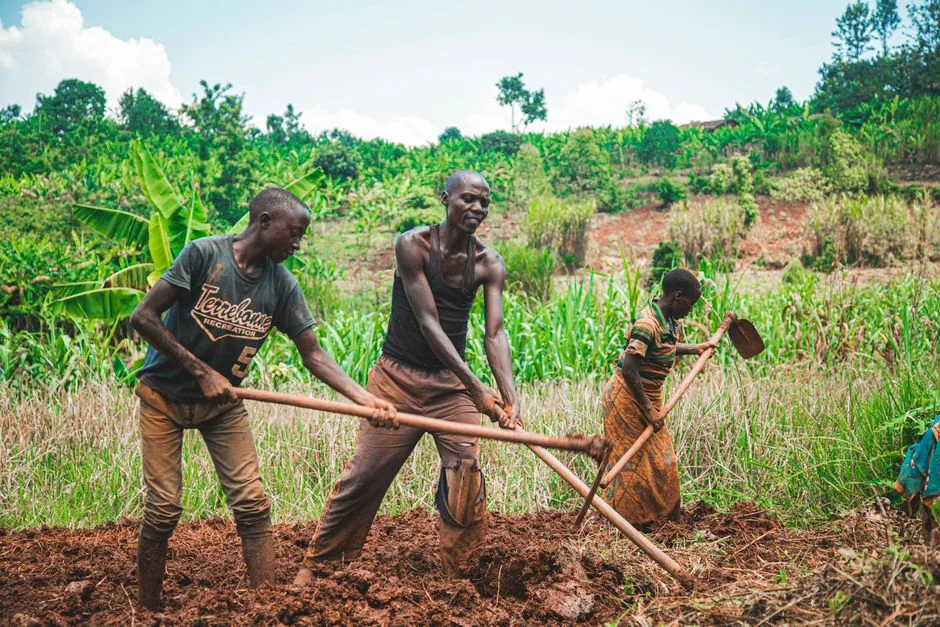
The Foundations for Farming standard is one plot you can master by hand:
- Mark a plot 39 m by 16 m — one sixteenth of a hectare.
- Pull a marked string for 52 rows spaced 75 cm apart — about one long pace.
- Along each row, mark 28 stations 60 cm apart, giving 1,456 stations in the plot.
- Open a small basin at each station, about a hoe-blade deep.
- Add one 350 ml tin (a small cup) of compost or manure per station before the rains.
- At planting, sow 3 seeds about 5 cm deep with roughly 2 litres of water per station.
- Cover the whole plot with mulch until you cannot see bare soil — that is your no-tool test.

Photo: Elvis KAMBIRE / Pexels
Budget about 2 kg of maize seed, 16 kg of basal and 16 kg of top-dressing fertiliser per plot. Dig now while the ground is dry and your hands are free; come the first rains, you only plant.
Will Pfumvudza really protect my yield in a drought year?
The evidence says yes. In drought conditions, Zimbabwe's own data credits Pfumvudza with an 11.5% higher maize yield and a 20% higher sorghum yield. A 2021 FAO-supported survey of over 1,100 Zimbabwean farm households found Pfumvudza plots averaging 4,190 kg/ha against 1,473 kg/ha on conventional fields — about 46 versus 16 ninety-kilogram bags per hectare, a gain of about 2,700 kg/ha. That extra roughly 30 bags a hectare is income you keep.
It works because the basin catches the little rain that falls and the mulch stops it evaporating, so residue-covered fields hold moisture and crop-failure risk drops. The same planting-basin method transfers straight to Zambia and Malawi, where the 90 kg bag is also the market measure. Pair it with a drought-tolerant maize plan and you have stacked two forms of insurance.
Your next step this week
Mark out one standard 39 m x 16 m plot and start digging its basins now, while the soil is dry and labour is free — then check the seasonal forecast so you know which planting rains to trust.